The sample copy of this report is available for access.
The Asia Pacific Heterogeneous Integration Market is expected to reach USD 17.7 billion by 2030, growing at a CAGR of 14.6% during (2026 – 2033).
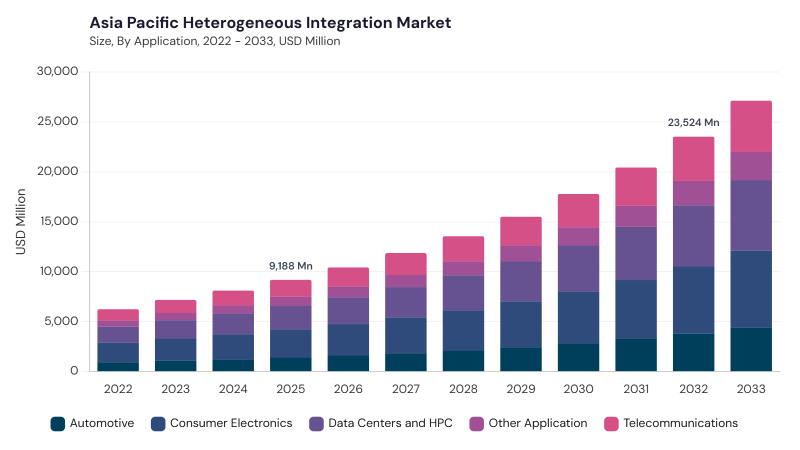
Heterogeneous integration across Asia Pacific developed as semiconductor manufacturers sought alternatives to conventional monolithic scaling for improving system performance, power efficiency, and miniaturization. Early approaches focused on two-dimensional system-in-package configurations combining logic, memory, sensors, and analog components, before progressing toward wafer-level packaging, through-silicon vias, micro-bump interconnections, and 3D stacking. Investments from foundries, OSAT providers, equipment manufacturers, and design houses accelerated the adoption of high-density interposers and advanced 2.5D/3D packaging architectures.
3D integration, chiplet architectures, AI-driven semiconductor design, localization, and collaborative ecosystem development are increasingly shaping regional market progress. Semiconductor manufacturers are moving toward vertical stacking and modular multi-die platforms to address performance and economic limitations associated with traditional transistor scaling. Partnerships among foundries, packaging specialists, equipment suppliers, material providers, and design companies are accelerating standardization and commercialization, while localized manufacturing investments are strengthening supply-chain resilience. Advanced wafer-level packaging, hybrid bonding, silicon interposers, smart manufacturing, and design automation are also improving integration density, yield, thermal performance, and scalability across the region.
Based on Application, the market is segmented into Consumer Electronics, Data Centers and HPC, Telecommunications, Automotive, and Other Application. The Consumer Electronics market dominated the Asia Pacific Heterogeneous Integration Market by Application in 2025, and would continue to be a dominant market till 2033; thereby, achieving a market value of USD 5.1 billion by 2030, growing at a CAGR of 13.6 % during the forecast period. The Data Centers and HPC market is expected to witness a CAGR of 14.9% during (2026 - 2033). The Other Application market is expected to witness a CAGR of 14.9% during (2026 - 2033).
Consumer Electronics uses heterogeneous integration to combine logic, memory, sensors, graphics, connectivity, and power-management functions within compact devices while improving battery efficiency and performance. Data Centers and HPC increasingly rely on CPUs, GPUs, accelerators, high-bandwidth memory, silicon interposers, and advanced stacking technologies to support AI, cloud computing, and intensive data-processing workloads. Telecommunications benefits from compact integration of RF, analog, digital, and power components for 5G, edge infrastructure, and evolving network equipment, while Automotive applications require integrated processors, sensors, communication devices, and power-management functions for electric mobility, intelligent cockpits, ADAS, and vehicle connectivity. Other Application includes robotics, factory equipment, healthcare devices, aerospace electronics, industrial automation, and other specialized systems requiring compact and reliable multi-function semiconductor solutions.
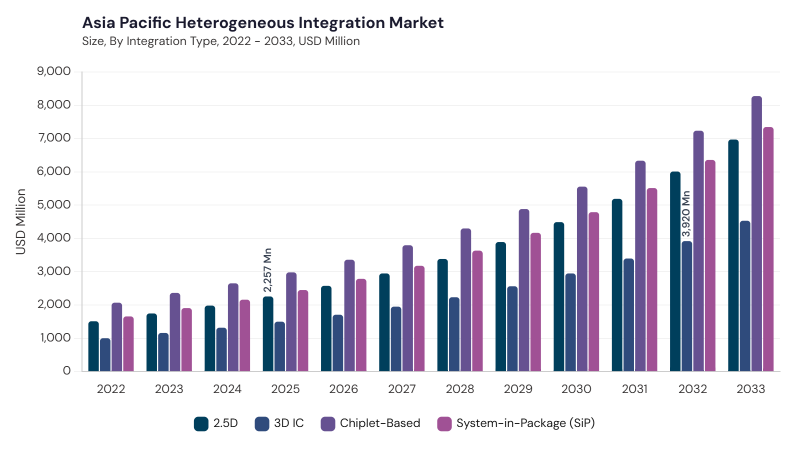
Based on Integration Type, the market is segmented into Chiplet-Based, System-in-Package (SiP), 2.5D, and 3D IC. The Chiplet-Based market dominated the Asia Pacific Heterogeneous Integration Market by Integration Type in 2025, and would continue to be a dominant market till 2033; thereby, achieving a market value of USD 5.5 billion by 2030, growing at a CAGR of 13.7 % during the forecast period. The System-in-Package (SiP) market is expected to witness a CAGR of 14.9% during (2026 - 2033). Additionally, The 2.5D market is expected to witness highest CAGR of 15.3% during (2026 - 2033).
Chiplet-Based integration enables individually optimized dies to be assembled within a unified package, supporting modularity, scalability, reusable semiconductor building blocks, and flexible combinations of logic, memory, analog, and other technologies. System-in-Package integrates multiple integrated circuits and passive components within compact modules and is particularly relevant to smartphones, wearables, IoT devices, automotive electronics, and other multifunctional systems. 2.5D integration positions multiple dies side-by-side on silicon or advanced interposers to provide dense communication, increased bandwidth, and improved processor-to-memory connectivity without full vertical stacking. 3D IC vertically stacks semiconductor dies through TSVs, hybrid bonding, and related technologies, enabling shorter interconnects, reduced footprint, high bandwidth, and enhanced performance for AI, data center, memory, and advanced computing applications.
Based on Packaging Technology, the market is segmented into Flip-Chip, Fan-Out Wafer-Level, Through-Silicon Via (TSV) Based, and Interposer-Based. Flip-Chip enables direct electrical connection between semiconductor dies and substrates through solder bumps, supporting high-density interconnections, strong signal integrity, and efficient thermal performance across mobile, computing, and communication devices. Fan-Out Wafer-Level packaging redistributes interconnections beyond the original die footprint, supporting thinner packages, high I/O density, reduced form factors, and advanced integration for consumer electronics, IoT, wearable, and imaging applications.
Through-Silicon Via Based packaging enables vertical electrical pathways through silicon and supports stacked memory, processors, and other components requiring high bandwidth and low latency. Interposer-Based packaging connects multiple heterogeneous dies through silicon or organic intermediary substrates, enabling fine-pitch interconnections, logic-memory integration, advanced chiplet assemblies, and high-throughput systems for AI, automotive, industrial, and next-generation communication applications.
Free Valuable Insights: Heterogeneous Integration Market is Predicted to reach USD 60.1 Billion billion by 2033, at a CAGR of 14.3%
Based on Country, the market is segmented into China, Japan, India, South Korea, Australia, Malaysia, and Rest of Asia Pacific. The China market dominated the Asia Pacific Heterogeneous Integration Market by Country in 2025, and would continue to be a dominant market till 2033; thereby, achieving a market value of USD 4.9 billion by 2030, growing at a CAGR of 12.6 % during the forecast period. The Japan market is expected to witness a CAGR of 13.8% during (2026 - 2033). Additionally, The India market is expected to witness a CAGR of 15.7% during (2026 - 2033).
Across Asia Pacific, heterogeneous integration development is increasingly shaped by AI computing, semiconductor localization, advanced packaging, photonics, chiplet architectures, and supply-chain resilience. China is strengthening domestic advanced packaging, chiplet-based systems, AI-focused integration, new substrate technologies, and localized manufacturing, while Japan is emphasizing sophisticated 2.5D and 3D packaging, high-bandwidth interconnects, novel materials, and government-supported semiconductor collaboration. India is advancing modular multi-die platforms, local packaging infrastructure, silicon photonics, thermal-management capabilities, and academic-industry partnerships, whereas South Korea is progressing through fan-out packaging, silicon interposers, embedded bridge technologies, photonic integration, and high-performance semiconductor manufacturing. Australia is focusing on chiplet architectures, silicon photonics, sustainable packaging, research collaboration, and specialized solutions for defense, telecommunications, and computing, while Malaysia is expanding from conventional assembly toward SiP, 3D IC, advanced packaging, automated manufacturing, and localized supply-chain capabilities.

By Application
By Integration Type
By Packaging Technology
By Country
Set to reach $17.7 Billion by 2030, growing at 14.6% CAGR during 2026-2033.
China leads with $4.9 billion by 2030, growing at 12.6% CAGR during the forecast period.
Consumer Electronics segment hits $5.1 billion by 2030, growing at 13.6% CAGR during the forecast period.
Chiplet-Based segment reaches $5.5 billion by 2030, growing at 13.7% CAGR during the forecast period.
India market is expected to witness a CAGR of 15.7% during 2026-2033.
Data Centers and HPC segment is expected to witness a CAGR of 14.9% during 2026-2033.
Our team of dedicated experts can provide you with attractive expansion opportunities for your business.




 Unique Offerings