“Global Headless Content Management System Software Market to reach a market value of USD 5.77 Billion by 2033 growing at a CAGR of 17.1%”
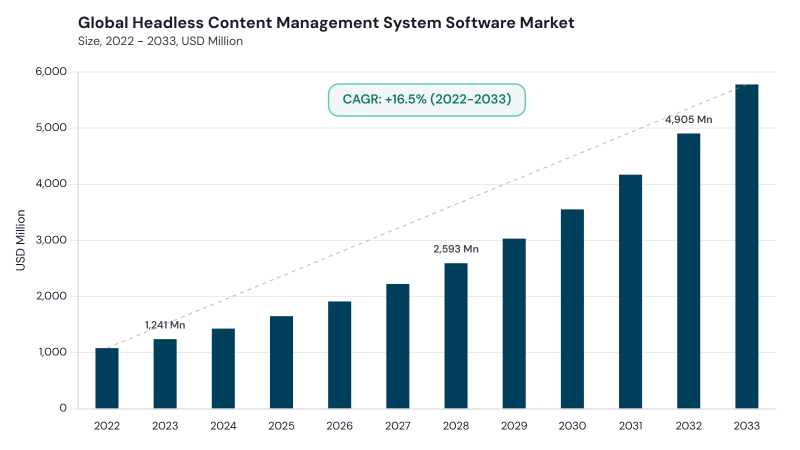
The Global Headless Content Management System Software Market size is expected to reach USD 5.77 billion by 2033, rising at a market growth of 17.1% CAGR during the forecast period.
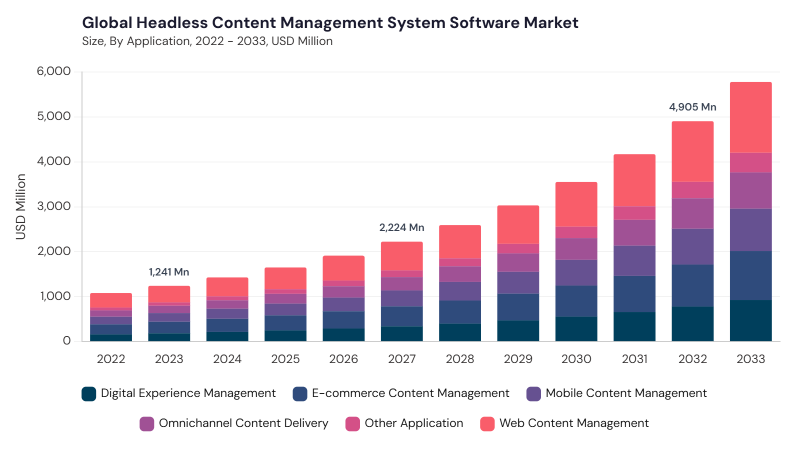
Growth in the Headless Content Management System Software Market is driven by the rising demand for omnichannel digital experiences, API-driven content delivery, cloud-native infrastructure, and personalized customer engagement strategies across enterprises. Organizations are increasingly transitioning from traditional monolithic CMS platforms toward flexible headless architectures that support websites, mobile applications, IoT devices, digital commerce platforms, and emerging digital touchpoints. Increasing adoption of composable architecture, AI-powered personalization, and microservices-based deployment models is further accelerating market expansion globally.
The Global Headless Content Management System Software Market has evolved significantly from traditional monolithic content management systems into highly flexible API-driven digital content ecosystems. Earlier content management platforms primarily focused on website publishing and centralized content storage, limiting scalability and omnichannel capabilities. However, the rapid expansion of digital commerce, mobile-first engagement strategies, and connected digital platforms has accelerated the shift toward headless architecture. Enterprises increasingly require agile content delivery solutions capable of supporting websites, mobile applications, digital kiosks, smart devices, streaming platforms, and emerging customer interaction channels simultaneously.
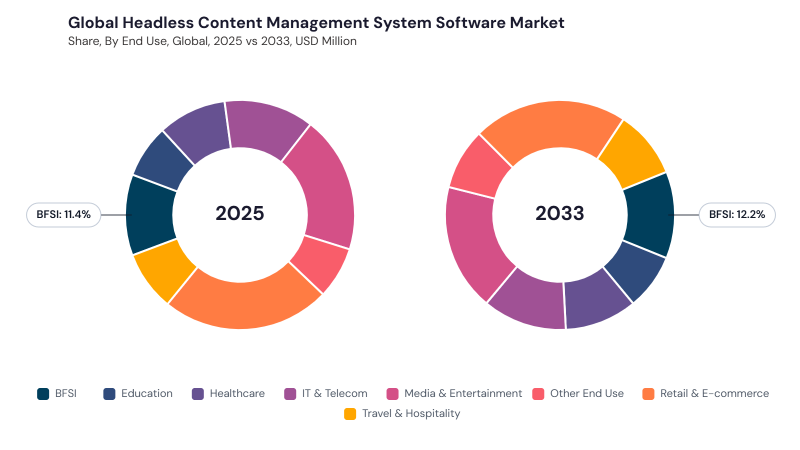
Advancements in cloud computing, microservices architecture, artificial intelligence, and real-time analytics have significantly transformed the market landscape. Headless CMS platforms now integrate seamlessly with AI-powered personalization engines, analytics platforms, customer data systems, and digital commerce ecosystems. Organizations across retail, media, BFSI, healthcare, and telecommunications sectors are increasingly adopting headless CMS software to improve digital agility, streamline content workflows, and enhance customer experience management. In addition, the growing adoption of composable digital experience platforms and API-first infrastructure is supporting long-term market expansion globally.
The major strategies followed by the market participants are Partnerships, Product Innovations, and Platform Expansion as the key developmental strategies to keep pace with the changing demands of enterprises. Companies are increasingly focusing on AI-powered content orchestration, low-code integrations, omnichannel delivery capabilities, and cloud-native deployment models to strengthen market positioning. Strategic collaborations between CMS vendors, cloud infrastructure providers, and digital commerce companies are further accelerating innovation across the market ecosystem.
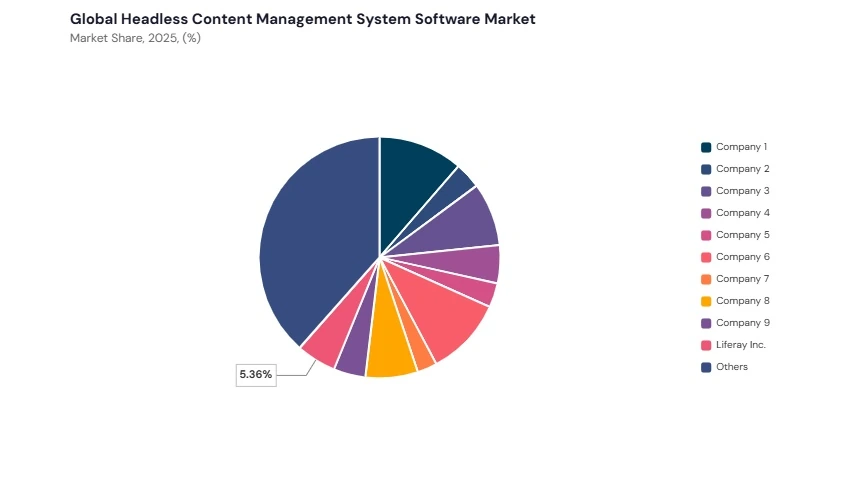
Based on the Analysis presented in the KBV Cardinal matrix; Contentful, Inc. and Contentstack LLC are the forerunners in the Headless Content Management System Software Market. Companies such as Storyblok GmbH, Strapi Solutions, and Sanity AS are some of the key innovators in the Headless Content Management System Software Market. Vendors are increasingly emphasizing API scalability, AI-powered personalization, composable architecture, and cloud-native deployment strategies to strengthen their competitive positioning.
The COVID-19 pandemic positively accelerated the adoption of Headless Content Management System Software globally as organizations rapidly expanded their digital presence and online engagement strategies. Businesses across retail, media, healthcare, education, and financial services sectors increasingly relied on digital channels to maintain customer communication and operational continuity during lockdowns and remote working environments. The sudden surge in digital commerce, streaming services, mobile applications, and omnichannel customer engagement significantly increased the demand for scalable and flexible content management infrastructure.
Enterprises accelerated investments in cloud-based headless CMS platforms to improve digital agility, support distributed teams, and streamline content delivery across multiple channels. However, certain organizations delayed large-scale digital transformation initiatives due to budget constraints and operational disruptions during the early stages of the pandemic. Despite these short-term challenges, the pandemic ultimately strengthened long-term market adoption trends and reinforced the importance of scalable digital content infrastructure.

The leading players in the market are competing with diverse innovative offerings to remain competitive in the market. Vendors are increasingly focusing on API-driven architecture, AI-enabled personalization, omnichannel content orchestration, and cloud scalability to strengthen their market presence. Strategic collaborations, acquisitions, and platform integrations are playing a crucial role in competitive differentiation. The key developmental strategies in the market are Partnerships & Collaborations, Product Innovation, and Cloud Platform Expansion.
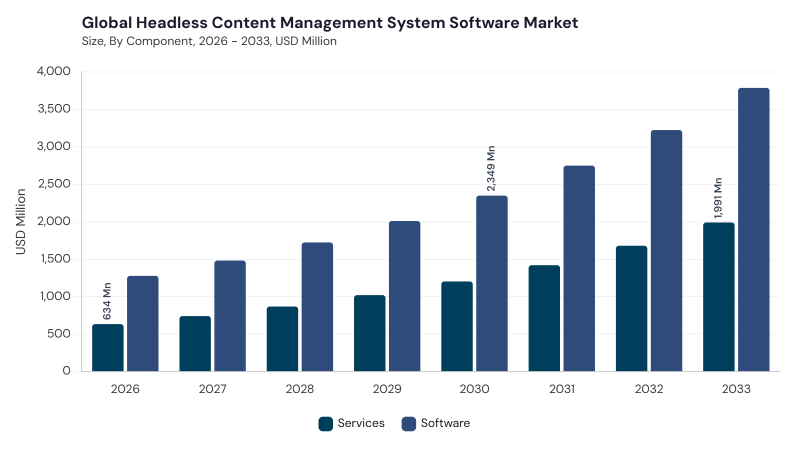
Based on component, the Headless Content Management System Software market is segmented into Software and Services. The Software segment dominated the market in 2025 and would continue to be a dominant market till 2033; thereby, achieving a market value of USD 3.78 billion by 2033, growing at a CAGR of 16.8% during the forecast period. The increasing deployment of API-first content management platforms, omnichannel delivery tools, and AI-powered content orchestration solutions is supporting segment growth globally.
Based on deployment, the Headless Content Management System Software market is classified into Cloud and On-Premise. The Cloud segment dominated the market in 2025 and is expected to reach a market value of USD 4.57 billion by 2033, growing at a CAGR of 17.3% during the forecast period. Enterprises are increasingly adopting cloud-native CMS platforms due to scalability, remote accessibility, lower infrastructure costs, and seamless integration capabilities with AI, analytics, and commerce ecosystems.
Based on application, the Headless Content Management System Software market is segmented into Web Content Management, E-commerce Content Management, Mobile Content Management, Digital Experience Management, Omnichannel Content Delivery, and Other Application. The Web Content Management segment dominated the market in 2025 and would continue to be a dominant market till 2033; thereby, achieving a market value of USD 1.57 billion by 2033, growing at a CAGR of 16.1% during the forecast period. Organizations increasingly require centralized and scalable web content infrastructure capable of supporting dynamic and personalized digital experiences.
By end use, the Headless Content Management System Software market is divided into Retail & E-commerce, Media & Entertainment, IT & Telecom, BFSI, Healthcare, Travel & Hospitality, Education, and Other End Use. The Retail & E-commerce segment dominated the market in 2025 and is projected to achieve a market value of USD 1.25 billion by 2033, growing at a CAGR of 15.9% during the forecast period. Increasing investments in digital storefronts, personalized customer engagement, omnichannel commerce, and mobile shopping experiences are driving segment growth globally.
Free Valuable Insights: Headless Content Management System Software Market Size to reach $5.77 Billion by 2033
Region-wise, the Headless Content Management System Software Market is analyzed across North America, Europe, Asia Pacific, and LAMEA. The North America segment dominated the market in 2025 and would continue to be a dominant market till 2033. The region benefits from strong cloud infrastructure, rapid digital transformation initiatives, advanced enterprise IT ecosystems, and high adoption of API-driven digital experience platforms.
Europe is witnessing strong market growth due to increasing enterprise modernization initiatives, growing digital commerce penetration, and rising demand for GDPR-compliant content management systems. Meanwhile, Asia Pacific is expected to exhibit the fastest growth during the forecast period owing to rapid expansion of digital commerce platforms, increasing smartphone penetration, and growing investments in cloud infrastructure across emerging economies.
The Headless Content Management System Software market is highly competitive and characterized by rapid technological innovation and API-driven digital transformation. Competition centers on scalability, omnichannel content orchestration, cloud-native deployment, and AI-powered personalization capabilities. Vendors are differentiating themselves through composable architecture, low-code integrations, real-time analytics, and developer-friendly ecosystems. Integration with digital commerce platforms, customer data systems, AI tools, and analytics infrastructure remains a key competitive factor. Both established enterprise software providers and emerging cloud-native vendors are actively competing, accelerating innovation across the market.
Headless Content Management System Software Market Coverage:
| Report Attribute | Details |
|---|---|
| Market size value in 2026 | USD 1.91 Billion |
| Market size forecast in 2033 | USD 5.77 Billion |
| Base Year | 2025 |
| Historical period | 2022 to 2024 |
| Forecast Period | 2026 to 2033 |
| Revenue Growth Rate | CAGR of 17.1% from 2026 to 2033 |
| Number of Pages | 765 |
| Tables | 870 |
| Report Coverage | Market Trends, Revenue Estimation and Forecast, Segmentation Analysis, Regional and Country Breakdown, Competitive Landscape, Market Share Analysis, Porter’s 5 Forces Analysis, Company Profiling, Companies Strategic Developments, SWOT Analysis, Winning Imperatives |
| Segments Covered | Component, Deployment, Application, End Use, Region |
| Country Scope | North America (US, Canada, Mexico, and Rest of North America), Europe (Germany, UK, France, Russia, Spain, Italy, and Rest of Europe), Asia Pacific (Japan, China, India, South Korea, Singapore, Malaysia, and Rest of Asia Pacific), LAMEA (Brazil, Argentina, UAE, Saudi Arabia, South Africa, Nigeria, and Rest of LAMEA) |
| Companies Included | Contentful, Inc., Contentstack LLC, Storyblok GmbH, Strapi Solutions, Sanity AS, dotCMS LLC, Kentico Software s.r.o., Butter CMS, Prismic.io, Directus |
By Component
By Deployment
By Application
By End Use
By Geography
Valued at USD 1.91 billion in 2026, reaching USD 5.77 billion by 2033 at 17.1% CAGR during 2026-2033.
Cloud segment dominates and continues growing at 17.3% CAGR during the forecast period (2026-2033).
Contentful, Inc., Contentstack LLC, Storyblok GmbH, and Strapi Solutions hold the leading positions.
North America leads, projected to reach USD 2.10 billion by 2033. Europe grows at 16.7% CAGR during 2026-2033.
Rising omnichannel digital experience demand, cloud-native API adoption, and expanding digital commerce platforms fuel growth.
Retail & E-commerce sector registers maximum revenue share, expanding at 15.9% CAGR during the forecast period.
Our team of dedicated experts can provide you with attractive expansion opportunities for your business.








 Unique Offerings