“Global Glass-reinforced Substrate Market to reach a market value of 1.42 Billion by 2032 growing at a CAGR of 13.3%”
The Global Glass-reinforced Substrate Market size is estimated at $1.11 billion in 2025 and is expected to reach $1.42 billion by 2032, rising at a market growth of 3.5% CAGR during the forecast period (2025-2032). The Global Glass-reinforced Substrate Market growth is supported by increasing demand from semiconductor packaging, consumer electronics, and high-performance computing applications. These substrates offer superior thermal stability, dimensional accuracy, and durability. Rising adoption in advanced chip packaging and electronic miniaturization is expected to steadily drive market expansion during the forecast period.
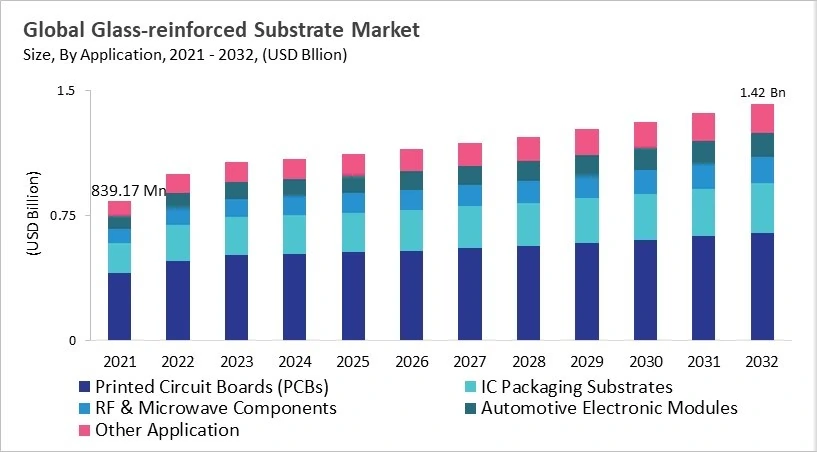
The glass-reinforced substrate market evolved from the need for durable, high-performance materials combining glass fibers with resin matrices to deliver thermal stability, superior mechanical strength, and electrical insulation. The market has developed significantly with advancements in material engineering, including enhanced resin systems, precision glass weaves, and automated manufacturing processes. These innovations allow the shift from basic composite laminates to sophisticated substrate used in high-tech applications like microelectronics, advanced electronics, and wearable devices. The market represents a combination of traditional composite technologies and modern innovations, catering to rising demands for reliability, performance, and miniaturization.
The glass-reinforced substrate market is driven by factors like the rising emphasis on sustainable and eco-friendly materials, high-functionality electronics, and the integration of IoT and AI in manufacturing processes. Key market players focus on strategic collaborations, R&D, and regional production to develop high-performance substrates tailored for next-generation applications such as semiconductor packaging and 5G infrastructure. The growth in the glass-reinforced substrate market depends on continued scalability, innovation, and the ability to cater to evolving technological and environmental demands.

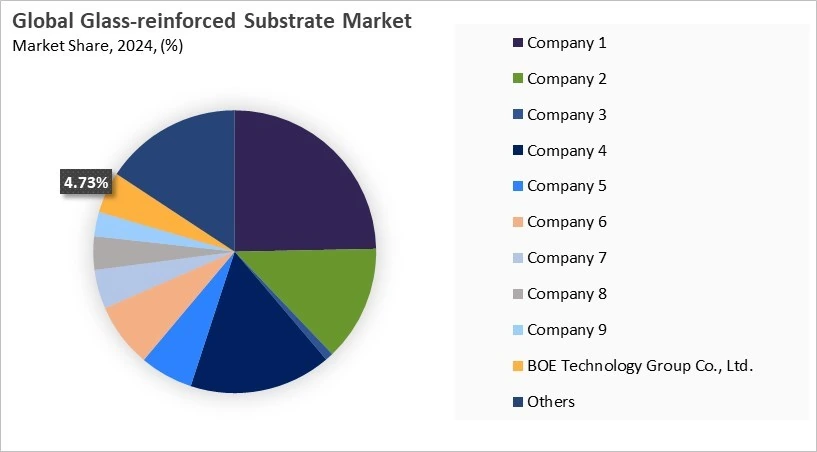
The leading players in the market are competing with diverse innovative offerings to remain competitive in the market. The above illustration shows the percentage of revenue shared by some of the leading companies in the market. The leading players of the market are adopting various strategies in order to cater to demand coming from the different industries. The key developmental strategies in the market are Acquisitions, and Partnerships & Collaborations.
Before the COVID-19 pandemic, the glass-reinforced substrate market grew steadily due to strong demand from electronics, automotive, and construction industries supported by stable supply chains. During the pandemic, the market faced major disruptions as raw material shortages, logistics delays, and workforce restrictions slowed production and increased lead times. Demand declined in sectors such as automotive and construction because of project delays and economic uncertainty. However, the situation accelerated digital transformation, encouraging manufacturers to adopt automation and remote monitoring technologies. Demand increased for substrates used in flexible electronics and communication devices driven by remote work trends. Companies also intensified innovation for applications in healthcare devices and consumer electronics. In the post-pandemic period, the market began recovering with improved supply chains and renewed demand. Long-term growth is supported by supply chain diversification, Industry 4.0 adoption, and expanding use of glass-reinforced substrates in advanced electronics and sustainable construction. Thus, the COVID-19 pandemic had negative impact on the glass-reinforced substrate market, accelerating innovation while disrupting traditional operations.
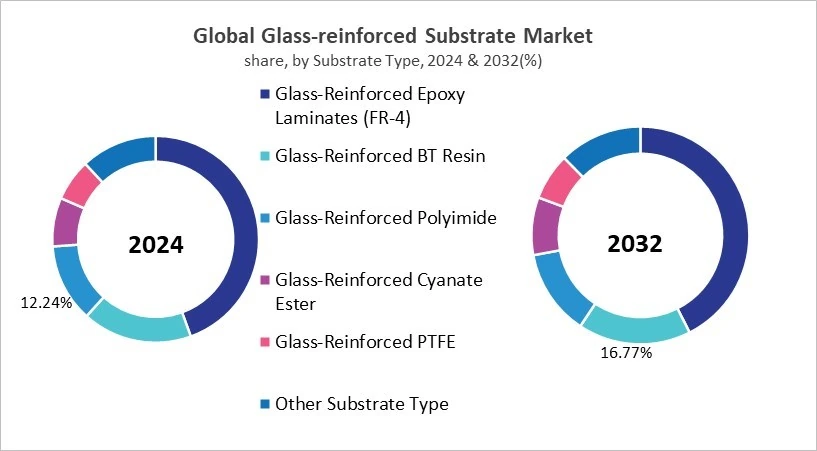
On the basis of Substrate Type, the Glass-reinforced Substrate Market is classified into Glass-Reinforced Epoxy Laminates (FR-4), Glass-Reinforced BT Resin, Glass-Reinforced Polyimide, Glass-Reinforced Cyanate Ester, Glass-Reinforced PTFE, and Other Substrate Type. The Glass-Reinforced BT Resin segment held 17.185% of the Glass-reinforced Substrate Market in 2024. These substrates are commonly used in high-performance semiconductor packaging due to their superior thermal resistance and dimensional stability. The growing demand for advanced electronics and high-speed devices supports the expansion of this segment.
By End-Use Industry, the Glass-reinforced Substrate Market is divided into Consumer Electronics, Automotive, Telecommunications, Aerospace & Defense, and Other End-Use Industry. The Automotive segment held 19.275% of the Glass-reinforced Substrate Market in 2024. The growing adoption of electronic systems in vehicles, including electric and hybrid vehicles, has driven the need for reliable substrate materials. Glass-reinforced substrates support the performance and safety requirements of modern automotive electronics.
Free Valuable Insights: Glass-reinforced Substrate Market Size to reach $1.42 by 2032
Region-wise, the Glass-reinforced Substrate Market is analyzed across North America, Europe, Asia Pacific, and LAMEA. The North America segment accounted for 21.16% of the Glass-reinforced Substrate Market in 2024. The glass-reinforced substrate market is estimated to experience significant growth in the North America and Europe regions. The market is driven by strong automotive, aerospace, and advanced electronics industries. In North America, the market demand is propelled by high investment in 5G infrastructure, semiconductor manufacturing, and defense technologies, accelerating the need for high-performance substates with electrical properties. The presence of leading tech giants and well-established R&D ecosystems further surges innovation and adoption of advanced materials. Moreover, Europe glass-reinforced substrate market is anticipated to grow at a steady pace. The rising focus on sustainability and regulatory compliance is encouraging the development of recyclable composites and eco-friendly resin systems. Regional nations play a crucial role because of their advanced automotive and industrial manufacturing bases, where glass-reinforced substrate are largely used in industrial electronics and electric vehicles.
In the Asia Pacific and LAMEA regions, the glass-reinforced substrate market is expected to expand at a substantial rate. The market is propelled by a strong electronics manufacturing ecosystem in nations such as South Korea, China, and Japan. The region’s growth, well-established consumer electronics, semiconductor fabrication, and PCB manufacturing creates significant demand for advanced substrate materials. Also, cost-effective manufacturing capabilities and government support for the semiconductor and electronics industries support growth. Furthermore, the LAMEA region is also predicted to offer lucrative opportunities. This is because of rising infrastructure development, increasing investments in telecommunications and renewable energy, and the expansion of manufacturing activities.
| Report Attribute | Details |
|---|---|
| Market size value in 2025 | USD 1.11 Billion |
| Market size forecast in 2032 | USD 1.42 Billion |
| Base Year | 2024 |
| Historical period | 2021 to 2023 |
| Forecast Period | 2025 to 2032 |
| Revenue Growth Rate | CAGR of 13.3% from 2025 to 2032 |
| Number of Pages | 639 |
| Tables | 525 |
| Report Coverage | Market Trends, Revenue Estimation and Forecast, Segmentation Analysis, Regional and Country Breakdown, Market Share Analysis, Porter’s 5 Forces Analysis, Company Profiling, Companies Strategic Developments, SWOT Analysis, Winning Imperatives |
| Segments Covered | Application, Substrate Type, End-Use Industry, Thickness, Region |
| Country Scope |
|
| Companies Included | Corning Incorporated, Schott AG (Carl-Zeiss-Stiftung), Nippon Express Co., Ltd., AGC, Inc., Saint-Gobain Group, Hoya Corporation, Ohara Inc., Shenzhen Laibao High Tech Co., Ltd., PLANOPTIK AG and BOE Technology Group Co., Ltd. |
By Application
By Substrate Type
By End-Use Industry
By Thickness
By Geography
Valued at USD 1.11 billion in 2025, it will reach USD 1.42 billion by 2032, growing at 13.3% CAGR during 2025-2032.
Glass-Reinforced Epoxy Laminates (FR-4) leads the market, projected to achieve $605.2 million by 2032.
Corning Incorporated, Schott AG, Nippon Express Co., Ltd., and AGC hold dominant positions in this space.
Asia Pacific leads with $727 million by 2032; North America grows at 3.1% CAGR during 2025-2032.
Enhanced performance demands in high-frequency electronics and rising advanced packaging adoption in semiconductor manufacturing fuel expansion.
0.1 mm – 0.5 mm thickness dominates, reaching $490.9 million by 2032 due to compact device applications.
Our team of dedicated experts can provide you with attractive expansion opportunities for your business.








 Unique Offerings