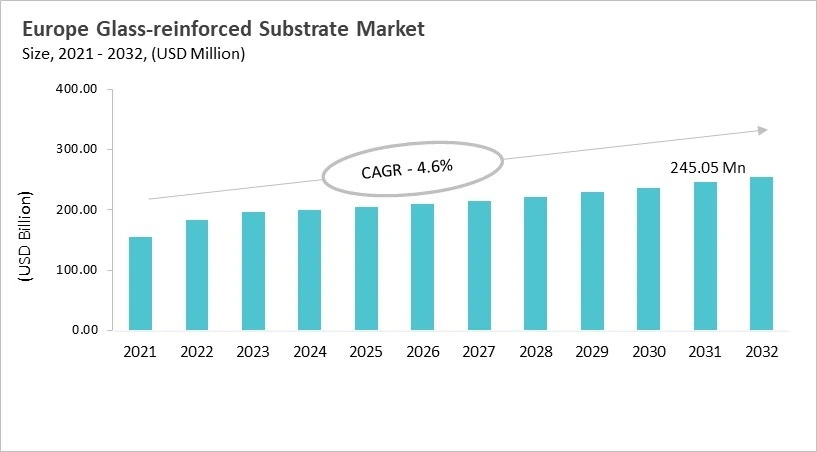
The Europe Glass-reinforced Substrate Market is expected to reach $245.05 million by 2031 and would witness market growth of 3.2% CAGR during the forecast period (2025-2032).
The Germany market dominated the Europe Glass-reinforced Substrate Market by Country in 2024, and would continue to be a dominant market till 2032; thereby, achieving a market value of $48 million by 2032. The UK market is experiencing a CAGR of 2% during (2025 - 2032). Additionally, The France market would exhibit a CAGR of 4% during (2025 - 2032). The Germany and UK led the Europe Glass-reinforced Substrate Market by Country with a market share of 21.1% and 15% in 2024.The Italy market is expected to witness a CAGR of 4.5% during throughout the forecast period.
The market for glass-reinforced substrates in Europe began in the late 20th century to meet the need for materials that are strong, stable at high temperatures, and electrically insulating in fields like electronics, cars, and construction. In the beginning, woven glass fibers were put into resin matrices to make them stronger and more resistant to the environment. Improvements in the chemistry of resin and the way glass fibers are made made it possible to customize substrate properties and make them more widely used in industry. Over time, lightweight glass reinforcement technologies and the trend toward smaller electronics made the market grow even faster. European rules about recycling and sustainability were very strict, which also made manufacturers make composite substrates that are good for the environment and can be recycled.
Three major trends are shaping the market right now: a strong focus on sustainability and recyclable composite materials, a rise in demand for multifunctional substrates with built-in sensors or conductive pathways, and a shift toward more localized supply chains within Europe. Companies that are at the top of their game focus on coming up with new ways to make resins and treat fibers, forming strategic partnerships with electronics and research institutions, and building more manufacturing plants in different parts of the world. Investing in new manufacturing technologies is making things more productive and better. Competitive dynamics balance innovation-driven differentiation with cost efficiency, as both regional and global players compete to deliver high-performance and environmentally compliant substrate solutions.
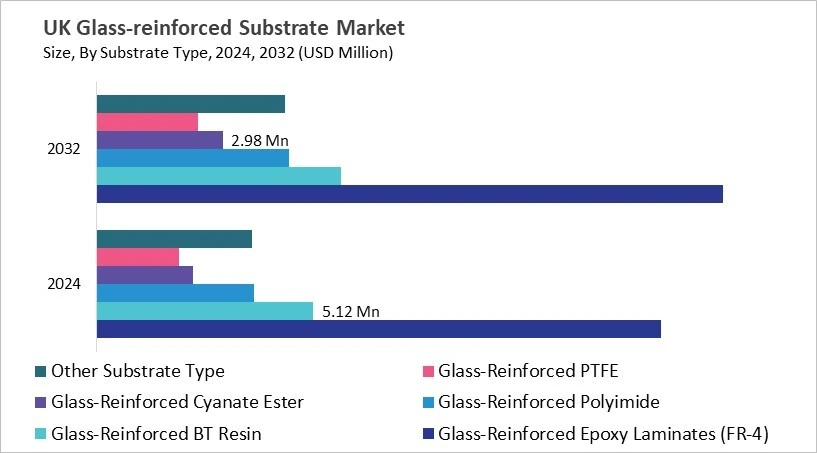
Based on Substrate Type, the market is segmented into Glass-Reinforced Epoxy Laminates (FR-4), Glass-Reinforced BT Resin, Glass-Reinforced Polyimide, Glass-Reinforced Cyanate Ester, Glass-Reinforced PTFE and Other Substrate Type. Among various UK Glass-reinforced Substrate Market by Substrate Type; The Glass-Reinforced Epoxy Laminates (FR-4) market achieved a market size of USD $13.3 Million in 2024 and is expected to grow at a CAGR of 1.4 % during the forecast period. The Glass-Reinforced Cyanate Ester market is predicted to experience a CAGR of 3.5% throughout the forecast period from (2025 - 2032).
Based on End-Use Industry, the market is segmented into Consumer Electronics, Automotive, Telecommunications, Aerospace & Defense and Other End-Use Industry. With a compound annual growth rate (CAGR) of 3.4% over the projection period, the Consumer Electronics Market, dominate the France Glass-reinforced Substrate Market by End-Use Industry in 2024 and would be a prominent market until 2032. The Aerospace & Defense market is expected to witness a CAGR of 4.8% during (2025 - 2032).
Free Valuable Insights: The Worldwide Glass-reinforced Substrate Market is projected to reach USD 1.42 billion by 2032, at a CAGR of 13.3%
The market for glass-reinforced substrates in Germany grew out of the European electronics materials industry to make long-lasting substrates for printed circuit boards and microelectronic packaging. Early uses were mostly for simple glass-reinforced laminates that offered mechanical stability and electrical insulation. Later, better resin formulations and fiber integration made the materials work better in terms of heat and mechanical strength. With the rise of high-density interconnect (HDI) technologies, which needed substrates that could handle fine lines and were very stable in three dimensions, there was a big change. Trends like electronic miniaturization, the development of eco-friendly materials, and the growing demand from automotive electrification and industrial automation are influencing the market today. Leading companies put a lot of money into research and development, strategic partnerships with electronics makers and research institutions, and investments in digitalized and automated production.

By Application
By Substrate Type
By End-Use Industry
By Thickness
By Country
Market will reach $245.05 million by 2031, growing at 3.2% CAGR during the forecast period.
Germany leads with 21.1% market share in 2024 and will reach $48 million by 2032.
UK holds 15% market share in 2024 and grows at 2% CAGR during 2025-2032.
France exhibits 4% CAGR during 2025-2032, while Italy shows faster growth at 4.5% CAGR.
Glass-Reinforced Epoxy Laminates (FR-4) reached $13.3 million in 2024, growing at 1.4% CAGR during the forecast period.
Our team of dedicated experts can provide you with attractive expansion opportunities for your business.




 Unique Offerings