The sample copy of this report is available for access.
“Global Flexible Substrates Market to reach a market value of USD 7,918.4 Million by 2033 growing at a CAGR of 11.2%”
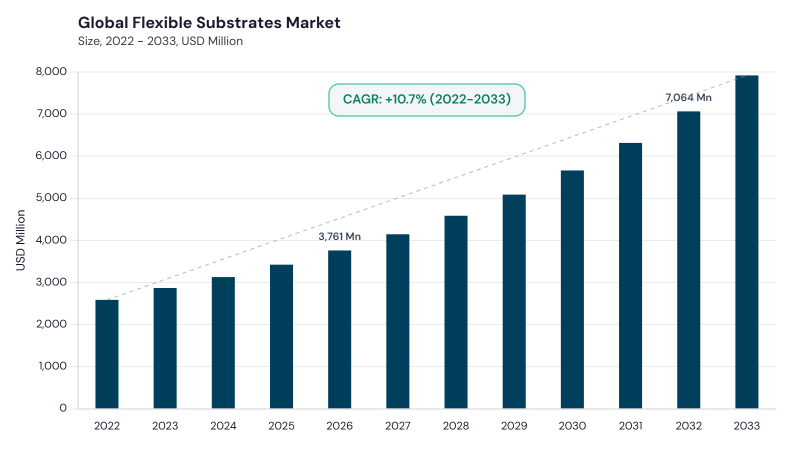
The Global Flexible Substrates Market size is expected to reach USD 7,918.4 Million by 2033, rising at a market growth of 11.2% CAGR during the forecast period.
Growth in the Flexible Substrates Market is driven by the increasing adoption of flexible electronics, foldable displays, wearable devices, advanced sensors, printed electronics, and lightweight electronic systems across consumer electronics, automotive, healthcare, industrial automation, and renewable energy applications. Rising demand for compact, durable, and high-performance electronic components is accelerating the deployment of advanced flexible substrate technologies globally. Furthermore, advancements in polymer engineering, flexible hybrid electronics, flexible displays, and roll-to-roll manufacturing technologies continue to support industry expansion and long-term commercialization opportunities.
Today, flexible substrates serve as critical components in foldable displays, wearable healthcare devices, flexible sensors, smart packaging, printed electronics, flexible solar cells, automotive electronics, and advanced communication systems. The proliferation of IoT devices, deployment of 5G infrastructure, increasing demand for wearable technologies, and advancements in flexible hybrid electronics continue to expand application opportunities worldwide. Additionally, sustainability initiatives and growing interest in recyclable substrate materials are influencing product innovation across the industry. As manufacturers continue investing in advanced materials, scalable production technologies, and customized electronic solutions, flexible substrates are expected to become increasingly important across multiple end-use industries.
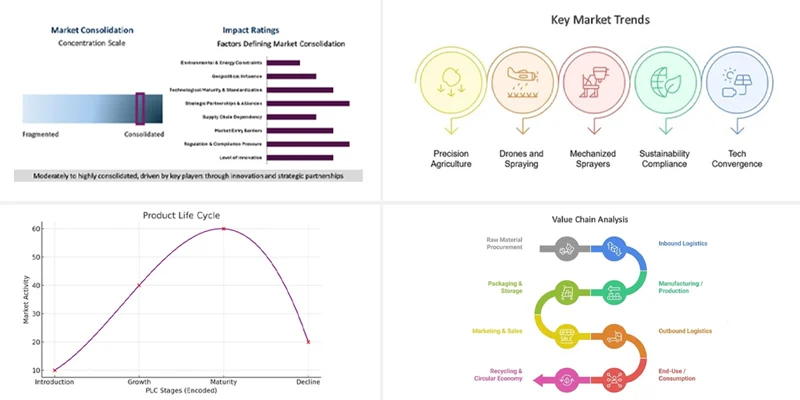
The major strategies followed by the market participants are Product Innovation, Strategic Partnerships, Manufacturing Expansion, and Advanced Material Development as the key developmental strategies to strengthen their competitive positions. Leading companies continue investing in specialty polymers, conductive materials, flexible laminates, advanced films, and next-generation substrate technologies to address evolving industry requirements.

Based on Material, the Flexible Substrates Market is segmented into Plastic, Metal, and Glass. The Plastic market dominated the Global Flexible Substrates Market by Material in 2025, and would continue to be a dominant market till 2033; thereby, achieving a market value of USD 5165.5 million by 2033, growing at a CAGR of 10.8% during the forecast period. The Metal market is expected to witness a CAGR of 11.9% during (2026 - 2033). Additionally, The Glass market is expected to witness highest CAGR of 12.4% during (2026 - 2033).
Metal substrates continue to gain traction in applications requiring superior thermal conductivity, electrical performance, and mechanical strength, particularly in automotive electronics and industrial systems. Meanwhile, flexible glass substrates are witnessing growing adoption due to their exceptional optical clarity, chemical resistance, and dimensional stability, making them increasingly suitable for foldable displays, advanced sensors, and high-performance optoelectronic devices.
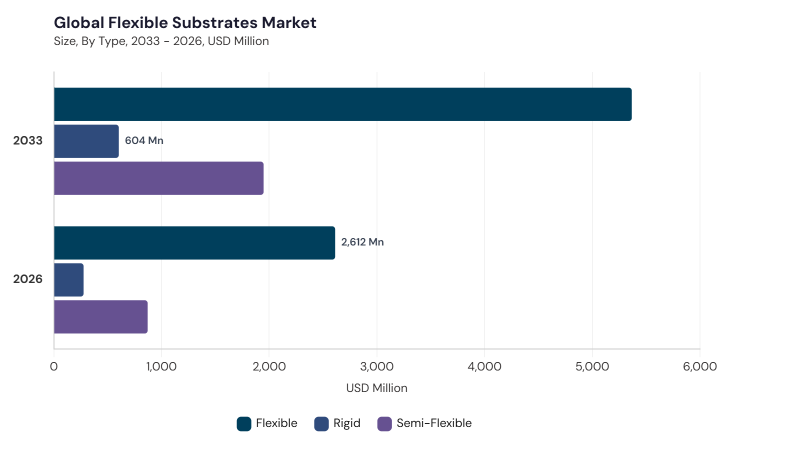
Based on Type, the Flexible Substrates Market is categorized into Flexible, Semi-Flexible, and Rigid. The Flexible market dominated the Global Flexible Substrates Market by Type in 2025, and would continue to be a dominant market till 2033; thereby, achieving a market value of USD 5366.7 million by 2033, growing at a CAGR of 10.8% during the forecast period. The Semi-Flexible market is expected to witness a CAGR of 12.2% during (2026 - 2033).
The Flexible segment is anticipated to dominate the market due to the increasing demand for bendable and lightweight electronic devices across consumer electronics, healthcare, and wearable technology applications. Semi-flexible substrates are gaining importance in applications requiring a balance between structural rigidity and flexibility, particularly in automotive electronics and industrial equipment. The Rigid segment remains relevant in specialized electronic systems where structural stability and precision performance are essential.
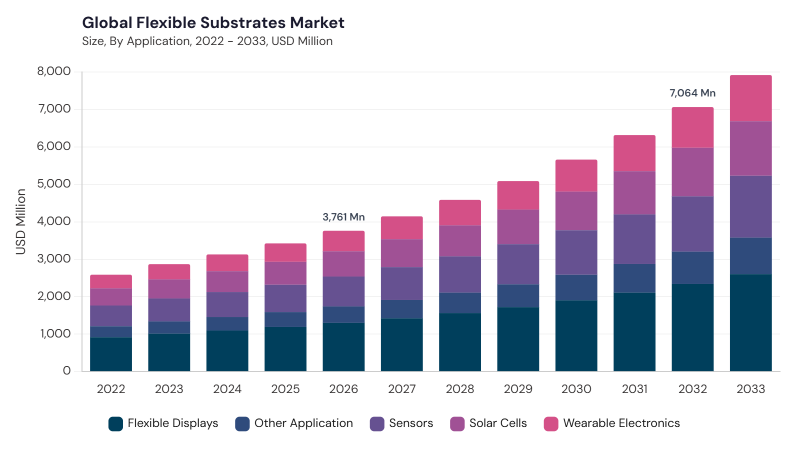
Based on Application, the Flexible Substrates Market is segmented into Flexible Displays, Sensors, Solar Cells, Wearable Electronics, and Other Applications. The Flexible Displays market dominated the Global Flexible Substrates Market by Application in 2025, and would continue to be a dominant market till 2033; thereby, achieving a market value of USD 2603.1 million by 2033, growing at a CAGR of 10.4 % during the forecast period. The Sensors market is expected to witness a CAGR of 10.9% during (2026 - 2033).
Flexible Displays represent the leading application segment, driven by growing demand for foldable smartphones, OLED displays, curved screens, and next-generation consumer electronics. The Sensors segment is witnessing strong growth due to increasing deployment of flexible sensing technologies across healthcare monitoring, industrial automation, automotive systems, and IoT-enabled devices. Flexible Solar Cells continue to gain momentum as industries seek lightweight and portable renewable energy solutions. Wearable Electronics remain a major growth area, supported by expanding consumer adoption of smartwatches, fitness trackers, healthcare wearables, and connected devices.
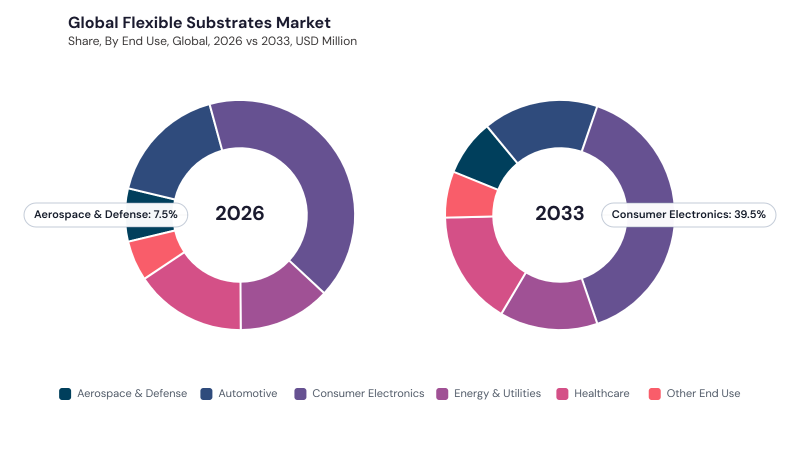
Based on End Use, the Flexible Substrates Market is classified into Consumer Electronics, Automotive, Healthcare, Energy & Utilities, Aerospace & Defense, and Other End Use. Consumer Electronics continues to account for the largest market share, supported by rising production of smartphones, tablets, wearable devices, foldable displays, and advanced smart electronics. The Automotive segment is expanding steadily as flexible electronics become increasingly integrated into advanced driver assistance systems, digital dashboards, infotainment systems, and electric vehicle architectures. Healthcare applications are experiencing strong growth due to increasing adoption of wearable medical devices, biosensors, remote patient monitoring systems, and digital healthcare technologies.
Free Valuable Insights: Flexible Substrates Market Size to reach $7,918.4 Million by 2033
Region-wise, the Flexible Substrates Market is analyzed across North America, Europe, Asia Pacific, and LAMEA. The Asia Pacific market dominated the Global Flexible Substrates Market by Region in 2025, and would continue to be a dominant market till 2033; thereby, achieving a market value of USD 2,967.01 million by 2033, growing at a CAGR of 11.7% during the forecast period. The Europe market is expected to witness a CAGR of 10.8% during (2026 - 2033). Additionally, The North America market is expected to witness a CAGR of 11.7% during (2026 - 2033).
Asia Pacific is expected to dominate the global market throughout the forecast period due to the concentration of electronics manufacturing facilities, semiconductor production centers, and display technology manufacturers in countries such as China, Japan, South Korea, and Taiwan. North America remains a significant market owing to increasing adoption of wearable healthcare technologies, advanced communication infrastructure, aerospace electronics, and semiconductor innovation.
Europe is witnessing growing demand for flexible substrates in automotive electronics, industrial automation, renewable energy applications, and healthcare technologies. Meanwhile, the LAMEA region is gradually expanding due to increasing digitalization initiatives, growing electronics consumption, infrastructure development, and rising adoption of advanced electronic systems across multiple industries.
Flexible Substrates Market Coverage
| Report Attribute | Details |
|---|---|
| Market size value in 2026 | USD 3,760.5 Million |
| Market size forecast in 2033 | USD 7,918.4 Million |
| Base Year | 2025 |
| Historical Period | 2022 to 2024 |
| Forecast Period | 2026 to 2033 |
| Revenue Growth Rate | CAGR of 11.2% from 2026 to 2033 |
| Number of Pages | 682 |
| Tables | 870 |
| Report Coverage | Market Trends, Revenue Estimation and Forecast, Segmentation Analysis, Regional and Country Breakdown, Competitive Landscape, Market Share Analysis, Porter’s 5 Forces Analysis, Company Profiling, Companies Strategic Developments, SWOT Analysis, Winning Imperatives |
| Segments Covered | Material, Type, Application, End Use, Region |
| Country Scope | North America: US, Canada, Mexico, and Rest of North America Europe: Germany, UK, France, Russia, Spain, Italy, and Rest of Europe Asia Pacific: China, Japan, India, South Korea, Singapore, Malaysia, and Rest of Asia Pacific LAMEA: Brazil, Argentina, UAE, Saudi Arabia, South Africa, Nigeria, and Rest of LAMEA |
| Companies Included | DuPont de Nemours, Inc.; 3M Company; Toray Industries, Inc.; LG Chem Ltd. (LG Corporation); Panasonic Holdings Corporation; Mitsubishi Chemical Holdings Corporation; Sumitomo Chemical Co., Ltd.; Nitto Denko Corporation; Rogers Corporation; Nippon Electric Glass Co., Ltd. |
By Material
By Type
By Application
By End Use
By Geography
The market is expected to reach USD 7,918.4 million by 2033, with an 11.2% CAGR during 2026-2033.
Flexible consumer electronics segment is leading due to increasing demand for wearable technology.
DuPont, 3M, Toray Industries, LG Chem, Panasonic, Mitsubishi Chemical, Sumitomo Chemical, Nitto Denko, Rogers, Nippon Electric Glass.
Asia Pacific is experiencing rapid growth due to advancements in materials science.
Demand for wearable electronics and flexible healthcare applications are major growth drivers.
The market is growing at an 11.2% CAGR during the forecast period (2026-2033).
Our team of dedicated experts can provide you with attractive expansion opportunities for your business.








 Unique Offerings