The sample copy of this report is available for access.
The Asia Pacific Flexible Substrates Market is expected to reach $2967 million by 2030, growing at a CAGR of 11.7% during 2026 - 2033. The China market dominated the Asia Pacific Flexible Substrates Market by Country in 2025, and would continue to be a dominant market till 2033; thereby, achieving a market value of $671.45 million by 2031, growing at a CAGR of 9.8% during the forecast period.
The Asia Pacific Flexible Substrates Market is witnessing robust growth driven by the region’s strong electronics manufacturing ecosystem, increasing adoption of flexible displays, wearable devices, advanced sensors, and renewable energy technologies. Countries such as China, Japan, South Korea, India, and Taiwan continue to play a significant role in the development and commercialization of flexible electronics, supported by substantial investments in advanced materials, semiconductor manufacturing, and display technologies. The growing demand for lightweight, durable, and highly adaptable electronic components is further contributing to market expansion across the region.
The market is benefiting from continuous advancements in polymer science, thin-film processing technologies, and flexible hybrid electronics manufacturing. Increasing deployment of foldable smartphones, flexible OLED displays, wearable healthcare devices, and connected consumer electronics is creating strong demand for high-performance substrate materials capable of supporting next-generation electronic architectures. Additionally, the presence of large-scale manufacturing facilities and cost-efficient production capabilities is strengthening the region’s position within the global flexible substrates industry.
Growing emphasis on sustainability, smart manufacturing, and digital transformation is further supporting market growth. Manufacturers are increasingly investing in recyclable materials, advanced production technologies, and innovative substrate solutions that improve flexibility, thermal stability, and electrical performance. Strategic collaborations among material suppliers, electronics manufacturers, and research organizations continue to accelerate innovation and commercialization of flexible substrate technologies across Asia Pacific.
Based on Material, the market is segmented into Plastic, Metal, and Glass.
The Plastic market dominated the Asia Pacific Flexible Substrates Market by Material in 2025, and would continue to be a dominant market till 2033; thereby, achieving a market value of $1,384.24 million by 2030, growing at a CAGR of 11.2% during the forecast period. The Metal market is expected to witness a CAGR of 12.3% during (2026 - 2033).
The Plastic segment acquired the largest revenue share in the Asia Pacific Flexible Substrates Market in 2025 owing to its lightweight characteristics, flexibility, durability, and compatibility with large-scale manufacturing processes. Strong demand from flexible displays, wearable electronics, printed sensors, and consumer electronic devices continues to support segment growth. Meanwhile, metal substrates are witnessing increasing adoption across industrial and automotive applications requiring superior thermal conductivity and durability, while glass substrates are gaining traction in advanced display technologies and premium electronic devices.
Based on Type, the market is segmented into Flexible, Semi-Flexible, and Rigid.
The Flexible market dominated the Asia Pacific Flexible Substrates Market by Type in 2025, and would continue to be a dominant market till 2033; thereby, achieving a market value of $1,437.54 million by 2030, growing at a CAGR of 11.3% during the forecast period. The Semi-Flexible market is expected to witness a CAGR of 12.6% during (2026 - 2033).
The Flexible segment acquired the largest revenue share in the Asia Pacific Flexible Substrates Market in 2025 driven by increasing adoption of foldable displays, wearable devices, flexible sensors, and next-generation consumer electronics. Semi-flexible substrates continue to gain popularity in industrial and automotive applications where both flexibility and durability are required, while rigid substrates remain important for applications demanding enhanced structural stability and operational reliability.
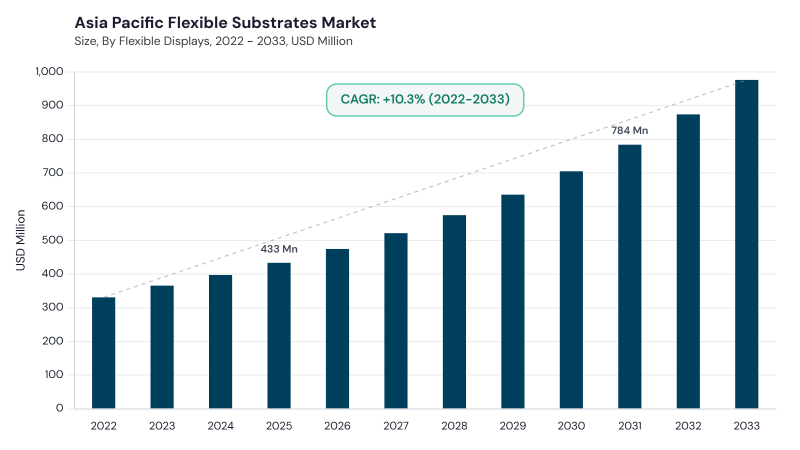
Based on Application, the market is segmented into Flexible Displays, Sensors, Solar Cells, Wearable Electronics, and Other Applications.
The Flexible Displays market dominated the Asia Pacific Flexible Substrates Market by Application in 2025, and would continue to be a dominant market till 2033; thereby, achieving a market value of $705.18 million by 2030, growing at a CAGR of 10.9% during the forecast period. The Sensors market is expected to witness a CAGR of 11.4% during (2026 - 2033).
The Flexible Displays segment acquired the largest revenue share in the Asia Pacific Flexible Substrates Market in 2025 owing to strong regional demand for foldable smartphones, OLED displays, tablets, and advanced consumer electronics. Sensor applications are also witnessing significant growth across healthcare, automotive, and industrial sectors, while increasing investments in renewable energy systems and connected wearable technologies continue to support demand for solar cells and wearable electronics applications.
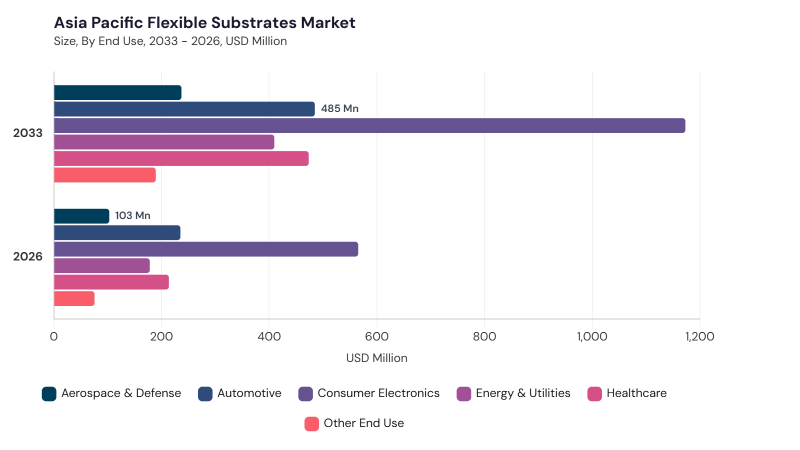
Based on End Use, the market is segmented into Consumer Electronics, Automotive, Healthcare, Energy & Utilities, Aerospace & Defense, and Other End Use.
The Consumer Electronics segment acquired the largest revenue share in the Asia Pacific Flexible Substrates Market in 2025 supported by the region’s dominant position in smartphone, tablet, wearable device, and display manufacturing. Automotive applications continue to expand with increasing integration of advanced electronic systems, electric vehicles, and connected vehicle technologies, while healthcare is witnessing rising adoption of wearable monitoring devices and flexible biosensors. Growing investments in renewable energy infrastructure and industrial digitalization are further supporting market growth across other end-use industries.
Free Valuable Insights: Flexible Substrates Market is Predicted to reach USD 7,918.4 Million billion by 2033, at a CAGR of 11.2%
Based on Country, the market is segmented into China, Japan, India, South Korea, Singapore, Malaysia, and Rest of Asia Pacific.
The China market dominated the Asia Pacific Flexible Substrates Market by Country in 2025, and would continue to be a dominant market till 2033; thereby, achieving a market value of $609.90 million by 2030, growing at a CAGR of 9.8% during the forecast period. The Japan market is expected to witness a CAGR of 10.7% during (2026 - 2033).
China represented the leading market within Asia Pacific owing to its extensive electronics manufacturing capabilities and strong investments in semiconductor and display technologies. Japan and South Korea continue to maintain significant market positions supported by advanced materials innovation and leadership in flexible display technologies. India is witnessing increasing growth driven by expanding electronics manufacturing activities and government initiatives supporting domestic production. Singapore and Malaysia continue to benefit from their strong semiconductor and electronics ecosystems, while the Rest of Asia Pacific market is experiencing growing adoption of flexible substrates across consumer electronics, renewable energy, industrial automation, and healthcare applications.

By Material
By Type
By Application
By End Use
By Country
Set to reach $2967 Million by 2030, growing at 11.7% CAGR during 2026-2033.
China leads with a market value of $671.45 million by 2031, growing at a CAGR of 9.8% during the forecast period.
Flexible Displays market achieves $705.18 million by 2030, growing at a CAGR of 10.9% during the forecast period.
Plastic segment hits $1,384.24 million by 2030, growing at a CAGR of 11.2% during the forecast period.
Japan market is expected to witness a CAGR of 10.7% during 2026-2033.
Metal segment is expected to witness a CAGR of 12.3% during 2026-2033.
Our team of dedicated experts can provide you with attractive expansion opportunities for your business.




 Unique Offerings