The sample copy of this report is available for access.
The Europe Mobile Device Management Market is expected to reach USD 14,875.58 Million by 2031, growing at a CAGR of 20.3% during 2026 - 2033.
The Europe Mobile Device Management (MDM) Market is witnessing steady growth, driven by the rapid digitalization of enterprises, increasing adoption of hybrid work environments, and stringent regional data privacy regulations. Organizations across Europe are increasingly deploying MDM solutions to securely manage smartphones, tablets, laptops, rugged devices, and connected endpoints while ensuring compliance with regulations such as the General Data Protection Regulation (GDPR). The market has evolved from basic device administration to comprehensive Unified Endpoint Management (UEM), integrating artificial intelligence, cloud computing, Zero Trust security, and advanced endpoint analytics.
Based on Enterprise, the market is segmented into Large Enterprises and Small & Medium-sized Enterprises (SMEs). The Large Enterprise market dominated the Europe Mobile Device Management Market by Enterprise Type in 2025, and would continue to be a dominant market till 2033; thereby, achieving a market value of USD 9,280.34 Million by 2031, growing at a CAGR of 19.9 % during the forecast period. The Small & Medium Size Enterprises market is expected to witness a CAGR of 20.9% during (2026 - 2033).
Large enterprises dominate the Europe Mobile Device Management Market owing to their extensive mobile ecosystems, cross-border business operations, complex IT environments, and strict regulatory compliance requirements. These organizations increasingly invest in advanced MDM platforms integrated with identity management, endpoint security, and cloud infrastructure to secure distributed workforces. SMEs are emerging as a fast-growing segment, supported by increasing workplace digitalization, affordable cloud-based deployment models, and subscription-based Software-as-a-Service (SaaS) offerings that enable efficient device management without significant infrastructure investments.
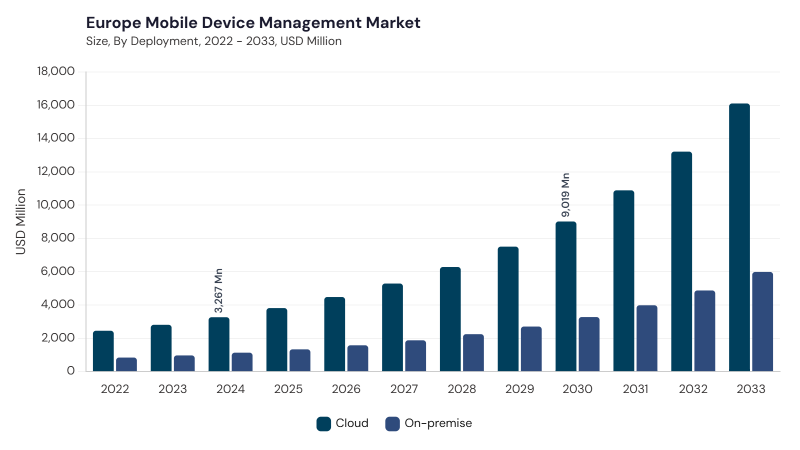
Based on Deployment, the market is segmented into Cloud and On-premise. The Cloud market dominated the Europe Mobile Device Management Market by Deployment in 2025, and would continue to be a dominant market till 2033; thereby, achieving a market value of USD 10,890.59 Million by 2031, growing at a CAGR of 20.1 % during the forecast period. The On-premise market is expected to witness a CAGR of 21% during (2026 - 2033).
Cloud deployment accounts for the largest share of the Europe Mobile Device Management Market due to its scalability, operational flexibility, simplified administration, and ability to support geographically dispersed employees. Organizations increasingly prefer cloud-native MDM solutions that provide centralized management, real-time policy enforcement, automated software updates, and seamless integration with enterprise applications. On-premise deployment continues to maintain a significant presence among government agencies, financial institutions, healthcare providers, and other highly regulated industries that require greater control over enterprise data, customized security frameworks, and compliance with national and regional regulations.
Based on End-user, the market is segmented into BFSI, IT & Telecommunications, Government, Healthcare, Retail, and Other End-users. BFSI remains the leading end-user segment, driven by stringent financial regulations, increasing digital banking adoption, and the need to secure highly sensitive customer and transaction data. IT & Telecommunications represents another major segment due to widespread enterprise mobility initiatives, growing mobile workforces, and continuous technology modernization. Government organizations increasingly deploy MDM platforms to strengthen cybersecurity and support digital public services, while healthcare institutions utilize these solutions to secure electronic health records, telemedicine applications, and connected medical devices. Retail enterprises leverage MDM for mobile point-of-sale systems, inventory management, and workforce mobility. Other industries, including manufacturing, logistics, education, and energy, continue to expand MDM adoption as part of broader digital transformation initiatives.
Free Valuable Insights: The Global Mobile Device Management Market will hit USD 78,405.5 Million billion by 2033, at a CAGR of 20.5%
Based on Country, the market is segmented into Germany, the United Kingdom, France, Russia, Spain, Italy, and Rest of Europe. The Germany and UK led the Europe Mobile Device Management Market by Country with a market share of 23.8% and 20.7% in 2025.The Spain market is expected to witness a CAGR of 21.9% during throughout the forecast period.
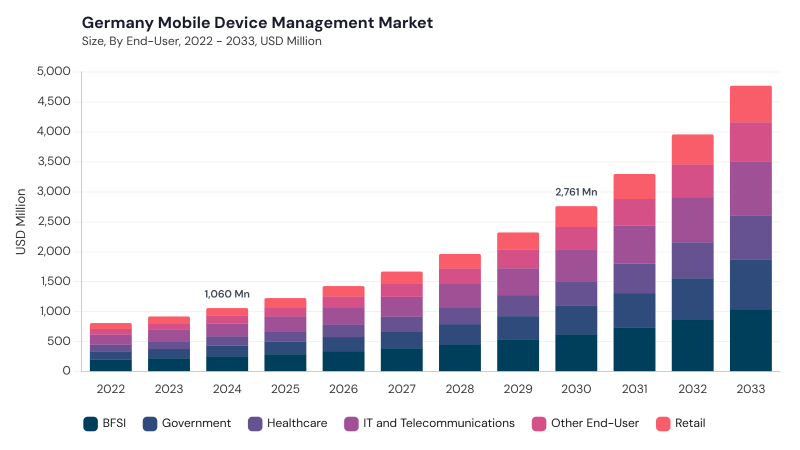
Germany accounts for the largest share of the Europe Mobile Device Management Market owing to its strong industrial base, advanced enterprise IT infrastructure, and stringent cybersecurity requirements. The United Kingdom remains a major contributor through extensive enterprise mobility adoption and cloud transformation initiatives. France continues to witness robust demand supported by regulatory compliance and increasing investments in digital workplaces. Russia, Spain, and Italy are experiencing steady market expansion through enterprise modernization, growing smartphone adoption, and increasing focus on mobile security. The Rest of Europe is also registering healthy growth as organizations continue investing in cloud-based MDM platforms, endpoint security solutions, and workforce mobility management across diverse industry verticals.

By Enterprise Type
By Deployment
By End User
By Country
Set to reach USD 14,875.58 million by 2033, growing at 20.3% CAGR during 2026-2033.
Germany and UK lead with market shares of 23.8% and 20.7% respectively in 2025.
Rising adoption of cloud deployment, reaching USD 10,890.59 million by 2031 at 20.1% CAGR during 2026-2033.
Large enterprises will reach USD 9,280.34 million by 2031, growing at 19.9% CAGR during 2026-2033.
Spain market is expected to witness a CAGR of 21.9% throughout the forecast period.
SMEs are expected to witness a CAGR of 20.9% during 2026-2033.
Our team of dedicated experts can provide you with attractive expansion opportunities for your business.




 Unique Offerings