The sample copy of this report is available for access.
The Europe Medical Rehabilitation Services Market is expected to reach USD 107.1 billion by 2031, growing at a CAGR of 5.7% during (2026 - 2033).
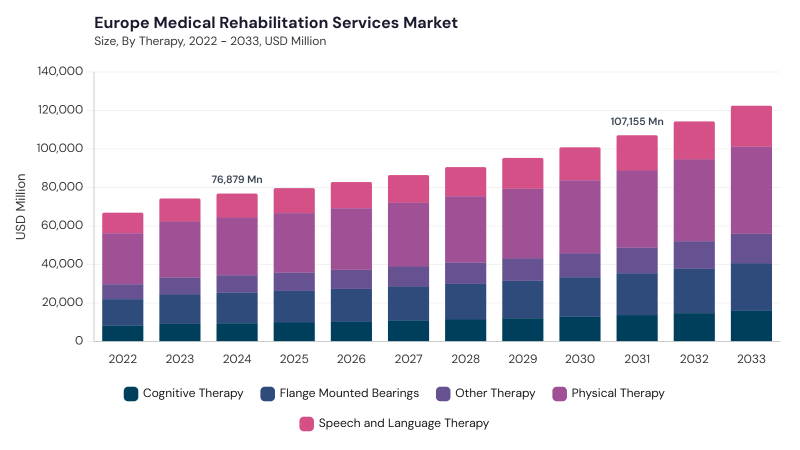
The Europe Medical Rehabilitation Services Market evolved from traditional physiotherapy and post-acute care frameworks established during the mid-20th century into multidisciplinary rehabilitation models spanning physical, occupational, speech, cognitive, neurological, and chronic-care services. Advances in diagnostic tools, therapeutic equipment, evidence-based protocols, and integrated healthcare pathways progressively improved treatment precision and coordination. Digital health technologies, remote monitoring, tele-rehabilitation, robotics, and data-driven treatment planning further transformed service delivery.
Digital rehabilitation, personalized treatment, value-based care, and supportive healthcare policies are shaping current market development. Providers increasingly use wearable sensors, AI-driven analytics, tele-rehabilitation platforms, robotics-assisted therapy, virtual rehabilitation, and real-time monitoring to improve patient engagement and functional outcomes. Growing emphasis on precision rehabilitation is encouraging treatment plans based on individual recovery data, while interoperability and multidisciplinary coordination strengthen continuity across care settings. Aging populations, chronic disease management, decentralized rehabilitation, and policy support for community-based care are also expanding demand for scalable and cost-efficient rehabilitation models.
Based on Setting, the market is segmented into Outpatient and Inpatient. The Outpatient market dominated the Europe Medical Rehabilitation Services Market by Setting in 2025, and would continue to be a dominant market till 2033; thereby, achieving a market value of USD 66.4 billion by 2031, growing at a CAGR of 5.4 % during the forecast period. The Inpatient market is expected to witness a CAGR of 6.3% during (2026 - 2033).
Outpatient rehabilitation delivers physical, occupational, speech, neurological, orthopedic, and cardiac therapies through community clinics, hospital outpatient departments, and specialized centers without prolonged hospitalization. Tele-rehabilitation, wearable monitoring, digital applications, and personalized recovery programs are improving accessibility and continuity of care. Inpatient rehabilitation remains essential for stroke, severe neurological impairment, major orthopedic procedures, trauma, and other complex post-acute conditions requiring multidisciplinary intervention, intensive therapy, and continuous clinical oversight. Robotics-assisted treatment and advanced neurorehabilitation technologies are increasingly integrated into these structured care environments.
Based on End-use, the market is segmented into Hospital and Clinics, Rehab Centers, Physiotherapy Centers, and Homecare Settings. The Hospital and Clinics market dominated the Europe Medical Rehabilitation Services Market by End-use in 2025, and would continue to be a dominant market till 2033; thereby, achieving a market value of USD 34.0 billion by 2031, growing at a CAGR of 4.9 % during the forecast period. The Rehab Centers market is expected to witness a CAGR of 5.9% during (2026 - 2033). The Homecare Settings market is expected to witness a CAGR of 6.2% during (2026 - 2033).
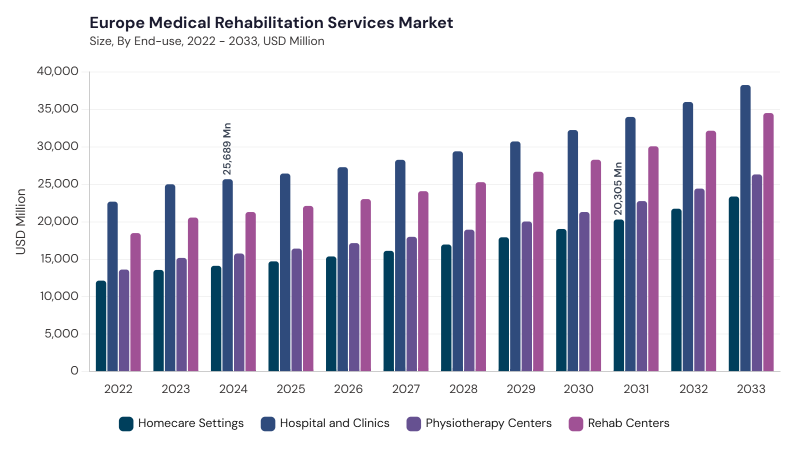
Hospital and Clinics provide early post-acute and multidisciplinary rehabilitation supported by specialist teams, diagnostics, advanced therapeutic equipment, and integrated care pathways. Rehab Centers deliver concentrated neurological, orthopedic, geriatric, and functional restoration programs for patients requiring prolonged or specialized rehabilitation beyond acute treatment. Physiotherapy Centers primarily serve musculoskeletal disorders, back pain, mobility limitations, sports injuries, and post-operative recovery through accessible outpatient interventions. Homecare Settings support elderly, chronically ill, mobility-limited, and post-discharge patients through personalized rehabilitation, telehealth, wearable monitoring, remote assessment, and therapist-supervised recovery within the home environment.
Based on Therapy, the market is segmented into Physical Therapy, Speech and Language Therapy, Cognitive Therapy, and Other Therapy. Physical Therapy focuses on mobility restoration, strength, pain management, musculoskeletal recovery, and post-operative rehabilitation through exercise, manual therapy, and technology-assisted interventions. Speech and Language Therapy supports patients with stroke-related communication impairment, swallowing disorders, developmental conditions, neurological diseases, and age-related speech difficulties.
Cognitive Therapy addresses memory, attention, reasoning, executive-function, and problem-solving limitations associated with stroke, brain injury, dementia, and neurological conditions. Other Therapy includes occupational therapy, respiratory therapy, neuropsychological rehabilitation, pain management, robotic-assisted rehabilitation, hydrotherapy, and other complementary approaches supporting complex and individualized recovery needs.
Based on Application, the market is segmented into Orthopedic, Neurological, Cardiologic, Sports Related Injuries, Pulmonary, and Other Application. Orthopedic rehabilitation addresses fractures, joint replacements, mobility impairment, osteoarthritis, and post-surgical recovery, while Neurological rehabilitation supports patients recovering from stroke, spinal cord injury, Parkinson's disease, multiple sclerosis, brain injury, and other neurological disorders. Cardiologic rehabilitation combines exercise, risk-factor management, education, and monitored recovery following cardiovascular events or procedures.
Sports Related Injuries focuses on functional restoration after ligament, tendon, muscle, and overuse injuries, whereas Pulmonary rehabilitation improves exercise tolerance, breathing efficiency, and functional capacity among patients with chronic respiratory conditions. Other Application includes cancer rehabilitation, trauma recovery, geriatric and pediatric rehabilitation, post-COVID recovery, chronic disease, and other complex conditions requiring personalized multidisciplinary care.
Free Valuable Insights: The Worldwide Medical Rehabilitation Services Market is projected to reach USD 449.9 Billion billion by 2033, at a CAGR of 6.1%
Based on Country, the market is segmented into Germany, UK, France, Russia, Spain, Italy, and Rest of Europe. The Germany market dominated the Europe Medical Rehabilitation Services Market by Country in 2025, and would continue to be a dominant market till 2033; thereby, achieving a market value of USD 20.2 billion by 2031, growing at a CAGR of 4.2 % during the forecast period. The UK market is expected to witness a CAGR of 4.7% during (2026 - 2033). Additionally, The France market is expected to witness a CAGR of 6.4% during (2026 - 2033).
Across Europe, medical rehabilitation services are being shaped by digital health, tele-rehabilitation, AI-enabled personalization, robotics, multidisciplinary care, and decentralized delivery models. Germany emphasizes digital rehabilitation, AI analytics, robotics, IoT monitoring, and home-based care, while the UK focuses on AI-driven rehabilitation, integrated physical and psychological care, community-based models, and wearable technologies. France is advancing tele-rehabilitation, robotic exoskeletons, personalized pathways, remote monitoring, and decentralized services, whereas Russia emphasizes telehealth, AI diagnostics, robotic therapy, specialized infrastructure, and individualized recovery. Spain focuses on AI-based assessment, digital interoperability, tele-rehabilitation, workforce optimization, and patient-specific treatment, while Italy emphasizes robotics, remote monitoring, motion capture, AI assessment, and personalized recovery programs. Rest of Europe continues to develop digital rehabilitation, telehealth, wearable sensors, AI-enabled analytics, evidence-based care, and specialized rehabilitation addressing aging and chronic disease.

By Setting
By End-use
By Therapy
By Application
By Country
Set to reach $107.1 Billion by 2031, growing at 5.7% CAGR during 2026-2033.
Germany leads with a market value of $20.2 billion by 2031, growing at a 4.2% CAGR during 2026-2033.
Outpatient services, reaching $66.4 billion by 2031, are a key driver with a 5.4% CAGR during 2026-2033.
Hospital and clinics segment reaches $34.0 billion by 2031, growing at a 4.9% CAGR during 2026-2033.
The France market is expected to grow at a 6.4% CAGR during 2026-2033.
Homecare settings are expected to grow at a 6.2% CAGR during 2026-2033.
Our team of dedicated experts can provide you with attractive expansion opportunities for your business.




 Unique Offerings