The sample copy of this report is available for access.
The Asia Pacific Medical Rehabilitation Services Market is expected to reach USD 95.5 billion by 2030, growing at a CAGR of 6.7% during (2026 - 2033).
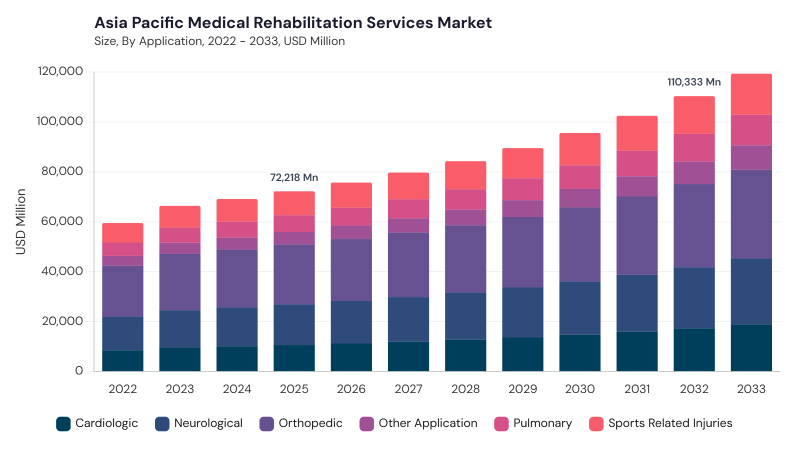
The Asia Pacific Medical Rehabilitation Services Market evolved from traditional hospital-based physical therapy and post-acute care into increasingly organized, multidisciplinary, and technology-enabled rehabilitation ecosystems. Early services relied mainly on manual therapeutic methods and basic assistive devices, while expansion of healthcare infrastructure gradually widened access to specialized recovery programs. Tele-rehabilitation, wearable monitoring, digital health platforms, and personalized treatment protocols subsequently transformed service delivery across geographically diverse populations.
Tele-rehabilitation, AI-enabled care, robotics, and multidisciplinary rehabilitation are shaping current market development. Providers increasingly use wearable sensors, virtual therapy platforms, AI-assisted assessments, robotic rehabilitation devices, mobile health applications, and real-time analytics to personalize treatment and monitor recovery. Remote rehabilitation is improving accessibility across rural and underserved areas, while data-driven protocols enable clinicians to adjust therapy intensity according to patient progress. Aging populations, chronic disease prevalence, government investment, digital-health expansion, and demand for holistic care are also encouraging broader integration of physical, cognitive, occupational, and other rehabilitation services.
Based on Setting, the market is segmented into Outpatient and Inpatient. The Outpatient market dominated the Asia Pacific Medical Rehabilitation Services Market by Setting in 2025, and would continue to be a dominant market till 2033; thereby, achieving a market value of USD 59.4 billion by 2030, growing at a CAGR of 6.4 % during the forecast period. The Inpatient market is expected to witness a CAGR of 7.2% during (2026 - 2033).
Outpatient rehabilitation delivers physical, occupational, speech, neurological, orthopedic, and other therapies without prolonged hospitalization, enabling patients to continue recovery alongside everyday activities. Tele-rehabilitation, wearable monitoring, and digital assessment are strengthening accessibility and continuity across outpatient settings. Inpatient rehabilitation remains essential for stroke, traumatic injuries, complex surgery, severe neurological impairment, and other conditions requiring intensive multidisciplinary treatment, continuous clinical observation, advanced equipment, and coordinated specialist intervention. Robotics-assisted therapy, gait-training systems, and neurostimulation technologies are increasingly incorporated into these higher-acuity environments.
Based on End-use, the market is segmented into Hospitals and Clinics, Rehabilitation Centers, Physiotherapy Centers, and Homecare Settings. The Hospital and Clinics market dominated the Asia Pacific Medical Rehabilitation Services Market by End-use in 2025, and would continue to be a dominant market till 2033; thereby, achieving a market value of USD 30.5 billion by 2030, growing at a CAGR of 5.9 % during the forecast period. The Rehab Centers market is expected to witness a CAGR of 6.9% during (2026 - 2033). The Homecare Settings market is expected to witness a CAGR of 7.2% during (2026 - 2033).
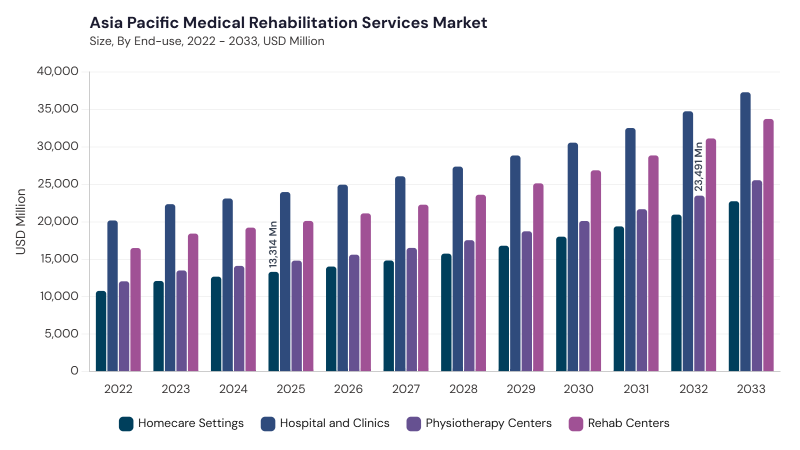
Hospitals and Clinics provide early-stage and post-acute rehabilitation supported by multidisciplinary teams, diagnostic infrastructure, and increasingly advanced digital and robotic technologies. Rehabilitation Centers focus on structured stroke recovery, neurological care, geriatric rehabilitation, mobility restoration, and prolonged functional recovery. Physiotherapy Centers mainly address musculoskeletal disorders, postoperative recovery, chronic pain, mobility limitations, and sports-related injuries through accessible outpatient care. Homecare Settings support elderly, mobility-limited, chronically ill, and post-discharge patients through personalized physical, occupational, and speech therapies increasingly assisted by telehealth, wearable sensors, mobile applications, and remote clinician monitoring.
Based on Therapy, the market is segmented into Physical Therapy, Speech and Language Therapy, Cognitive Therapy, and Other Therapy. Physical Therapy addresses movement impairment, pain management, strength recovery, postoperative rehabilitation, and mobility restoration using exercise, manual therapy, electrotherapy, wearable sensors, and digital tools. Speech and Language Therapy supports communication, swallowing, and cognitive-communication disorders associated with stroke, traumatic brain injury, developmental conditions, and neurological diseases.
Cognitive Therapy focuses on memory, attention, executive function, and problem-solving limitations resulting from stroke, dementia, brain injury, and related conditions. Other Therapy includes occupational therapy, vocational rehabilitation, behavioral therapy, music and art therapy, and other individualized interventions supporting functional independence, psychosocial recovery, and broader reintegration.
Based on Application, the market is segmented into Orthopedic, Neurological, Cardiologic, Sports Related Injuries, Pulmonary, and Other Application. Orthopedic rehabilitation supports recovery from fractures, joint replacements, musculoskeletal disorders, ligament repair, osteoporosis, and related mobility impairment, while Neurological rehabilitation addresses stroke, spinal cord injury, Parkinson’s disease, multiple sclerosis, traumatic brain injury, and other complex neurological conditions.
Cardiologic rehabilitation combines structured exercise, lifestyle modification, monitored recovery, and risk-factor management for cardiovascular patients. Sports Related Injuries focuses on ligament, muscle, tendon, and activity-related recovery using physiotherapy and performance-oriented rehabilitation. Pulmonary rehabilitation supports COPD, asthma, post-COVID respiratory impairment, and other chronic pulmonary conditions through exercise, breathing training, and education. Other Application includes pediatric, geriatric, burn, cancer, amputation, trauma, and other specialized rehabilitation needs.
Free Valuable Insights: Medical Rehabilitation Services Market is Predicted to reach USD 449.9 Billion billion by 2033, at a CAGR of 6.1%
Based on Country, the market is segmented into China, Japan, India, South Korea, Singapore, Malaysia, and Rest of Asia Pacific. The China market dominated the Asia Pacific Medical Rehabilitation Services Market by Country in 2025, and would continue to be a dominant market till 2033; thereby, achieving a market value of USD 26.7 billion by 2030, growing at a CAGR of 4.9 % during the forecast period. The Japan market is expected to witness a CAGR of 6% during (2026 - 2033). Additionally, The India market is expected to witness a CAGR of 7.4% during (2026 - 2033).
Across Asia Pacific, medical rehabilitation services are being reshaped by tele-rehabilitation, AI, robotics, remote monitoring, personalized care, and multidisciplinary delivery. China emphasizes AI-assisted rehabilitation, virtual reality, IoT monitoring, big-data analytics, and decentralized care, while Japan focuses on robotics, AI diagnostics, community rehabilitation, homecare, and technology-enabled elder care. India is advancing tele-rehabilitation, wearable monitoring, personalized programs, integrated care pathways, and expansion into underserved cities, whereas South Korea emphasizes telerehabilitation, AI-enabled robotics, holistic rehabilitation, quality assurance, and digital infrastructure. Singapore focuses on telehealth, robotic exoskeletons, preventive rehabilitation, wearable technologies, and data-driven personalization, while Malaysia emphasizes AI, IoT monitoring, tele-rehabilitation, medical tourism, and localized treatment. Rest of Asia Pacific continues to develop AI-enabled devices, robotic rehabilitation, home-based care, digital monitoring, regulatory improvement, and scalable technology-supported rehabilitation.

By Setting
By End-use
By Therapy
By Application
By Country
Set to reach $95.5 Billion by 2030, growing at 6.7% CAGR during 2026-2033.
China leads with $26.7 billion by 2030, growing at 4.9% CAGR during the forecast period.
Outpatient services dominate, reaching $59.4 billion by 2030, growing at 6.4% CAGR during the forecast period.
The Inpatient segment is expected to witness a CAGR of 7.2% during 2026-2033.
India is expected to witness a CAGR of 7.4% during 2026-2033.
Expected to reach $30.5 billion by 2030, growing at 5.9% CAGR during the forecast period.
Our team of dedicated experts can provide you with attractive expansion opportunities for your business.




 Unique Offerings