The Europe Healthcare CRM Market is expected to reach $7,309.86 million by 2031, growing at a CAGR of 6.6% during 2026 - 2033.
The Germany market dominated the Europe Healthcare CRM Market by Country in 2025, and would continue to be a dominant market till 2033; thereby, achieving a market value of $1,213.38 million by 2031, growing at a CAGR of 4.9 % during the forecast period. The UK market is expected to witness a CAGR of 5.4% during (2026 - 2033).
The Europe Healthcare CRM Market has evolved from basic patient management and administrative systems into advanced platforms that support patient engagement, care coordination, marketing automation, and healthcare relationship management. Initially focused on appointment scheduling and patient record management, healthcare CRM solutions have transformed through the integration of electronic health records (EHRs), cloud computing, artificial intelligence, analytics, and telehealth technologies. Growing emphasis on patient-centric care, digital healthcare transformation, and strict regulatory frameworks such as GDPR have accelerated CRM adoption across healthcare providers, life sciences organizations, and healthcare payers throughout Europe.
The market is being shaped by several important trends, including the integration of advanced EHR systems with CRM platforms, increasing deployment of cloud-based healthcare CRM solutions, growing focus on data privacy and regulatory compliance, and widespread adoption of AI-driven analytics and automation technologies. Healthcare organizations are increasingly utilizing CRM platforms to improve patient communication, enhance operational efficiency, personalize healthcare delivery, and support value-based care initiatives. These developments are transforming CRM systems from administrative tools into intelligent patient engagement ecosystems capable of delivering data-driven healthcare experiences.
Technology vendors across Europe continue to invest heavily in artificial intelligence, machine learning, predictive analytics, workflow automation, cybersecurity, and interoperability standards such as HL7 and FHIR. Strategic collaborations between healthcare providers, CRM vendors, cloud service providers, and digital health companies are further strengthening CRM capabilities. The increasing demand for personalized healthcare experiences, omnichannel communication, and integrated healthcare management is expected to support continued market expansion across the region.
Based on Component, the market is segmented into Software and Services.
The Software market dominated the Europe Healthcare CRM Market by Component in 2025, and would continue to be a dominant market till 2033; thereby, achieving a market value of $4,861.33 million by 2031, growing at a CAGR of 6.3 % during the forecast period. The Services market is expected to witness a CAGR of 7.2% during (2026 - 2033).
Healthcare providers increasingly utilize CRM software integrated with electronic health records, telehealth systems, analytics platforms, and patient engagement tools to improve operational efficiency and healthcare outcomes.
The Services segment continues to experience substantial growth due to rising demand for consulting, implementation, customization, integration, maintenance, workforce training, and managed services. Growing complexity of healthcare CRM deployments and increasing adoption of cloud-based healthcare technologies are driving demand for specialized service providers throughout Europe.
Based on End Use, the market is segmented into Healthcare Providers, Life Sciences Industry, and Healthcare Payers.
The Healthcare Providers segment garnered the largest revenue share in the Europe Healthcare CRM Market due to increasing focus on patient engagement, care coordination, patient satisfaction, and operational efficiency. Hospitals, clinics, and healthcare networks increasingly rely on CRM systems to improve communication workflows and support personalized healthcare delivery.
The Life Sciences Industry segment is witnessing strong adoption of CRM technologies for healthcare professional engagement, customer relationship management, sales optimization, and commercialization strategies. Meanwhile, Healthcare Payers are increasingly implementing CRM solutions to improve member engagement, streamline claims support, enhance customer service, and strengthen retention strategies.
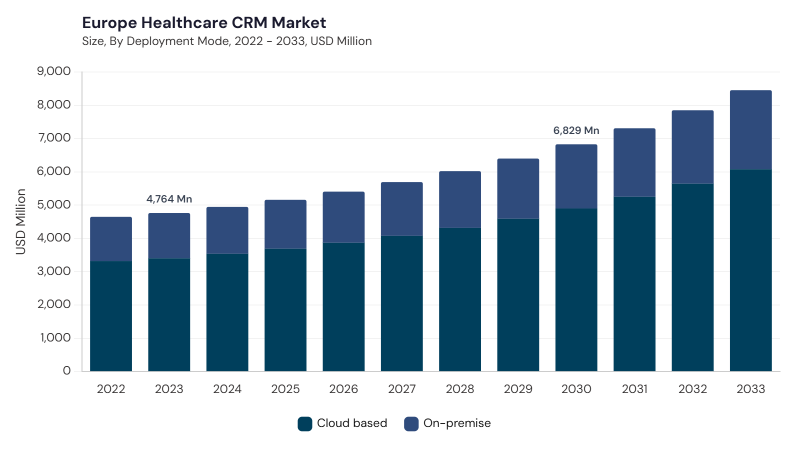
Based on Deployment Mode, the market is segmented into Cloud Based and On-premise.
The Cloud based market dominated the Europe Healthcare CRM Market by Deployment Mode in 2025, and would continue to be a dominant market till 2033; thereby, achieving a market value of $5,250.31 million by 2033, growing at a CAGR of 6.7 % during the forecast period. The On-premise market is expected to witness a CAGR of 6.4% during (2026 - 2033).
The Cloud Based segment garnered the largest revenue share in the Europe Healthcare CRM Market owing to increasing demand for scalable, flexible, and cost-efficient healthcare engagement platforms. Cloud-based CRM systems support remote accessibility, centralized data management, telehealth integration, and rapid deployment of advanced healthcare functionalities.
The On-premise segment maintains an important position within the market, particularly among large healthcare institutions requiring direct control over sensitive healthcare information, cybersecurity management, and compliance with stringent European data privacy regulations. Organizations with established IT infrastructure continue to prefer on-premise deployment for critical healthcare operations.
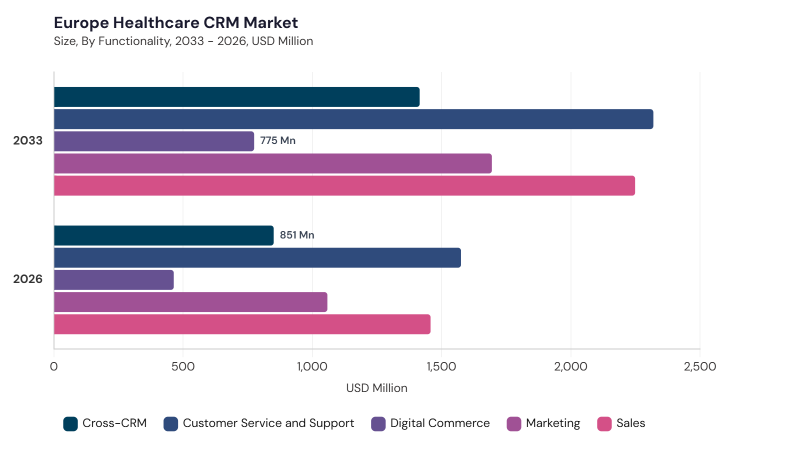
Based on Functionality, the market is segmented into Customer Service and Support, Sales, Marketing, Cross-CRM, and Digital Commerce.
The Customer Service and Support segment garnered the largest revenue share in the Europe Healthcare CRM Market due to increasing emphasis on patient engagement, appointment management, communication support, and patient satisfaction initiatives. Healthcare organizations increasingly deploy AI-powered chatbots, automated communication tools, and omnichannel engagement capabilities to improve service delivery.
The Sales segment continues to expand through increasing adoption by pharmaceutical companies, medical device manufacturers, and healthcare technology providers seeking to optimize customer engagement and commercial operations. Marketing functionalities are witnessing growing demand due to personalized communication and digital outreach initiatives, while Cross-CRM capabilities are strengthening integrated healthcare engagement. Digital Commerce is emerging rapidly through expansion of telehealth services, online healthcare platforms, and digital healthcare transactions.
Free Valuable Insights: The Worldwide Healthcare CRM Market is projected to reach USD 34,816.0 Million billion by 2033, at a CAGR of 6.8%
Based on Country, the market is segmented into Germany, UK, France, Russia, Spain, Italy, and Rest of Europe.
The Germany and UK led the Europe Healthcare CRM Market by Country with a market share of 18.2% and 15.7% in 2025.The Spain market is expected to witness a CAGR of 8.1% during throughout the forecast period.
Germany acquired a significant revenue share owing to strong healthcare digitization initiatives, advanced healthcare infrastructure, and increasing adoption of AI-enabled patient engagement solutions. The UK continues to benefit from NHS digital transformation initiatives, telehealth expansion, and growing emphasis on patient-centric care models. France is witnessing increasing CRM adoption through telemedicine integration and advanced patient engagement strategies. Russia, Spain, and Italy are experiencing growing demand for CRM platforms driven by healthcare modernization, cloud adoption, and operational efficiency requirements.

By Component
By End Use
By Deployment Mode
By Functionality
By Country
Set to reach $7,309.86 Million by 2031, growing at 6.6% CAGR during 2026-2033.
Germany leads with $1,213.38 million by 2031, growing at a CAGR of 4.9% during the forecast period.
Cloud-based deployment hits $5,250.31 million by 2033, growing at 6.7% CAGR during the forecast period.
Software segment achieves $4,861.33 million by 2031, growing at a CAGR of 6.3% during the forecast period.
The UK market is expected to witness a CAGR of 5.4% during 2026-2033.
Spain is expected to witness a CAGR of 8.1% throughout the forecast period.
Our team of dedicated experts can provide you with attractive expansion opportunities for your business.




 Unique Offerings