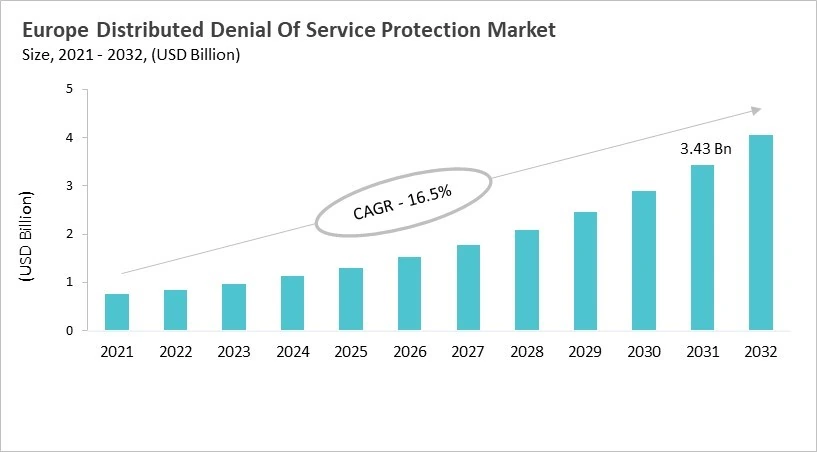
The Europe Distributed Denial Of Service Protection Market is expected to reach $3.43 billion by 2031 and would witness market growth of 17.6% CAGR during the forecast period (2025-2032).
The UK market dominated the Europe Distributed Denial Of Service Protection Market by Country in 2024, and would continue to be a dominant market till 2032; thereby, achieving a market value of $803.3 million by 2032. The Germany market is expected to witness a CAGR of 16.5% during (2025 - 2032). Additionally, The France market is expected to witness a CAGR of 18.5% during (2025 - 2032). The UK and Germany led the Europe Distributed Denial Of Service Protection Market by Country with a market share of 22% and 18.9% in 2024. The Spain market is expected to witness a CAGR of 19.4% during throughout the forecast period.
As more people relied on the internet, businesses became more vulnerable to disruptive cyberattacks. This led to the rise of the Europe Distributed Denial of Service (DDoS) Protection Market in the early 2000s. Early mitigation used simple firewall rules and manual filtering. Over time, these became more advanced defenses that used behavioral analytics, automated mitigation, and cloud-based scrubbing centers. The demand for adaptive and real-time DDoS protection grew as attacks became more common, digital transformation happened, the Internet of Things (IoT) grew, and cybersecurity rules became stricter across Europe. Because of this, the market has moved from reactive blocking to proactive, AI-driven defense systems that work with global threat intelligence and strong security frameworks.
Some important trends that are affecting the market are the use of AI and machine learning to find problems in real time, the EU's growing pressure to improve cyber resilience, and the growth of cloud and edge-based mitigation architectures. To stay competitive, top companies keep coming up with new technologies, work with telecom and cloud providers, and build up regional infrastructure to meet data sovereignty needs. There are both global and regional cybersecurity companies that compete by offering advanced mitigation capabilities, following the rules, building infrastructure that can grow with the company, and providing services at a low cost.
Based on End Use Industry, the market is segmented into IT & Telecommunications, BFSI, Government & Public Sector, Retail & E-commerce, Manufacturing, Healthcare, Energy & Utilities, Media & Entertainment, and Other End Use Industry. The IT & Telecommunications market segment dominated the UK Distributed Denial Of Service Protection Market by End Use Industry is expected to grow at a CAGR of 13.7 % during the forecast period thereby continuing its dominance until 2032. Also, The Energy & Utilities market is anticipated to grow as a CAGR of 16.8 % during the forecast period during (2025 - 2032).
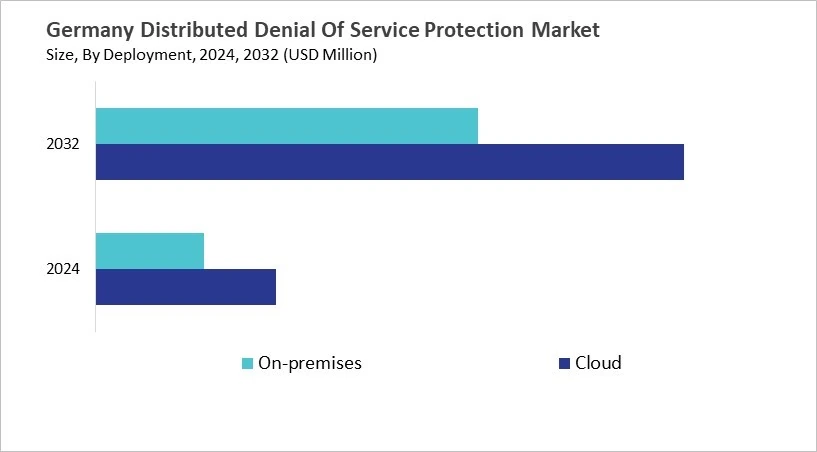
Based on Deployment, the market is segmented into Cloud, and On-premises. With a compound annual growth rate (CAGR) of 16.1% over the projection period, the Cloud Market, dominate the Germany Distributed Denial Of Service Protection Market by Deployment in 2024 and would be a prominent market until 2032. The On-premises market is expected to witness a CAGR of 17.3% during (2025 - 2032).
Free Valuable Insights: The Worldwide Distributed Denial Of Service Protection Market is projected to reach USD 16.22 billion by 2032, at a CAGR of 17.9%
As internet services and digital infrastructure grew, so did the UK Distributed Denial of Service (DDoS) Protection Market. This made people more vulnerable to cyberattacks that cause problems. At first, firewalls and intrusion detection systems were used for protection. But as more advanced botnet-driven attacks became common, more advanced mitigation methods like traffic filtering, anomaly detection, and cloud-based scrubbing centers were used. The market has changed from reactive on-premises hardware solutions to proactive, scalable, and AI-driven protection frameworks over time. Some important trends are that DDoS attacks are getting harder to stop because of IoT devices, cybersecurity and data privacy laws are getting stricter, and more people are using hybrid architectures that combine on-premises and cloud-based defenses. Market leaders stay competitive by coming up with new ways to use machine learning to find threats, forming strategic partnerships with telecom and cloud providers, and building up their infrastructure in the UK. There are both global and regional cybersecurity vendors in the competitive landscape. They stand out from each other by offering advanced technology, regulatory knowledge, scalability, and affordable services.

By Enterprise Size
By Deployment
By Component
By Application
By End Use Industry
By Country
Market will reach $3.43 billion by 2031, growing at 17.6% CAGR during 2025-2032.
UK dominates with 22% market share and will reach $803.3 million by 2032. Germany follows with 18.9% share in 2024.
Increasing cyber threats and enterprise digital transformation accelerate demand for advanced protection solutions.
Germany's market grows at 16.5% CAGR during 2025-2032.
France leads growth at 18.5% CAGR during 2025-2032.
IT & Telecommunications dominates and grows at 13.7% CAGR during the forecast period.
Our team of dedicated experts can provide you with attractive expansion opportunities for your business.




 Unique Offerings