The Asia Pacific Distributed Denial Of Service Protection Market is expected to reach $2.84 billion by 2029 and would witness market growth of 18.5% CAGR during the forecast period (2025-2032).
The China market dominated the Asia Pacific Distributed Denial Of Service Protection Market by Country in 2024, and would continue to be a dominant market till 2032; thereby, achieving a market value of $1,345.7 million by 2032. The Japan market is registering a CAGR of 17.6% during (2025 - 2032). Additionally, The India market would showcase a CAGR of 19.3% during (2025 - 2032). The China and Japan led the Asia Pacific Distributed Denial Of Service Protection Market by Country with a market share of 31.9% and 17.4% in 2024. The Australia market is expected to witness a CAGR of 20% during throughout the forecast period.
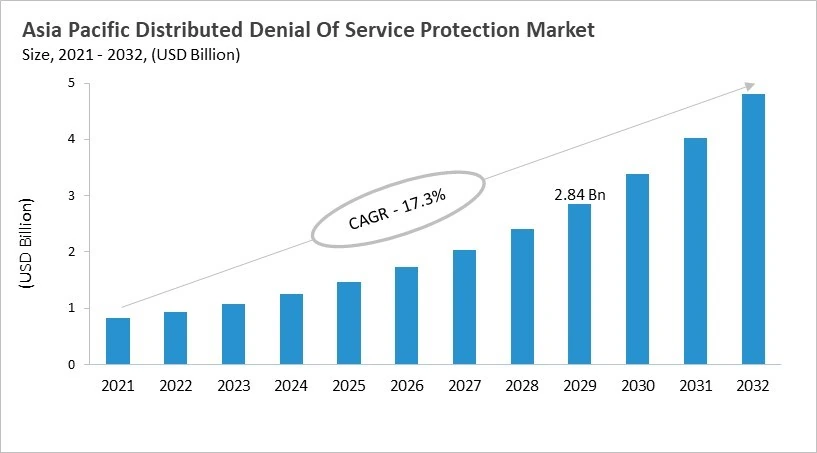
The Asia Pacific Distributed Denial of Service (DDoS) Protection Market grew because there was a growing need to protect digital infrastructure from big cyberattacks that shut down network services. At first, protection methods used simple firewalls, intrusion detection systems, and manual filtering, which didn't work very well. As cloud computing, mobile internet, and e-commerce grew quickly in the area, DDoS attacks became more common and harder to stop. This led to the development of more advanced ways to stop attacks, such as automated monitoring, real-time traffic analysis, and behavior-based anomaly detection. Adding artificial intelligence and machine learning made protection even stronger by making it possible to find threats before they happen. Also, using cloud-based scrubbing centers helped businesses make their defenses bigger and better able to deal with attacks that happened a lot.
There are a few important trends that are affecting the growth of the market in the Asia-Pacific region. One big trend is the use of AI-powered security systems that improve threat intelligence and automate mitigation processes. This cuts down on the time it takes to respond to attacks. The rapid growth of cloud-native DDoS protection solutions is another important trend. This is because businesses are becoming more digital and need security infrastructure that can grow with them. More and more countries are putting in place stricter rules about data protection and cybersecurity. This is also pushing businesses to buy stronger protection systems. The competition in the market is still fierce, with global and regional providers focusing on new ideas, strategic partnerships, and building up their infrastructure. Providers are also putting money into advanced threat intelligence networks and localized services to meet the different cybersecurity needs of different regions.
Based on End Use Industry, the market is segmented into IT & Telecommunications, BFSI, Government & Public Sector, Retail & E-commerce, Manufacturing, Healthcare, Energy & Utilities, Media & Entertainment, and Other End Use Industry. Among various Japan Distributed Denial Of Service Protection Market by End Use Industry; The IT & Telecommunications market achieved a market size of USD $50.3 Million in 2024 and is expected to grow at a CAGR of 15.3 % during the forecast period. The Media & Entertainment market is predicted to experience a CAGR of 18.9% throughout the forecast period from (2025 - 2032).
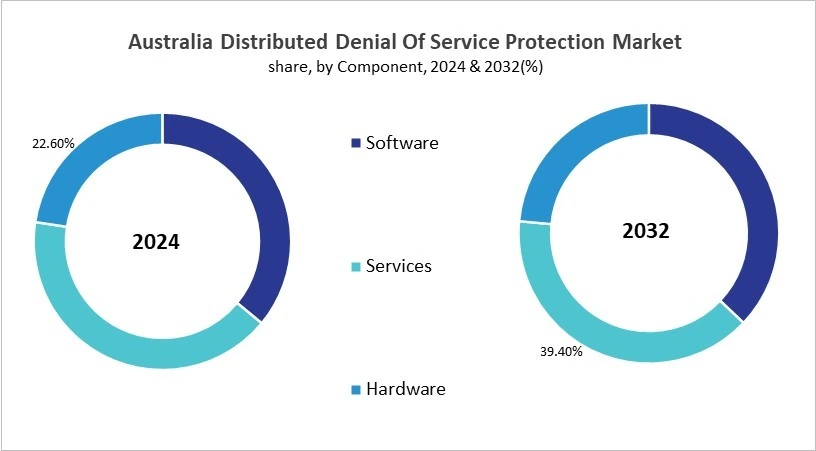
Based on Component, the market is segmented into Software, Services, and Hardware. The Services market segment dominated the Australia Distributed Denial Of Service Protection Market by Component is expected to grow at a CAGR of 19.3 % during the forecast period thereby continuing its dominance until 2032. Also, The Hardware market is anticipated to grow as a CAGR of 20.7 % during the forecast period during (2025 - 2032).
Free Valuable Insights: Distributed Denial Of Service Protection Market is Predicted to reach USD 16.22 billion by 2032, at a CAGR of 17.9%
As cybersecurity measures got better to deal with more cyber threats aimed at digital infrastructure, the China Distributed Denial of Service (DDoS) Protection Market grew. Basic firewalls and intrusion detection systems were used in the early days of defense. Over time, these systems got better and better, adding traffic filtering, behavioral analytics, and cloud-based scrubbing centers. The rapid digitalization of society and strict government rules on cybersecurity made it easier for people to use advanced mitigation technologies like AI, big data analytics, and automated response systems. Some important market trends are the growing use of AI-driven defense to find threats before they happen, the growing need for security solutions to be more localized because of data sovereignty and regulatory requirements, and the addition of DDoS protection to cloud and edge computing environments. Leading companies focus on innovation by using AI-based algorithms, working with telecom and cloud providers, and expanding their infrastructure in specific areas.

By Enterprise Size
By Deployment
By Component
By Application
By End Use Industry
By Country
Market will reach $2.84 billion by 2029, growing at 18.5% CAGR during 2025-2032.
China leads with 31.9% market share in 2024 and will reach $1,345.7 million by 2032.
Australia shows the highest growth at 20% CAGR during 2025-2032, followed by India at 19.3%.
Japan holds 17.4% market share in 2024 and grows at 17.6% CAGR during 2025-2032.
Market is segmented by End Use Industry and Component categories across the region.
Our team of dedicated experts can provide you with attractive expansion opportunities for your business.




 Unique Offerings