The sample copy of this report is available for access.
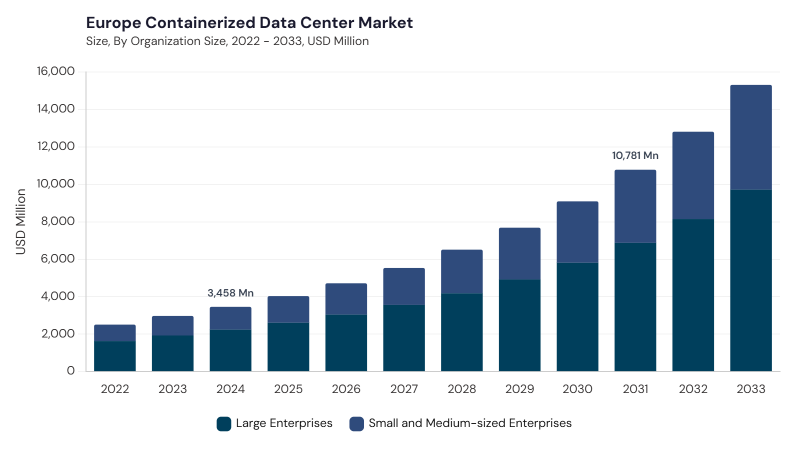
The Europe Containerized Data Center Market is expected to reach USD 10.7 billion by 2031, growing at a CAGR of 18.3% during (2026 – 2033).
The Europe Containerized Data Center Market originated from the need for scalable, modular, and rapidly deployable data infrastructure driven by cloud computing and edge computing adoption. Early containerized solutions served niche applications such as military use, disaster recovery, and temporary IT capacity through modified shipping containers. Over time, advanced cooling systems, power management, integrated networking, and energy-efficient designs transformed these units into highly capable self-contained data center modules. Hyperscale cloud providers and telecommunications companies accelerated adoption by using containerized data centers for distributed edge deployments closer to end users.
The Europe Containerized Data Center Market is being shaped by sustainability imperatives, edge computing expansion, data sovereignty requirements, AI workloads, modular construction, and regulatory compliance. Organizations are adopting containerized data centers to reduce deployment timelines, support localized processing, improve scalability, and meet strict European energy and data protection standards. Demand is supported by large enterprises, SMEs, IT and telecommunications, BFSI, aerospace and defense, healthcare, retail and e-commerce, energy and utilities, and other end-use sectors. Providers are focusing on liquid cooling, advanced airflow management, AI-driven infrastructure monitoring, renewable energy integration, modular hardware, secure enclosures, and rapid deployment models.
Based on Organization Size, the market is segmented into Large Enterprises and Small and Medium-sized Enterprises. The Large Enterprises market dominated the Europe Containerized Data Center Market by Organization Size in 2025, and would continue to be a dominant market till 2033; thereby, achieving a market value of USD 6.8 billion by 2031, growing at a CAGR of 18.1 % during the forecast period. Additionally, The Small and Medium-sized Enterprises market is expected to witness highest CAGR of 18.8% during (2026 - 2033).
Large Enterprises lead due to increasing investments in cloud infrastructure, enterprise digitalization, hybrid IT environments, advanced analytics, and mission-critical workloads across major European economies. These organizations require scalable, secure, compliant, and high-performance infrastructure that supports rapid capacity expansion and localized data control. Small and Medium-sized Enterprises remain significant as containerized solutions offer lower deployment costs, simplified scalability, compact infrastructure, and efficient support for expanding digital operations. The availability of managed infrastructure services, pre-configured modules, pay-as-you-grow models, and lower power and cooling requirements continues to encourage SME adoption.
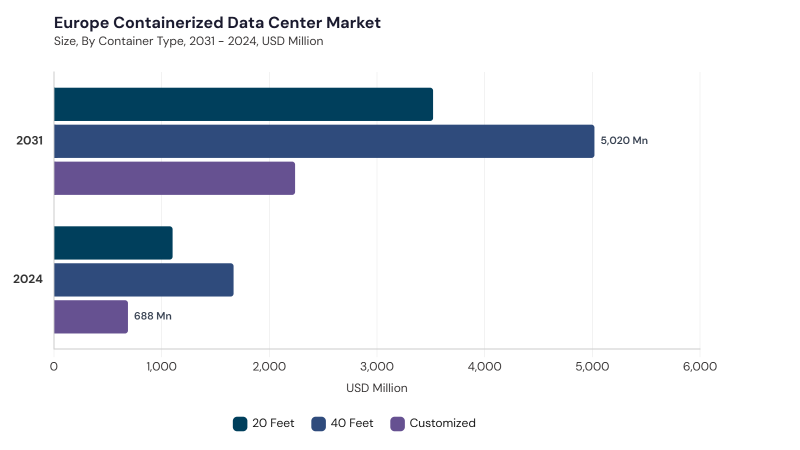
Based on Container Type, the market is segmented into 40 Feet, 20 Feet, and Customized. The 40 Feet market dominated the Europe Containerized Data Center Market by Container Type in 2025, and would continue to be a dominant market till 2033; thereby, achieving a market value of USD 5.0 billion by 2031, growing at a CAGR of 17.7 % during the forecast period. The 20 Feet market is expected to witness a CAGR of 18.7% during (2026 - 2033). Additionally, The Customized market is expected to witness highest CAGR of 19% during (2026 - 2033).
40 Feet containers lead due to their ability to accommodate high-density computing equipment, larger rack capacity, stronger power systems, advanced cooling infrastructure, and complex configurations suited for enterprise campuses, cloud facilities, and large-scale digital infrastructure projects. These units support hybrid cloud, disaster recovery, and regional data center deployments with strong scalability benefits. 20 Feet containers remain significant for branch offices, edge computing sites, telecom base stations, remote industrial locations, and compact urban deployments requiring rapid setup. Customized containers serve organizations needing specialized security, environmental resilience, liquid cooling, renewable energy integration, tailored power systems, and industry-specific configurations for finance, healthcare, government, and AI workloads.
Based on End-use, the market is segmented into IT and Telecommunications, BFSI, Aerospace & Defense, Healthcare, Retail and E-commerce, Energy & Utilities, and Other End-use. IT and Telecommunications leads due to expanding cloud ecosystems, edge computing initiatives, 5G rollout, IoT connectivity, data traffic growth, and demand for high-speed digital infrastructure. Containerized data centers help telecom and IT providers deploy scalable, low-latency infrastructure closer to users while supporting distributed network architectures.
BFSI remains significant as financial institutions require secure, compliant, and resilient infrastructure for digital banking, real-time transaction processing, disaster recovery, and localized data handling. Aerospace & Defense uses containerized systems for secure deployable computing, while Healthcare, Retail and E-commerce, Energy & Utilities, and Other End-use sectors adopt these solutions for medical data, omnichannel operations, smart grids, renewable integration, government services, manufacturing automation, education, and media workloads.
Free Valuable Insights: The Worldwide Containerized Data Center Market is projected to reach USD 60.3 Billion billion by 2033, at a CAGR of 18.8%
Based on Country, the market is segmented into Germany, UK, France, Russia, Spain, Italy, and Rest of Europe. The Germany market dominated the Europe Containerized Data Center Market by Country in 2025, and would continue to be a dominant market till 2033; thereby, achieving a market value of USD 2.1 billion by 2031, growing at a CAGR of 16.7 % during the forecast period. The UK market is expected to witness a CAGR of 17.3% during (2026 - 2033). Additionally, The France market is expected to witness a CAGR of 19.1% during (2026 - 2033).
Germany leads due to data sovereignty requirements, green IT infrastructure, liquid cooling, renewable energy integration, Industry 4.0 adoption, IoT growth, AI workloads, and strong regulatory focus on energy efficiency and privacy. The UK supports market growth through edge computing, net-zero priorities, hybrid cloud adoption, local data residency needs, automation, and containerized infrastructure for finance and healthcare. France contributes through edge deployment, renewable-powered infrastructure, liquid cooling, AI-driven monitoring, predictive maintenance, and low-carbon containerized data center models. Russia, Spain, and Italy add momentum through digital sovereignty, local manufacturing, AI and edge workloads, modular designs, regulatory compliance, advanced cooling, and rapid deployment, while Rest of Europe benefits from green data center demand, decentralized infrastructure, high-density computing, governance complexity, and standardized containerized solutions.

By Organization Size
By Container Type
By End-use
By Country
Set to reach $10.7 Billion by 2031, growing at 18.3% CAGR during 2026-2033.
Germany leads with a market value of $2.1 billion by 2031, growing at 16.7% CAGR during the forecast period.
Rising demand from large enterprises, reaching $6.8 billion by 2031 at 18.1% CAGR during the forecast period.
The 40 Feet segment will reach $5.0 billion by 2031, growing at 17.7% CAGR during the forecast period.
The UK market is expected to witness a CAGR of 17.3% during 2026-2033.
The SME segment is expected to witness the highest CAGR of 18.8% during 2026-2033.
Our team of dedicated experts can provide you with attractive expansion opportunities for your business.




 Unique Offerings
