The sample copy of this report is available for access.
The Asia Pacific Containerized Data Center Market is expected to reach USD 11.0 billion by 2030, growing at a CAGR of 19.6% during (2026 – 2033).
The Asia Pacific Containerized Data Center Market originated from the early demand for flexible, rapidly deployable data infrastructure across fast-growing digital economies. Traditional data centers required long construction timelines and high site preparation, encouraging the development of prefabricated container-based units with built-in cooling, power, and networking systems. Over time, high-efficiency power distribution, liquid cooling, intelligent monitoring, and modular engineering improved operational efficiency and deployment flexibility. Hyperscale cloud growth and AI-driven workloads became major turning points by increasing demand for agile and scalable compute capacity.
The Asia Pacific Containerized Data Center Market is being shaped by cloud expansion, AI infrastructure, edge computing, hyperscale capacity growth, data sovereignty, energy efficiency, and regionalized digital infrastructure deployment. Organizations are adopting containerized data centers to reduce construction timelines, support high-density workloads, improve scalability, and establish localized computing capacity closer to users. Demand is supported by large enterprises, SMEs, IT and telecommunications, BFSI, aerospace and defense, healthcare, retail and e-commerce, energy and utilities, and other end-use sectors. Providers are focusing on AI-ready modules, liquid cooling, high-voltage DC power architectures, battery energy storage, intelligent monitoring, renewable energy integration, and customized container designs.
Based on Organization Size, the market is segmented into Large Enterprises and Small and Medium-sized Enterprises. The Large Enterprises market dominated the Asia Pacific Containerized Data Center Market by Organization Size in 2025, and would continue to be a dominant market till 2033; thereby, achieving a market value of USD 7.0 billion by 2030, growing at a CAGR of 19.3 % during the forecast period. Additionally, The Small and Medium-sized Enterprises market is expected to witness highest CAGR of 20.1% during (2026 - 2033).
Large Enterprises lead due to rapid cloud adoption, AI infrastructure expansion, hyperscale data center investments, hybrid cloud deployment, disaster recovery needs, and geographically distributed operations across China, Japan, India, South Korea, and Australia. These organizations require secure, scalable, high-density, and rapidly deployable infrastructure to support AI workloads, analytics, business continuity, and data sovereignty compliance. Small and Medium-sized Enterprises remain significant as containerized solutions provide cost-effective, modular, and easy-to-manage IT infrastructure with lower capital requirements. Cloud services, managed infrastructure, digital transformation, public cloud integration, backup needs, localized processing, and secure on-premises data handling continue to encourage SME adoption across the region.
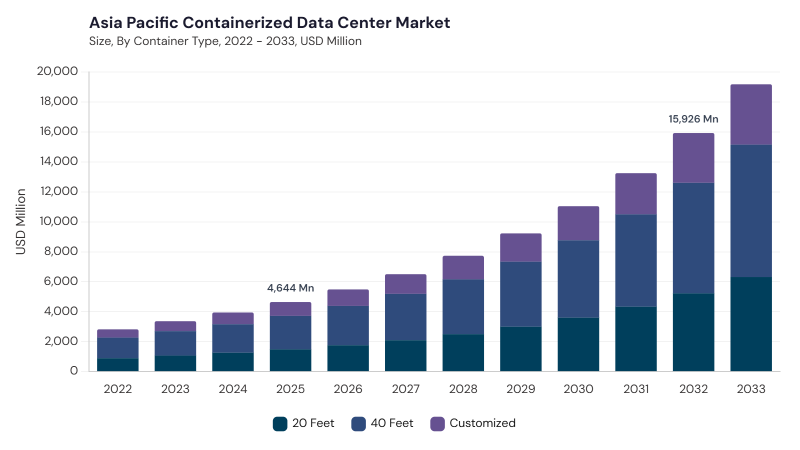
Based on Container Type, the market is segmented into 40 Feet, 20 Feet, and Customized. The 40 Feet market dominated the Asia Pacific Containerized Data Center Market by Container Type in 2025, and would continue to be a dominant market till 2033; thereby, achieving a market value of USD 5.1 billion by 2030, growing at a CAGR of 19 % during the forecast period. The 20 Feet market is expected to witness a CAGR of 20% during (2026 - 2033). Additionally, The Customized market is expected to witness highest CAGR of 20.3% during (2026 - 2033).
40 Feet containers lead due to high equipment capacity, expanded server rack space, stronger power infrastructure, integrated cooling systems, and suitability for hyperscale facilities, enterprise campuses, cloud deployments, AI workloads, big data analytics, and content streaming. These containers support larger-scale data center requirements while reducing deployment timelines compared to traditional builds. 20 Feet containers remain significant for telecom sites, industrial facilities, remote locations, edge computing environments, temporary data center augmentation, and mid-sized enterprise deployments where compact size and rapid installation are important. Customized containers serve organizations requiring application-specific designs, enhanced cooling, stronger security, ruggedized construction, seismic resilience, tropical humidity protection, and specialized power configurations.
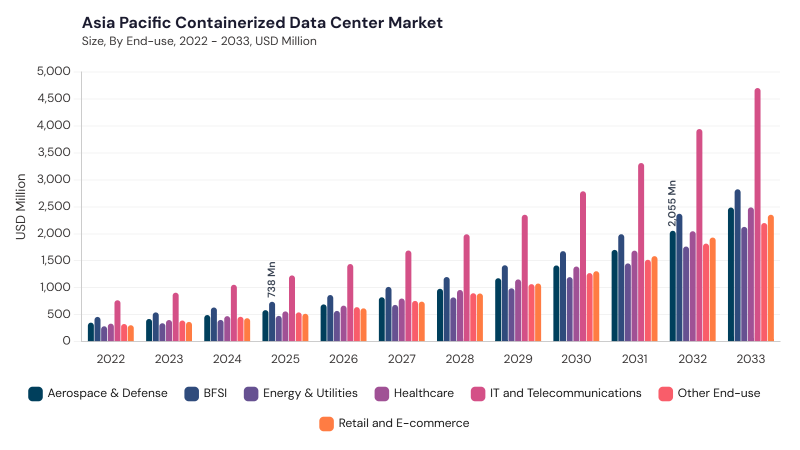
Based on End-use, the market is segmented into IT and Telecommunications, BFSI, Aerospace & Defense, Healthcare, Retail and E-commerce, Energy & Utilities, and Other End-use. IT and Telecommunications leads due to expanding 5G infrastructure, hyperscale cloud investments, growing data traffic, broadband services, edge computing, IoT expansion, and demand for low-latency digital infrastructure. Containerized data centers help telecom operators, internet service providers, cloud service operators, and IT firms expand capacity in remote, urban, and edge locations without lengthy civil construction.
BFSI remains significant as financial institutions require secure, compliant, and resilient infrastructure for mobile banking, real-time transactions, fraud detection, disaster recovery, and data governance. Aerospace & Defense uses containerized systems for defense communications and mission-critical computing, while Healthcare, Retail and E-commerce, Energy & Utilities, and Other End-use sectors adopt these solutions for telemedicine, medical data, online commerce, inventory analytics, smart grids, renewable integration, government, education, logistics, mining, manufacturing, and media applications.
Free Valuable Insights: Containerized Data Center Market is Predicted to reach USD 60.3 Billion billion by 2033, at a CAGR of 18.8%
Based on Country, the market is segmented into China, Japan, India, South Korea, Singapore, Malaysia, and Rest of Asia Pacific. The China market dominated the Asia Pacific Containerized Data Center Market by Country in 2025, and would continue to be a dominant market till 2033; thereby, achieving a market value of USD 3.4 billion by 2030, growing at a CAGR of 17.7 % during the forecast period. The Japan market is expected to witness a CAGR of 18.7% during (2026 - 2033). Additionally, The India market is expected to witness a CAGR of 20.4% during (2026 - 2033).
China leads due to smart city development, hyperscale cloud expansion, edge computing adoption, AI-driven monitoring, liquid cooling, green technologies, cybersecurity requirements, and large-scale digital infrastructure growth. Japan supports market growth through AI-centric infrastructure, prefabricated container clusters, high-density computing, sustainable cooling, seismic robustness, and localized control of sensitive data. India is advancing through cloud demand, data localization, AI-ready container modules, renewable energy integration, regional diversification, digital twin monitoring, and edge deployments across emerging urban and suburban markets. South Korea, Singapore, and Malaysia add momentum through 5G, IoT, hybrid cloud, sustainability mandates, AI workloads, smart infrastructure, edge computing, and high-efficiency container designs, while Rest of Asia Pacific benefits from high-voltage DC architectures, battery energy storage, localized customization, energy-efficient modules, and distributed infrastructure modernization.

By Organization Size
By Container Type
By End-use
By Country
Set to reach $11.0 Billion by 2030, growing at 19.6% CAGR during 2026-2033.
China leads with $3.4 billion by 2030, growing at 17.7% CAGR during the forecast period.
Rising enterprise cloud adoption and AI-driven workloads are the main catalysts.
Large enterprises market will reach $7.0 billion by 2030, growing at 19.3% CAGR during the forecast period.
India is expected to witness a CAGR of 20.4% during 2026-2033.
The 20 Feet market is expected to witness a CAGR of 20% during 2026-2033.
Our team of dedicated experts can provide you with attractive expansion opportunities for your business.




 Unique Offerings
