The Europe Contactless Payment Market is expected to reach $49.21 billion by 2031 and would witness market growth of 18.3% CAGR during the forecast period (2025-2032).
The UK market dominated the Europe Contactless Payment Market by Country in 2024, and would continue to be a dominant market till 2032; thereby, achieving a market value of $13,549.2 million by 2032. The Germany market is exhibiting a CAGR of 17.1% during (2025 - 2032). Additionally, The France market would experience a CAGR of 19.2% during (2025 - 2032). The UK and Germany led the Europe Contactless Payment Market by Country with a market share of 25.3% and 16.8% in 2024. The Italy market is expected to witness a CAGR of 19% during throughout the forecast period.
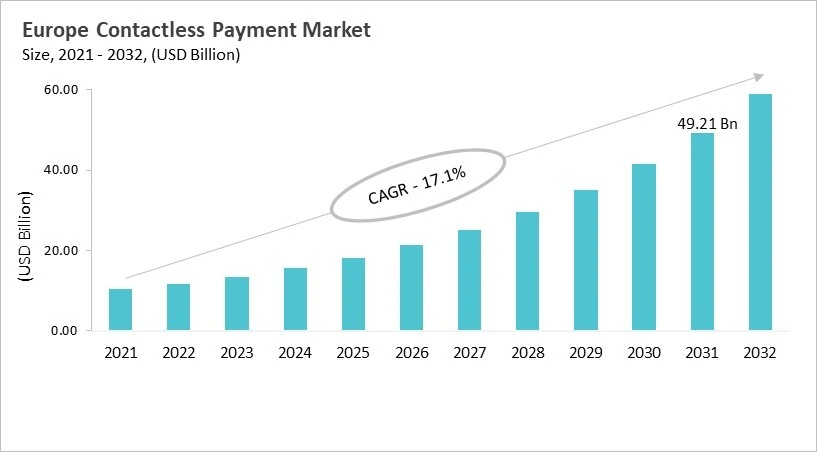
The contactless payment market in Europe has changed a lot since the early 2000s. It went from being used by only a few people with NFC-enabled cards to being a fully integrated digital payment system. At first, growth was slow because of problems with infrastructure and security concerns. However, the rise of smartphones with built-in NFC capabilities and digital wallets made adoption happen much faster. Regulatory efforts like PSD2 were very important in making things safer, more interoperable, and more competitive by letting fintech companies take part. Today, contactless payments are widely accepted in retail, transportation, and hospitality. This is because merchants are investing more in them and consumers are becoming more interested in convenience and hygiene, especially after the pandemic. Leading markets like Sweden have also affected regional adoption by setting standards for cashless economies.
Some of the most important trends that are shaping the market right now are the upcoming Financial Data Access (FiDA) framework, the merging of contactless payments with real-time payment systems, and the fast growth of mobile wallets. These trends are pushing new ideas, speeding up transactions, and making the customer experience better with value-added services. To stay competitive, market leaders are using strategies like technological innovation, strategic partnerships, and localized expansion. They are also putting money into AI-powered fraud detection and advanced security solutions. The competition is fierce, with global companies using their size and technology to their advantage and regional companies using their local knowledge to win over niche markets. In the end, seamless, integrated financial experiences are becoming more important for differentiation than just price. This is creating a dynamic market where innovation is key.
Based on Type, the market is segmented into Card Based Payments, and Smartphone Based Payments. With a compound annual growth rate (CAGR) of 16.2% over the projection period, the Card Based Payments Market, dominate the UK Contactless Payment Market by Type in 2024 and would be a prominent market until 2032. The Smartphone Based Payments market is expected to witness a CAGR of 19.1% during (2025 - 2032).
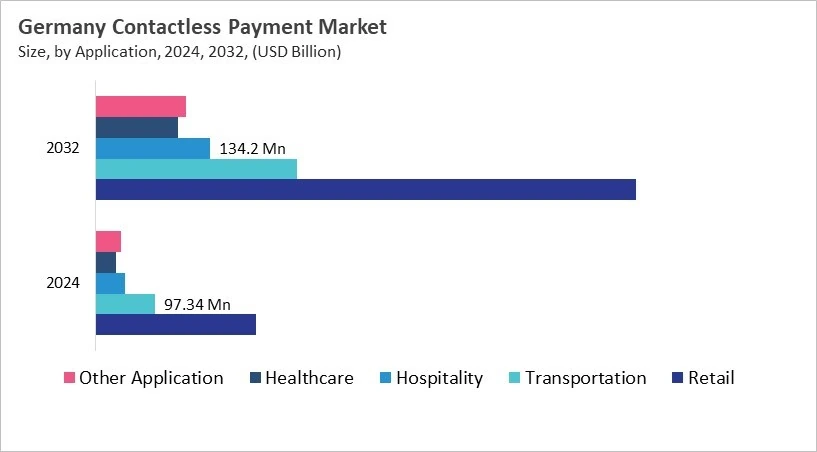
Based on Application, the market is segmented into Retail, Transportation, Hospitality, Healthcare, and Other Application. Among various Germany Contactless Payment Market by Application; The Retail market achieved a market size of USD $1422.2 Million in 2024 and is expected to grow at a CAGR of 16.5 % during the forecast period. The Healthcare market is predicted to experience a CAGR of 19.3% throughout the forecast period from (2025 - 2032).
Free Valuable Insights: The Worldwide Contactless Payment Market is projected to reach USD 207.47 billion by 2032, at a CAGR of 18.7%
The UK contactless payment market has grown from the early days of NFC-enabled cards in the 2000s to a highly developed, almost universal system that is driven by convenience, security, and rapid technological progress. Key factors that have sped up its growth include the easing of transaction limits by regulators, the widespread use of mobile wallets, and the fact that consumers now prefer digital payments that don't require any extra steps, especially after the COVID-19 pandemic. Improvements in cloud-based infrastructure, real-time processing, and better fraud prevention technologies are also changing the market by making it more scalable and resilient. To improve user experience and strengthen their presence in the market, leading companies focus on new ideas, strategic partnerships, and investments in infrastructure. Competition is still focused on innovation, and companies set themselves apart by offering security features, ecosystem integration, and value-added services instead of lower prices. In general, the market is a dynamic balance between global technology leaders and regional players. This leads to constant change and high consumer adoption.

By Type
By Application
By Country
Set to reach $31.01 billion by 2029 at 19.7% CAGR during 2025-2032.
China leads with a 29.5% market share in 2024 and will reach $13,842.2 million by 2032.
Increasing smartphone adoption and government digitalization initiatives across emerging economies fuel market expansion.
Card-based payments dominate the market segment across the region.
Japan registers 18.8% CAGR during 2025-2032 while India showcases 20.4% CAGR during the same period.
Retail dominates China's market with 17% CAGR during the projection period.
Our team of dedicated experts can provide you with attractive expansion opportunities for your business.




 Unique Offerings