The sample copy of this report is available for access.
The Europe Anti-Chafing Products Market is expected to reach USD 271.3 Million by 2031, growing at a CAGR of 6% during (2026 – 2033).
The Europe Anti-Chafing Products Market originated from rising consumer awareness around personal comfort and skin health, initially serving athletes and individuals involved in physically demanding activities. Early products were mainly simple topical powders and balms designed to reduce friction on sensitive skin areas. Over time, moisture-wicking fabrics, breathable textiles, synthetic fiber blends, dermatologically safe ingredients, hypoallergenic formulations, smart textiles, and nanotechnology expanded the market beyond topical applications. Today, anti-chafing products in Europe are positioned as preventive body-comfort and skincare solutions used across sports, commuting, travel, outdoor activity, workplace routines, medical care, and daily wear.
The growing emphasis on fabric innovation, natural ingredients, dermatologically tested formulas, sustainable packaging, eco-friendly materials, digital retailing, and active lifestyle adoption is shaping the next phase of market growth across Europe. Manufacturers are increasingly investing in moisture-wicking textiles, temperature-regulating fabrics, plant-based extracts, clean-label ingredients, biodegradable components, skin-friendly balms, creams, powders, wipes, sprays, protective patches, and anti-friction wearables to improve comfort, safety, and product versatility. Rising walking and cycling habits, outdoor leisure culture, summer travel, pharmacy-led skincare purchasing, sensitive-skin awareness, and preventive personal care adoption are also supporting improved scalability, service quality, and market expansion.
Based on Distribution Channel, the market is segmented into Offline and Online. The Offline market dominated the Europe Anti-Chafing Products Market by Distribution Channel in 2025, and would continue to be a dominant market till 2033; thereby, achieving a market value of USD 139.6 Million by 2031, growing at a CAGR of 5.6 % during the forecast period. The Online market is expected to witness a CAGR of 6.4% during (2026 - 2033).
Offline channels lead the market due to strong consumer trust in pharmacies, drugstores, supermarkets, sports outlets, health-and-beauty retailers, and specialty personal care stores. European consumers often prefer physical retail when buying products for skin irritation because pharmacies and drugstores offer product familiarity, immediate access, and confidence in dermatologist-oriented or sensitive-skin formulations. Seasonal demand during holidays, hiking trips, cycling activity, warm weather, festivals, and city commuting further supports in-store buying. Online channels are also expanding through e-commerce platforms, brand websites, digital pharmacies, sports-specialty retailers, customer reviews, personalized recommendations, subscription models, and access to fragrance-free, vegan, sensitive-skin, endurance-sport, and travel-friendly product formats.
Based on Product Type, the market is segmented into Balms & Sticks, Creams & Lotions, Powders, and Other Product Type. The Balms & Sticks market dominated the Europe Anti-Chafing Products Market by Product Type in 2025, and would continue to be a dominant market till 2033; thereby, achieving a market value of USD 124.9 Million by 2031, growing at a CAGR of 5.5 % during the forecast period. The Creams & Lotions market is expected to witness a CAGR of 6.2% during (2026 - 2033). The Other Product Type market is expected to witness a CAGR of 7.1% during (2026 - 2033).
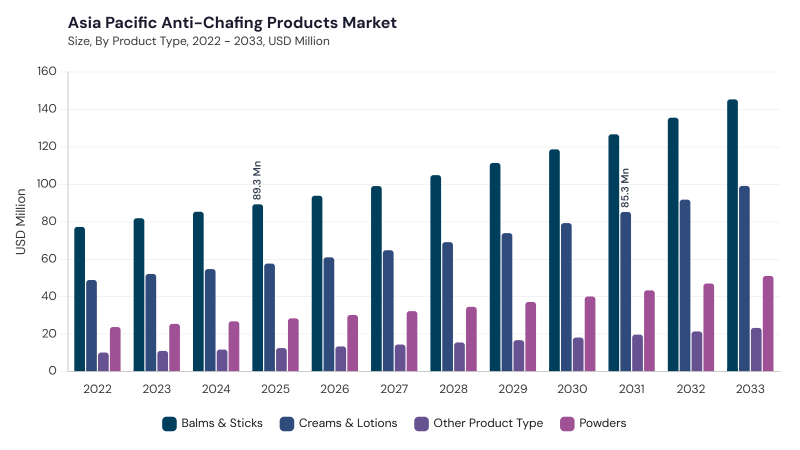
Balms and sticks lead the market due to compact handling, direct application, mess-free use, targeted protection, and suitability for thighs, feet, underarms, waistlines, bra areas, and shoe-contact points. These formats are preferred by cyclists, walkers, runners, office commuters, festival visitors, travelers, and consumers needing convenient on-the-go protection. Creams and lotions also hold a strong position among users seeking soothing textures, moisturization, barrier support, and formulas suited to dry or sensitive skin. Powders serve consumers looking for moisture control, sweat absorption, and a dry-skin feel during warm weather or active days, while sprays, gels, wipes, tapes, protective patches, and anti-friction wearables address specialized needs in endurance sports, travel, occupational use, and recurring irritation management.
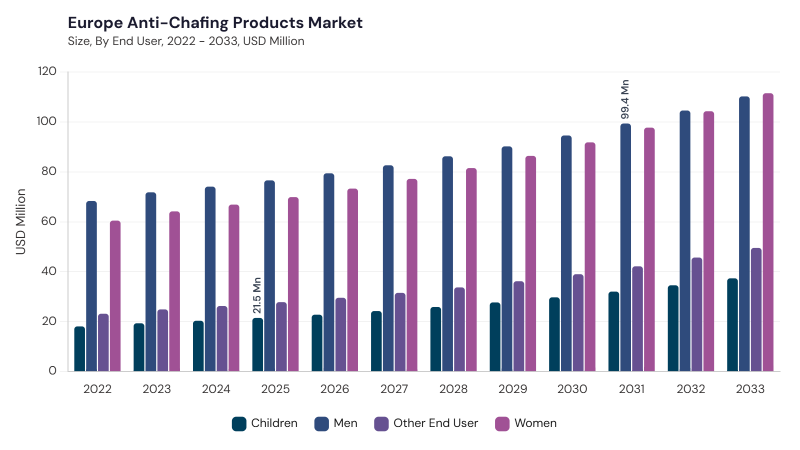
Based on End User, the market is segmented into Men, Women, Children, and Other End User. Men lead the market due to demand linked with cycling, running, football, hiking, gym activity, outdoor labor, military-style activity, and irritation around thighs, groin, feet, underarms, and sportswear contact areas. Male users often prefer quick-absorbing, non-greasy, moisture-control, breathable, and long-lasting products aligned with active and occupational routines.
Women also account for substantial demand, supported by thigh chafing, dresses and skirts, activewear, maternity comfort, bra-line friction, walking routines, fragrance-free products, and discreet daily-use formats. Children contribute through school sports, outdoor play, summer camps, footwear rubbing, sensitive skin, and diaper-area comfort, while other users include older adults, plus-size consumers, travelers, uniformed workers, mobility-related users, and individuals prone to recurring skin sensitivity.
Based on Application, the market is segmented into Sports & Fitness, Daily Use, Medical, and Other Application. Sports & Fitness leads the market due to strong demand from cycling, running, hiking, football, gym training, triathlon activity, endurance sports, and outdoor recreation. Consumers in this category look for sweat resistance, durability, quick absorption, non-greasy feel, moisture management, and protection during repetitive movement and contact with performance fabrics.
Daily Use is also prominent due to commuting, walking, workplace uniforms, warm-weather clothing, travel, festivals, and long urban activity days. Medical use supports friction-related skin-fold discomfort, post-treatment care, sensitive skin management, mobility-related irritation, and preventive support, while other applications include backpacking, holiday travel, pilgrimage walking, maternity routines, military-style activity, outdoor events, occupational use, and general personal care situations.
Free Valuable Insights: The Global Anti-Chafing Products Market will hit USD 1,192 Million billion by 2033, at a CAGR of 6.4%
Based on Country, the market is segmented into Germany, UK, France, Russia, Spain, Italy, and Rest of Europe. The Germany market dominated the Europe Anti-Chafing Products Market by Country in 2025, and would continue to be a dominant market till 2033; thereby, achieving a market value of USD 58.05 Million by 2031, growing at a CAGR of 4.7 % during the forecast period. The UK market is expected to witness a CAGR of 4.9% during (2026 - 2033). Additionally, The France market is expected to witness a CAGR of 6.7% during (2026 - 2033).
Germany leads through clean-label formulations, eco-friendly ingredients, dermatologically safe formulas, moisture-wicking products, sprays, gels, and sustainability-focused consumer demand. The UK is growing with natural and multifunctional products, botanical extracts, personalized skincare, influencer engagement, and active lifestyle-led adoption. France is supported by silicone-based gels, breathable balms, protective films, hypoallergenic formulations, sweat-resistant solutions, and fragrance-free products. Russia, Spain, Italy, and Rest of Europe add growth through daily comfort needs, pharmacy-led skincare, sports participation, and wider retail availability.

By Distribution Channel
By Product Type
By End User
By Application
By Country
Set to reach USD 271.3 Million by 2033, growing at a 6% CAGR during 2026-2033.
Germany leads, achieving a market value of USD 58.05 Million by 2031, with a 4.7% CAGR during 2026-2033.
The Offline distribution channel dominates, reaching USD 139.6 Million by 2031, growing at a 5.6% CAGR during 2026-2033.
Balms & Sticks segment to reach USD 124.9 Million by 2031, with a 5.5% CAGR during 2026-2033.
France market is expected to witness a 6.7% CAGR during 2026-2033.
Online distribution channel to witness a 6.4% CAGR during 2026-2033.
Our team of dedicated experts can provide you with attractive expansion opportunities for your business.




 Unique Offerings