The sample copy of this report is available for access.
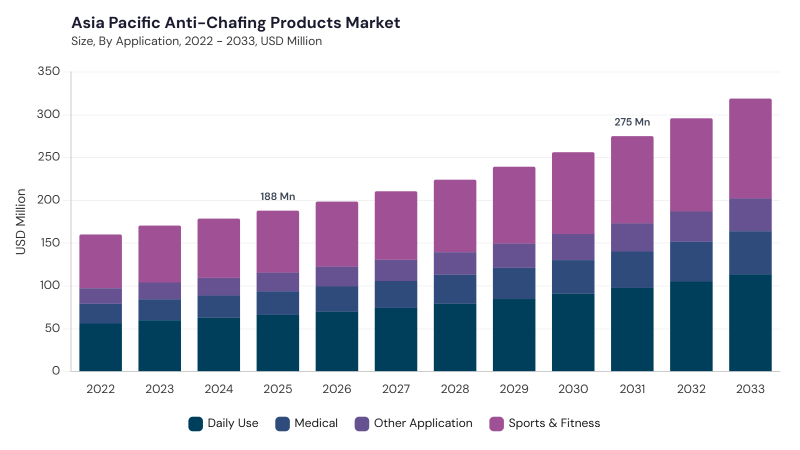
The Asia Pacific Anti-Chafing Products Market is expected to reach USD 256.3 Million by 2030, growing at a CAGR of 7% during (2026 – 2033).
The Asia Pacific Anti-Chafing Products Market traces its origins to rising demand for personal care solutions that improve comfort during physical activity, daily wear, and warm or humid climatic conditions. Initially, anti-chafing products were limited to simple powders and ointments formulated to reduce skin irritation caused by friction. Over time, material science, dermatological formulations, silicone-based products, water-resistant balms, natural ingredients, hypoallergenic solutions, creams, gels, and wearable anti-friction formats transformed the market. Today, anti-chafing products across Asia Pacific are gaining attention as practical personal care essentials for athletes, office commuters, travelers, children, outdoor workers, and consumers managing friction caused by clothing, footwear, sweat, and daily mobility.
The growing preference for natural formulations, organic ingredients, multifunctional products, digital commerce, e-commerce platforms, active lifestyles, and climate-suitable skincare is shaping the next phase of market growth across Asia Pacific. Manufacturers are increasingly investing in plant-based ingredients, anti-inflammatory botanicals, silicone derivatives, encapsulation techniques, sweat-resistant balms, cooling effects, UV protection, travel-friendly packs, portable sticks, powders, sprays, gels, wipes, and anti-friction wearables to improve comfort, application convenience, and product versatility. Rising humid climates, fitness participation, outdoor recreation, activewear use, urban commuting, travel, and consumer awareness of skin comfort during heat, sweat, and prolonged movement are also supporting improved scalability, service quality, and market expansion.
Based on Distribution Channel, the market is segmented into Offline and Online. The Offline market dominated the Asia Pacific Anti-Chafing Products Market by Distribution Channel in 2025, and would continue to be a dominant market till 2033; thereby, achieving a market value of USD 132.4 Million by 2030, growing at a CAGR of 6.6 % during the forecast period. The Online market is expected to witness a CAGR of 7.4% during (2026 - 2033).
Offline channels lead the market due to strong consumer reliance on pharmacies, supermarkets, convenience stores, sports retailers, beauty stores, personal care outlets, and health-and-beauty specialty retailers for immediate product access. Physical retail is especially relevant for shoppers seeking quick relief during summer, travel, workouts, outdoor activity, commuting, or humid-weather discomfort. Offline channels also support impulse buying and brand visibility across urban and semi-urban markets. Online channels are expanding rapidly due to mobile commerce, marketplace discounts, influencer-led product discovery, customer reviews, direct-to-consumer engagement, fast delivery, and access to international and niche brands offering sweat-resistant formulas, sensitive-skin claims, athlete-focused products, travel-friendly packs, and discreet personal care solutions.
Based on Product Type, the market is segmented into Balms & Sticks, Creams & Lotions, Powders, and Other Product Type. The Balms & Sticks market dominated the Asia Pacific Anti-Chafing Products Market by Product Type in 2025, and would continue to be a dominant market till 2033; thereby, achieving a market value of USD 118.7 Million by 2030, growing at a CAGR of 6.4 % during the forecast period. The Creams & Lotions market is expected to witness a CAGR of 7.2% during (2026 - 2033). The Other Product Type market is expected to witness a CAGR of 8.2% during (2026 - 2033).
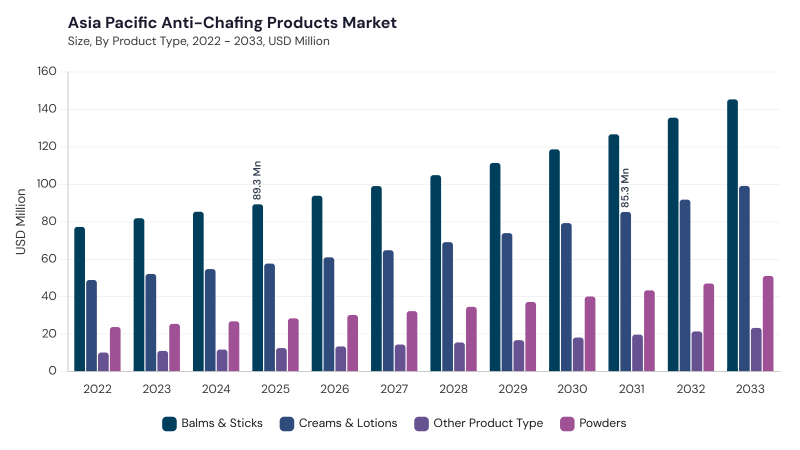
Balms and sticks lead the market due to easy application, portability, clean handling, targeted protection, less greasy finish, and suitability for thighs, feet, underarms, waistbands, groin areas, bra lines, and shoe-contact zones. These formats fit well with runners, gym users, hikers, commuters, travelers, outdoor workers, and consumers wearing fitted or synthetic clothing. Creams and lotions also hold a strong role among users seeking soothing texture, moisturization, skin-barrier support, and comfort after irritation. Powders remain especially relevant in Asia Pacific because warm and humid conditions increase demand for sweat absorption, dryness, and moisture control, while other formats such as sprays, gels, wipes, protective patches, tapes, and anti-friction wearables serve endurance sports, travel, occupational use, and sensitive-skin needs.
Based on End User, the market is segmented into Men, Women, Children, and Other End User. Men lead the market due to demand linked with sports, running, cycling, gym training, outdoor work, military-style activity, long hours of physical exertion, and friction around thighs, groin, feet, underarms, and sportswear contact points. Men’s products often emphasize efficacy, long-lasting protection, cooling effects, sweat resistance, and convenient application for hot and humid conditions.
Women also generate strong demand, supported by thigh chafing, activewear, dresses, walking, maternity comfort, bra-line rubbing, skincare benefits, discreet body-care products, and natural or organic formulations. Children contribute through school sports, outdoor play, summer activities, footwear rubbing, sensitive skin, and diaper-area comfort, while other users include older adults, plus-size consumers, travelers, workers wearing uniforms or protective clothing, and individuals prone to recurring skin irritation.
Based on Application, the market is segmented into Sports & Fitness, Daily Use, Medical, and Other Application. Sports & Fitness leads the market due to strong demand from running, cycling, trekking, gym workouts, yoga, team sports, outdoor recreation, endurance activities, fitness clubs, and organized sports events. Users in this category seek sweat resistance, long-lasting protection, easy reapplication, quick absorption, and compatibility with performance clothing during repetitive movement and perspiration.
Daily Use is also important, driven by commuting, walking, travel, warm-weather clothing, workplace uniforms, school routines, public transportation, and long hours of movement in humid conditions. Medical use covers skin-fold irritation, mobility-related rubbing, sensitive skin management, post-treatment comfort, and preventive care, while other applications include backpacking, festival attendance, beach travel, occupational use, maternity routines, military training, cultural clothing use, and general personal care situations.
Free Valuable Insights: The Global Anti-Chafing Products Market will hit USD 1,192 Million billion by 2033, at a CAGR of 6.4%
Based on Country, the market is segmented into China, Japan, India, South Korea, Australia, Malaysia, and Rest of Asia Pacific. The China market dominated the Asia Pacific Anti-Chafing Products Market by Country in 2025, and would continue to be a dominant market till 2033; thereby, achieving a market value of USD 74.3 Million by 2030, growing at a CAGR of 5.2 % during the forecast period. The Japan market is expected to witness a CAGR of 6.1% during (2026 - 2033). Additionally, The India market is expected to witness a CAGR of 7.8% during (2026 - 2033).
China leads through urban lifestyles, fitness culture, moisture-wicking fabrics, natural ingredients, e-commerce growth, sprays, gels, and antimicrobial products. Japan is growing with humid-climate skincare needs, silicone-based gels, breathable textile treatments, wearable patches, and hypoallergenic formulations. India is supported by hot and humid conditions, urbanization, creams, balms, powders, Ayurvedic ingredients, e-commerce adoption, and fitness influencer engagement. South Korea, Australia, Malaysia, and Rest of Asia Pacific add growth through skincare awareness, active lifestyles, online retail, and climate-adapted products.

By Distribution Channel
By Product Type
By End User
By Application
By Country
Set to reach USD 256.3 Million by 2030, growing at 7% CAGR during 2026-2033.
China leads with USD 74.3 Million by 2030, growing at 5.2% CAGR during 2026-2033.
The offline distribution channel dominates with USD 132.4 Million by 2030, at 6.6% CAGR during 2026-2033.
Balms & sticks reach USD 118.7 Million by 2030, growing at 6.4% CAGR during 2026-2033.
The India market is expected to witness a CAGR of 7.8% during 2026-2033.
The online market is expected to witness a CAGR of 7.4% during 2026-2033.
Our team of dedicated experts can provide you with attractive expansion opportunities for your business.




 Unique Offerings