The sample copy of this report is available for access.
The Europe Active Power Steering Market is expected to reach USD 7.5 billion by 2031, growing at a CAGR of 14.1% during (2026 - 2033).
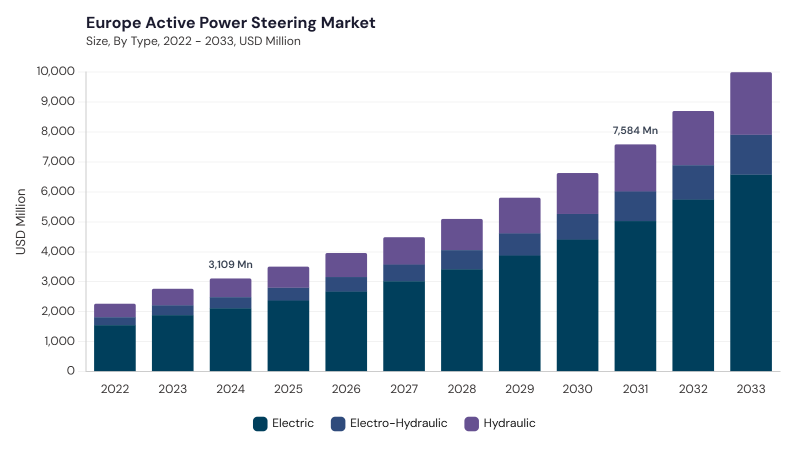
Europe Active Power Steering Market originated as a response to the automotive industry’s demand for enhanced vehicle control and driver comfort, replacing traditional hydraulic power steering systems that were bulkier and less energy-efficient. The transition toward electric power steering marked a critical turning point by enabling lighter, electronically controlled systems with variable assistance. Over time, sensor integration, electronic control units, and control algorithms transformed active power steering from a steering-assistance feature into a key enabler of ADAS, automated parking, lane-keeping support, and electric or hybrid drivetrain compatibility.
ADAS integration, electrification, energy efficiency, regional customization, and software-led steering control are shaping current market development. European automakers increasingly use active power steering to support safety systems, autonomous functions, lower mechanical energy losses, and improved steering precision. Suppliers are developing region-specific calibrations, fail-safe designs, sensor-rich systems, and scalable electric steering platforms. However, high compliance burden, production and integration cost, technological complexity, limited standardization, and system interoperability challenges continue to influence adoption across Europe.
Based on Application, the market is segmented into Passenger Car and Commercial Vehicle. The Passenger Car market dominated the Europe Active Power Steering Market by Application in 2025, and would continue to be a dominant market till 2033; thereby, achieving a market value of USD 5.7 billion by 2031, growing at a CAGR of 13.8 % during the forecast period. The Commercial Vehicle market is expected to witness a CAGR of 15.3% during (2026 - 2033).
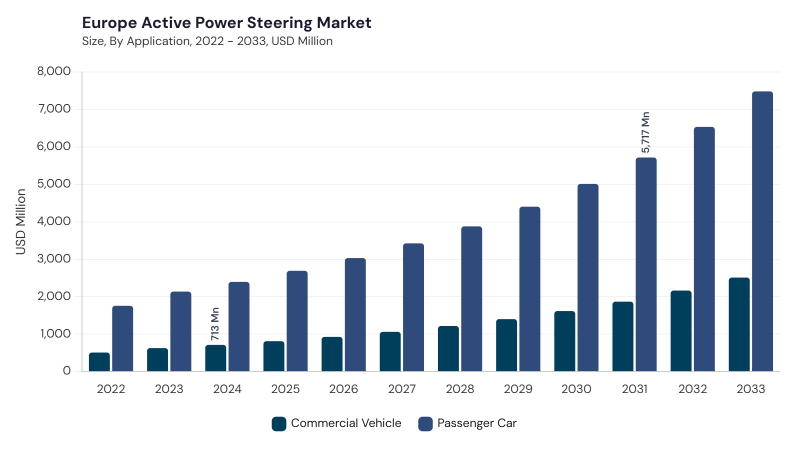
Passenger Car applications include compact cars, sedans, SUVs, luxury vehicles, electric vehicles, hybrid models, and urban mobility platforms where steering precision, driving comfort, fuel efficiency, ADAS compatibility, and responsive handling are key priorities. Active power steering supports electronic stability, lane-keeping assistance, automated parking, speed-sensitive steering, and smoother maneuverability in congested and highway conditions. Commercial Vehicle maintained a promising presence through vans, trucks, buses, logistics fleets, and transport vehicles, supported by fleet modernization, driver ergonomics, vehicle stability, maneuverability, durability, and progressive electrification of commercial platforms.
Based on Type, the market is segmented into Electric, Hydraulic, and Electro-Hydraulic. Electric active power steering uses electric motors, electronic control units, sensors, and software algorithms to provide variable steering assistance while reducing parasitic energy loss. It supports electric and hybrid vehicle architectures, ADAS functions, automated parking, lane-keeping support, customizable steering feel, and efficiency-focused vehicle development.
Hydraulic garnered a considerable share through proven durability and steering-force capability in established vehicle platforms, especially demanding load applications. Electro-Hydraulic maintained a promising presence as a transitional solution, combining hydraulic steering characteristics with electronic control for platforms seeking improved energy management without immediately shifting to fully electric steering.
Free Valuable Insights: The Worldwide Active Power Steering Market is projected to reach USD 37.9 Billion billion by 2033, at a CAGR of 14.4%
Based on Country, the market is segmented into Germany, UK, France, Russia, Spain, Italy, and Rest of Europe. The Germany market dominated the Europe Active Power Steering Market by Country in 2025, and would continue to be a dominant market till 2033; thereby, achieving a market value of USD 1.6 billion by 2031, growing at a CAGR of 12.7 % during the forecast period. The UK market is expected to witness a CAGR of 12.8% during (2026 - 2033). Additionally, The France market is expected to witness a CAGR of 15% during (2026 - 2033).
Across Europe, Active Power Steering adoption varies by automotive manufacturing strength, EV transition, ADAS integration, regulatory pressure, road conditions, and supplier localization. Germany is shaped by ADAS-linked steering, energy-efficient EPS, customization, and strong OEM-supplier collaboration; the UK reflects electrification, lightweight components, urban maneuverability, and ADAS-ready systems; France is driven by EPS adoption, sustainability policy, modular designs, and semi-autonomous functionality; Russia reflects digital steering control, electrification, and local supply-chain adaptation; Spain is supported by EV integration, safety regulation, and EPS adoption; Italy emphasizes electric steering, modular APS, ADAS compatibility, and cost-efficient innovation; Rest of Europe remains shaped by electrification, steer-by-wire development, lightweight design, ADAS integration, and localized regulatory needs.

By Application
By Type
By Country
Set to reach $7.5 Billion by 2031, growing at 14.1% CAGR during 2026-2033.
Germany leads with $1.6 billion by 2031, growing at 12.7% CAGR during 2026-2033.
Rising demand in the Passenger Car segment, reaching $5.7 billion by 2031 at 13.8% CAGR.
Expected to witness a CAGR of 15.3% during 2026-2033.
The UK market is expected to witness a CAGR of 12.8% during 2026-2033.
France is expected to witness a CAGR of 15% during 2026-2033.
Our team of dedicated experts can provide you with attractive expansion opportunities for your business.




 Unique Offerings
