The sample copy of this report is available for access.
The Asia Pacific Active Power Steering Market is expected to reach USD 8.3 billion by 2030, growing at a CAGR of 14.9% during (2026 - 2033).
Asia Pacific Active Power Steering Market originated alongside the automotive industry’s pursuit of enhanced vehicle control and safety, evolving from conventional hydraulic power steering systems toward electro-hydraulic and fully electric configurations. The transition was driven by the need for higher fuel efficiency, lower mechanical complexity, and more precise electronic steering assistance. Over time, electronic sensors, motors, control units, digital algorithms, and ADAS integration transformed APS into a core automotive technology supporting passenger cars, commercial vehicles, electric vehicles, stability systems, and adaptive steering solutions.
Vehicle electrification, autonomous driving, ADAS integration, safety regulations, and localized manufacturing are shaping current market development. Government incentives for emissions reduction and fuel economy are accelerating the shift from hydraulic to electric APS systems, while intelligent steering units are increasingly required for lane-keeping assist, automated parking, and variable steering feedback. Manufacturers are investing in lightweight motors, torque sensors, intelligent control units, and localized production. However, high system cost, fragmented regulations, limited aftermarket support, integration complexity, and price sensitivity continue to influence adoption across Asia Pacific.
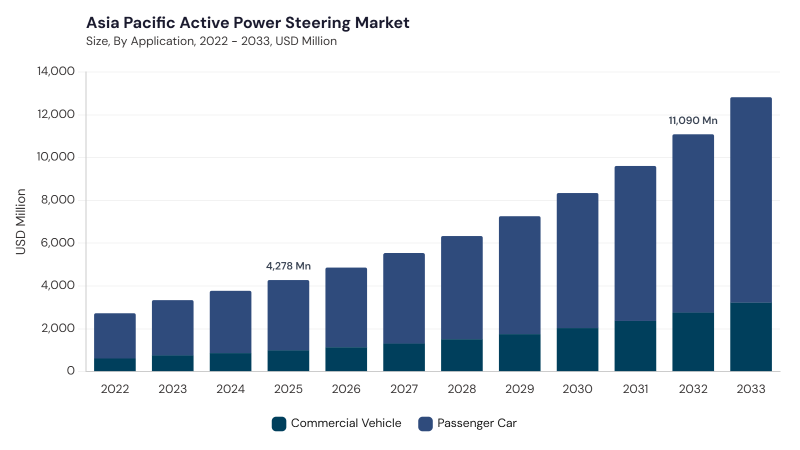
Based on Application, the market is segmented into Passenger Car and Commercial Vehicle. The Passenger Car market dominated the Asia Pacific Active Power Steering Market by Application in 2025, and would continue to be a dominant market till 2033; thereby, achieving a market value of USD 6.3 billion by 2030, growing at a CAGR of 14.5 % during the forecast period. The Commercial Vehicle market is expected to witness a CAGR of 16% during (2026 - 2033).
Passenger Car applications include compact cars, sedans, SUVs, luxury vehicles, electric vehicles, hybrid models, and personal mobility platforms where steering responsiveness, driver comfort, fuel efficiency, ADAS compatibility, and easy maneuverability are key priorities. APS supports lane-keeping assistance, automated parking, electronic stability control, adaptive feedback, and improved handling in congested urban and high-speed driving conditions. Commercial Vehicle maintained a promising presence through trucks, buses, delivery vans, logistics fleets, and freight vehicles, supported by urban freight activity, fleet modernization, driver workload reduction, steering precision, durability, and gradual commercial vehicle electrification.
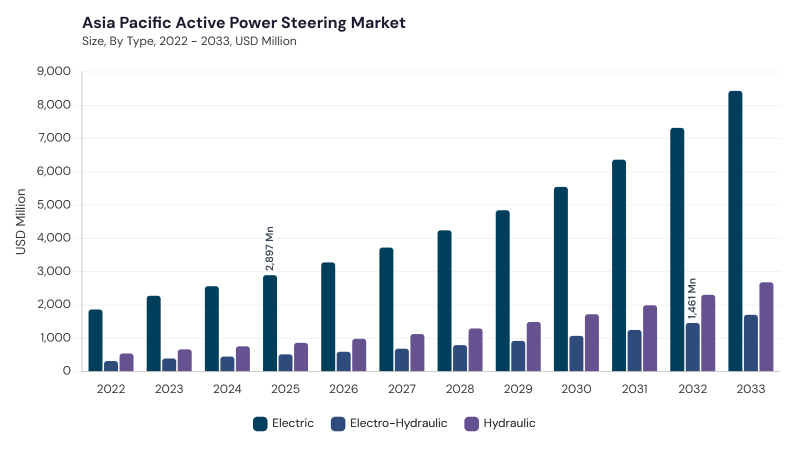
Based on Type, the market is segmented into Electric, Hydraulic, and Electro-Hydraulic. Electric active power steering uses electric motors, sensors, ECUs, and software algorithms to provide variable steering assistance with lower energy consumption than hydraulic systems. It supports passenger cars, light commercial vehicles, EVs, hybrid vehicles, ADAS, lane assistance, parking assistance, and intelligent vehicle functions.
Hydraulic garnered a considerable share through continued use in established vehicle designs, heavy-duty applications, commercial vehicles, off-road machinery, and markets requiring dependable steering under demanding operating conditions. Electro-Hydraulic maintained a promising presence by combining hydraulic steering capability with electronic actuation and control, serving transitional platforms and higher-load applications requiring balanced performance and efficiency.
Free Valuable Insights: Active Power Steering Market is Predicted to reach USD 37.9 Billion billion by 2033, at a CAGR of 14.4%
Based on Country, the market is segmented into China, Japan, India, South Korea, Singapore, Malaysia, and Rest of Asia Pacific. The China market dominated the Asia Pacific Active Power Steering Market by Country in 2025, and would continue to be a dominant market till 2033; thereby, achieving a market value of USD 3.3 billion by 2030, growing at a CAGR of 13.5 % during the forecast period. The Japan market is expected to witness a CAGR of 14% during (2026 - 2033). Additionally, The India market is expected to witness a CAGR of 15.7% during (2026 - 2033).
Across Asia Pacific, Active Power Steering adoption varies by EV production, ADAS penetration, vehicle manufacturing scale, safety regulation, affordability, and local supplier capability. China is shaped by NEV growth, steer-by-wire development, autonomous driving, and localized APS supply chains; Japan reflects advanced ADAS integration, miniaturized EPS, connected vehicles, and software-driven steering; India is driven by urbanization, fuel-efficiency rules, modular APS, and cost-sensitive localization; South Korea emphasizes EVs, autonomous features, adaptive feedback, and sensor accuracy; Singapore reflects EV adoption, safety regulation, urban maneuverability, and smart APS integration; Malaysia is supported by 48V architectures, steer-by-wire progress, tropical-market customization, and local manufacturing; Rest of Asia Pacific remains shaped by electrification, connected vehicles, modular design, localization, and cost-optimized APS adoption.

By Application
By Type
By Country
Set to reach $8.3 Billion by 2030, growing at 14.9% CAGR during 2026-2033.
China leads with $3.3 billion by 2030, growing at 13.5% CAGR during 2026-2033.
Rising demand in the Passenger Car segment, hitting $6.3 billion by 2030 at 14.5% CAGR.
Passenger Car segment will reach $6.3 billion by 2030, growing at 14.5% CAGR during 2026-2033.
India market is expected to grow at 15.7% CAGR during 2026-2033.
Commercial Vehicle segment is expected to witness a CAGR of 16% during 2026-2033.
Our team of dedicated experts can provide you with attractive expansion opportunities for your business.




 Unique Offerings
