“Global Customer Experience Management Market to reach a market value of 38.48 Billion by 2032 growing at a CAGR of 14.5%”
The Global Customer Experience Management Market size is estimated at $14.92 billion in 2025 and is expected to reach $38.48 billion by 2032, rising at a market growth of 14.5% CAGR during the forecast period (2025-2032). This growth is due to more people wanting personalized interactions with customers, AI and analytics being adopted quickly, more digital channels being added, and a greater focus on keeping customers. To support long-term market growth businesses are putting money into advanced experience management solutions to boost engagement, satisfaction, and competitive edge.
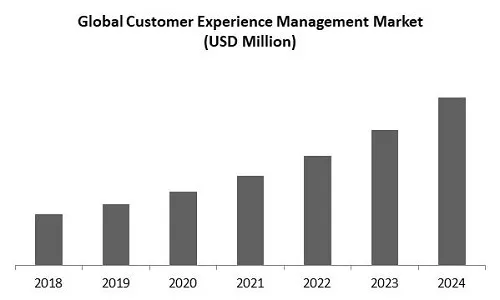
Customer experience management market has developed from basic feedback collection into a sophisticated, data-driven discipline central to business strategy. Early advancements are shaped by the integration of central experience management systems, which allowed enterprises to centralize customer data and improve service delivery. Customer experience management platforms have advanced to support multichannel engagement and analytics, addressing largely complex customer journeys. Additionally, the growth of machine learning and AI marked a noticeable shift, allowing automation, predictive insights, and highly personalized interactions. CXM is further defined by AI-driven analytics, customer journey mapping, and omnichannel orchestration, positioning it as a crucial tool for driving retention, customer loyalty, and measurable business outcomes.
The customer experience management market is driven by elements including the widespread adoption of smart automation and AI and hyper-personalization, and a rising focus on bridging the gap through data-driven decision-making and advanced journey analytics. Also, the integration of human expertise with AI is fostering hybrid service models. Leading companies are responding with strategies focusing on partnerships to expand technology ecosystems, innovation in AI capabilities, and investment in scalable, cloud-based platforms. The competitive landscape of the market remains intense with leading players differentiating through advanced features and global reach.
The major strategies followed by the market participants are Partnerships as the key developmental strategy to keep pace with the changing demands of end users. For instance, In February, 2025, Salesforce, Inc. teamed up with Google integrate Google's Gemini into Salesforce's Agentforce platform, enhancing multi-cloud and AI capabilities. This collaboration will allow Salesforce users to run applications on Google Cloud, with features like image recognition, real-time language translation, and seamless integration with Google Workspace. Moreover, In December, 2024, Adobe, Inc. announced the partnership with AWS, a cloud computing company to bring Adobe Experience Platform (AEP) to AWS, offering brands the ability to enhance customer engagement through personalized experiences. AEP includes tools like Adobe Real-Time CDP, Journey Optimizer, and Customer Journey Analytics, enabling real-time insights and seamless customer interactions across channels.
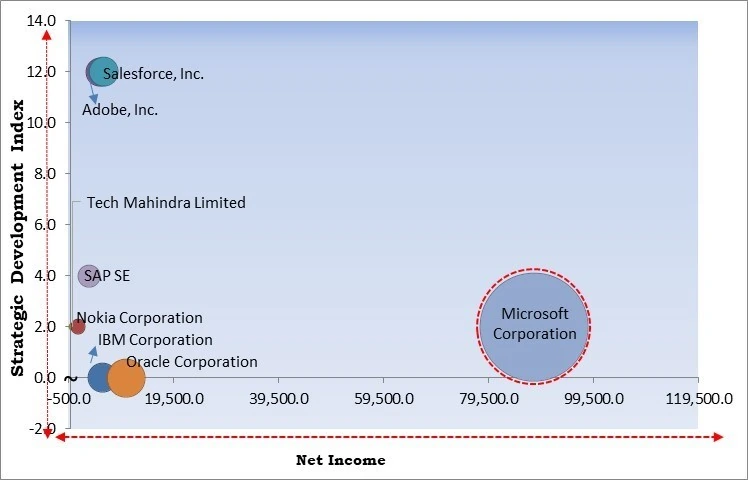
Based on the Analysis presented in the KBV Cardinal matrix; Microsoft Corporation is the forerunner in the Customer Experience Management Market. In February, 2023, Microsoft Corporation announced the partnership with Amdocs, a telecommunications company to launch an intelligent Customer Engagement Platform that enhances telco experiences. Combining Amdocs' cloud-native Commerce and Care Suite with Microsoft’s Dynamics 365, Power Platform, and AI, the platform streamlines business processes, improves customer engagement, and supports 5G monetization and cloud adoption. Companies such as Oracle Corporation, Salesforce, Inc., and IBM Corporation are some of the key innovators in Customer Experience Management Market.
Before the COVID-19 pandemic, the Customer Experience Management (CEM) market was growing steadily as more and more businesses used digital tools to improve interactions with customers across multiple channels. At first, the pandemic slowed down progress because of operational problems, a lack of workers, and investments in technology that were put off because of economic uncertainty. But it sped up digital transformation by a lot, leading to the quick adoption of cloud-based platforms, AI-driven analytics, and omnichannel engagement solutions to meet the needs of more and more online customers. This change led to new ideas in areas like virtual assistants, automation, and personalized digital experiences. As the recovery went on, businesses adopted CEM strategies that were more flexible, strong, and based on data. Overall, the pandemic had a beneficial impact because it sped up the development of technology and the evolution of the market over time. Hence, the COVID-19 pandemic had a positive impact on the market.
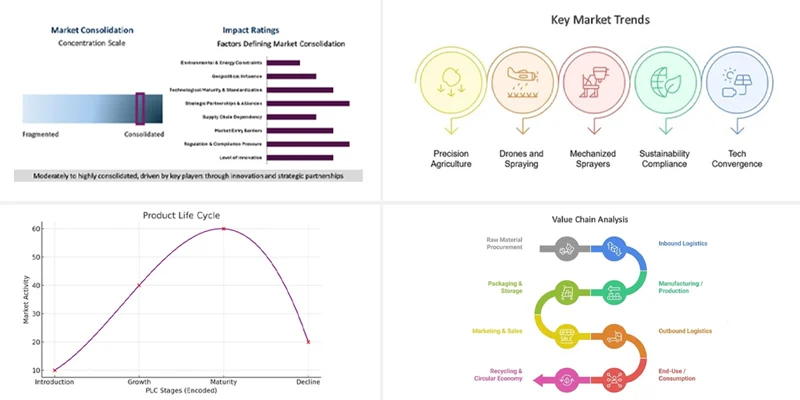

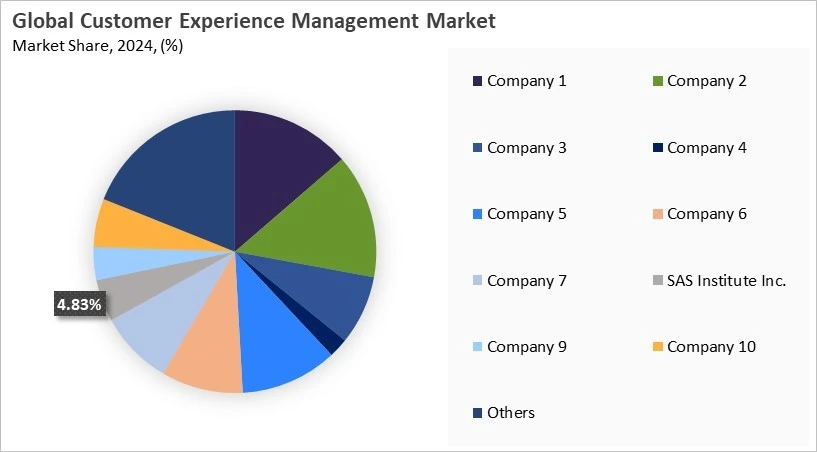
The leading players in the market are competing with diverse innovative offerings to remain competitive in the market. The above illustration shows the percentage of revenue shared by some of the leading companies in the market. The leading players of the market are adopting various strategies in order to cater demand coming from the different industries. The key developmental strategies in the market are Acquisitions, and Partnerships & Collaborations.
Based on Enterprise Size, the market is segmented into Large Enterprises, and SMEs. The SMEs segment recorded revenue share of 29.61% in the Customer Experience Management market. This growth is driven by increasing adoption of customer engagement solutions among small and medium-sized enterprises. These organizations are focusing on improving customer retention and satisfaction. Cost-effective and scalable solutions are encouraging adoption across SMEs. Digital transformation initiatives further support market penetration.
Based on Deployment, the market is segmented into Cloud, and On-premise. The on-premise segment recorded revenue share of 45.31% in the Customer Experience Management market. This is driven by the need for greater data control and security. Organizations handling sensitive customer data prefer on-premise solutions. It allows customization and integration with existing infrastructure. Despite higher costs, it remains relevant for large-scale operations. The segment continues to maintain steady demand across industries.
Free Valuable Insights: Customer Experience Management Market Size to reach $38.48 by 2032
Region-wise, the Customer Experience Management Market is analyzed across North America, Europe, Asia Pacific, and LAMEA. The North America segment held a 39.60% share in the Customer Experience Management Market in 2024. In North America, the customer experience management market is predicted to grow at a significant rate. This is because of the strong presence of leading technology vendors, a well-established digital ecosystem, and early adoption of AI-driven customer engagement solutions. Enterprises in Canada and the US are largely investing in omnichannel platforms, advanced analytics, and cloud-based customer experience tools to deliver real-time and personalized customer interactions. Moreover, Europe customer experience management market is projected to capture prominent growth. The market is driven by strong demand for customer-centric solutions but propelled by stringent data privacy regulations like GDPR, which drive a focus on compliant, secure, and regional CXM implementations. Organizations across the region prioritize consent management, data protection, and industry-specific customization, and balancing innovation with regulatory adherence, along with rising investments in digital transformation.
The customer experience management market is projected to experience a prominent growth rate in the Asia Pacific and LAMEA region. This is because of expanding internet penetration, rapid digitalization, and the growth of large consumer bases in nations including India, China, and Japan. The region is also anticipated to experience strong growth, propelled by the rising adoption of AI powered customer engagement tools and the presence of mobile-first business models. Furthermore, the LAMEA customer experience management market is expected to expand at a noticeable rate. The market is driven by increasing enterprise awareness of customer experience strategies and enhancing digital infrastructure. These regions are benefiting from the adoption of more structured CXM deployment, offering lucrative opportunities for market expansion.
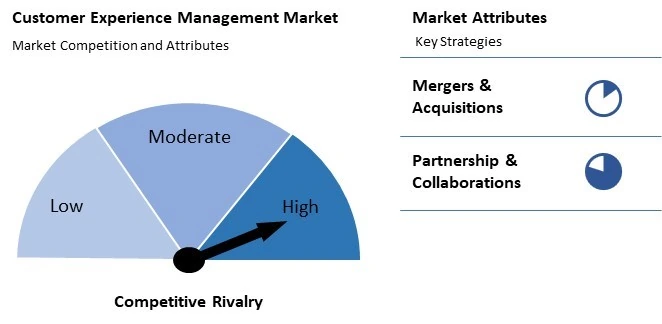
The Customer Experience Management market is highly competitive, because of fast-paced digital transformation and the growing need for personalized, omnichannel engagement. Companies compete by coming up with new ways to use analytics, artificial intelligence, and cloud-based solutions to make interactions with customers better. Real-time insights, integration capabilities, and scalability are the main things that set companies apart. As the digital ecosystem changes, companies work together strategically and come up with new ideas all the time to try to improve customer loyalty and value based on experience.
| Report Attribute | Details |
|---|---|
| Market size value in 2025 | USD 14.92 Billion |
| Market size forecast in 2032 | USD 38.48 Billion |
| Base Year | 2024 |
| Historical period | 2021 to 2023 |
| Forecast Period | 2025 to 2032 |
| Revenue Growth Rate | CAGR of 14.5% from 2025 to 2032 |
| Number of Pages | 605 |
| Tables | 527 |
| Report Coverage | Market Trends, Revenue Estimation and Forecast, Segmentation Analysis, Regional and Country Breakdown, Competitive Landscape, Market Share Analysis, Porter’s 5 Forces Analysis, Company Profiling, Companies Strategic Developments, SWOT Analysis, Winning Imperatives |
| Segments Covered | Enterprise Size, Deployment, Component, Touchpoint, Region |
| Country Scope |
|
| Companies Included | Adobe, Inc., Salesforce, Inc., IBM Corporation, Nokia Corporation, Microsoft Corporation, Oracle Corporation, SAP SE, SAS Institute Inc., Tech Mahindra Limited, and Zendesk, Inc. |
By Enterprise Size
By Deployment
By Component
By Touchpoint
By Geography
Valued at USD 14.92 billion in 2025, it's set to reach USD 38.48 billion by 2032, growing at 14.5% CAGR during the forecast period (2025-2032).
Large Enterprises segment captured maximum revenue, achieving a market value of $26.5 billion by 2032.
Adobe, Inc., Salesforce, Inc., and IBM Corporation hold the dominant positions in this space.
North America leads at $14.7 billion by 2032; Europe grows at 14.3% CAGR during 2025-2032.
Cloud segment experiences 14.6% CAGR during the forecast period due to scalable solution needs.
Solution segment led maximum revenue, reaching $25.7 billion by 2032 from comprehensive platform demand.
Our team of dedicated experts can provide you with attractive expansion opportunities for your business.








 Unique Offerings