The sample copy of this report is available for access.
“Global Bus Dispatch Management System Market to reach a market value of USD 1120.41 Million by 2033 growing at a CAGR of 10.3%”
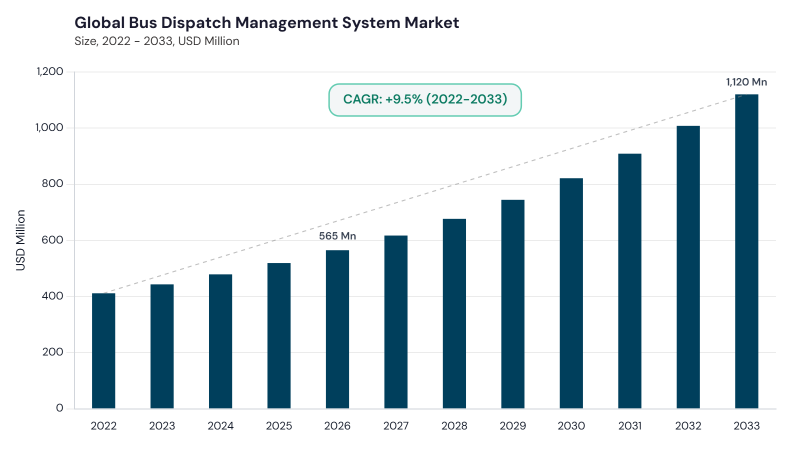
The Global Bus Dispatch Management System Market is expected to reach USD 1.1 Billion by 2033, growing at a CAGR of 10.3% during (2026 – 2033).
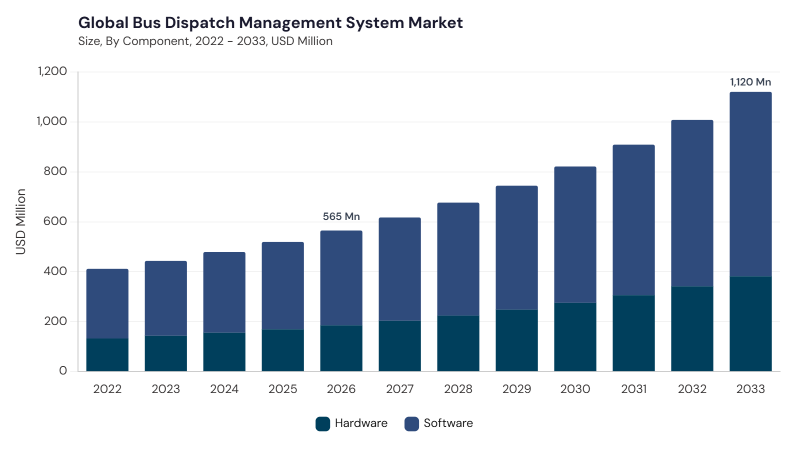
The Bus Dispatch Management System Market is expanding as transport operators focus on improving fleet scheduling, route efficiency, passenger safety, driver allocation, and real-time operational control. Rising urbanization, smart mobility initiatives, public transport modernization, and GPS-based fleet management are increasing demand for automated dispatching, route optimization, vehicle tracking, and passenger communication platforms. The market started with manual scheduling, radio communication, and basic fleet assignment tools. Over time, it evolved into computer-based dispatch systems, GPS tracking, and Automatic Vehicle Location systems, scheduling software, and centralized control platforms.
The Bus Dispatch Management System Market is witnessing strong expansion as transport operators increasingly move from manual dispatching toward integrated digital platforms that support real-time control, automated scheduling, vehicle tracking, route optimization, and driver-dispatcher communication. These systems help reduce delays, improve fleet utilization, lower fuel consumption, strengthen passenger service reliability, and support operational transparency. The market is further supported by growing public transport investments, smart city programs, expanding school and shuttle transportation networks, and rising demand for cloud-based platforms that can manage complex fleets across multiple routes and locations.
The Bus Dispatch Management System Market is characterized by a moderately consolidated and transit technology-driven competitive environment consisting of public transportation software providers, intelligent transportation system vendors, fleet management companies, and mobility technology platforms. Competition is centered on CAD/AVL capabilities, scheduling accuracy, AI-based optimization, cloud deployment, passenger information integration, real-time analytics, electric fleet management, and interoperability with existing transit systems. Global vendors compete through broad transit management suites and long-term agency relationships, while specialized players compete through modular software, localized deployment, and advanced optimization capabilities.
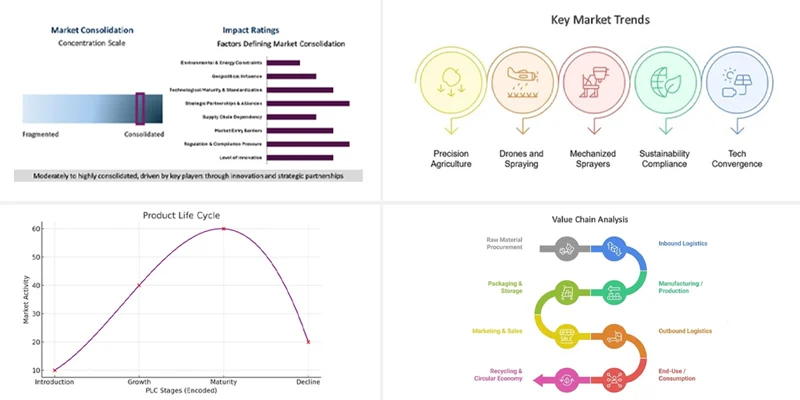

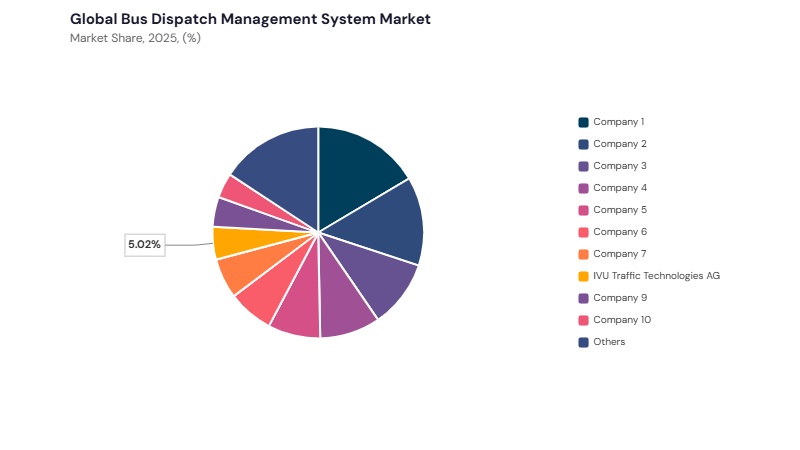
The global Bus Dispatch Management System Market is moderately consolidated, with competition led by specialized transit software vendors, CAD/AVL providers, intelligent transportation system companies, and fleet management solution providers. Trapeze Group (Modaxo Inc.) leads the market due to its comprehensive dispatch, scheduling, route planning, passenger information, and transit operations software portfolio. INIT GmbH, GIRO Inc., Clever Devices Ltd., and Optibus Ltd. also hold strong positions through advanced public transport management, AI-enabled scheduling, dispatch optimization, and real-time fleet monitoring capabilities. Other key players such as Hitachi Rail, Siemens Mobility, IVU Traffic Technologies, GMV, and Cubic strengthen the market through integrated mobility platforms, fleet control, and intelligent transportation solutions. Future competition is expected to depend on AI-driven dispatching, cloud-native platforms, predictive analytics, multimodal integration, electric fleet support, and real-time operational intelligence.
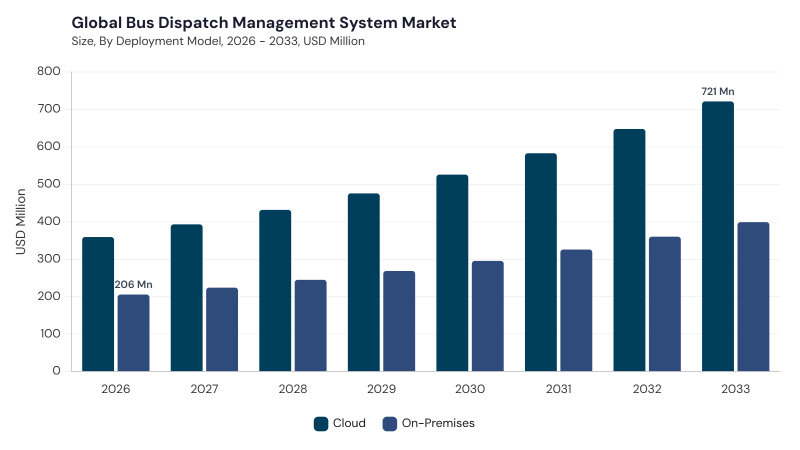
Based on Deployment Model, the market is segmented into Cloud and On-Premises. The Cloud market dominated the Global Bus Dispatch Management System Market by Deployment Model in 2025, and would continue to be a dominant market till 2033; thereby, achieving a market value of USD 721.4 Million by 2033, growing at a CAGR of 10.5 % during the forecast period. The On-Premises market is expected to witness a CAGR of 9.9% during (2026 - 2033).
Cloud deployment dominates the market as transport operators increasingly prefer scalable, remotely accessible, and cost-efficient platforms for managing distributed bus fleets. Cloud-based dispatch systems enable real-time vehicle monitoring, centralized dashboards, automatic software updates, faster deployment, and easier integration with AI, GPS, IoT, and passenger information systems. On-Premises deployment remains important for transit agencies and operators that require direct control over dispatch data, stronger internal security, local customization, and integration with legacy systems. This model continues to serve organizations with strict data governance requirements or limited reliance on external cloud infrastructure.
Based on Component, the market is segmented into Software and Hardware. The Software market dominated the Global Bus Dispatch Management System Market by Component in 2025, and would continue to be a dominant market till 2033; thereby, achieving a market value of USD 738.6 Million by 2033, growing at a CAGR of 10 % during the forecast period. The Hardware market is expected to witness a CAGR of 10.9% during (2026 - 2033).
Software forms the core of the Bus Dispatch Management System Market by enabling route planning, automated dispatching, driver scheduling, real-time fleet tracking, passenger information, performance analytics, and operational control. These platforms help transport operators reduce manual workload, improve schedule adherence, respond quickly to disruptions, and enhance fleet utilization. Hardware remains essential as GPS devices, onboard communication systems, driver terminals, sensors, telematics units, and control room equipment provide the data and connectivity needed for reliable dispatch operations. Together, software and hardware create an integrated dispatch ecosystem that supports efficient, safe, and data-driven bus operations.
Based on Propulsion Type, the market is segmented into ICE and Electric. The ICE market dominated the Global Bus Dispatch Management System Market by Propulsion Type in 2025, and would continue to be a dominant market till 2033; thereby, achieving a market value of USD 689.1 Million by 2033, growing at a CAGR of 9.8 % during the forecast period. The Electric market is expected to witness a CAGR of 11% during (2026 - 2033).
ICE buses continue to dominate the market due to the large existing base of diesel and conventional bus fleets operating across public, school, private, shuttle, and intercity transportation networks. Dispatch systems for ICE fleets focus on route efficiency, fuel consumption management, maintenance scheduling, driver monitoring, and service reliability. Electric buses are witnessing strong adoption as cities and transit agencies move toward low-emission and sustainable transportation. Electric fleet dispatch requires advanced capabilities such as battery status monitoring, charging schedule coordination, energy consumption tracking, and route planning based on range and charging infrastructure availability.
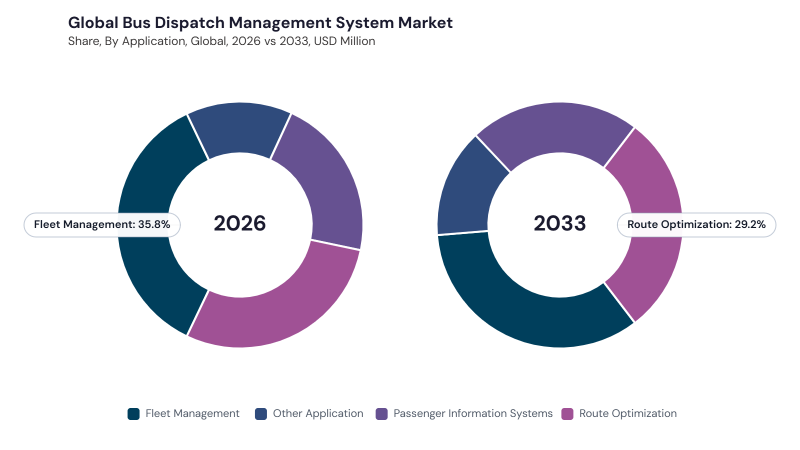
Based on Application, the market is segmented into Fleet Management, Route Optimization, Passenger Information Systems, and Other Application. The Fleet Management market dominated the Global Bus Dispatch Management System Market by Application in 2025, and would continue to be a dominant market till 2033; thereby, achieving a market value of USD 382.0 Million by 2033, growing at a CAGR of 9.5 % during the forecast period. The Route Optimization market is expected to witness a CAGR of 10.5% during (2026 - 2033). Additionally, The Passenger Information Systems market is expected to witness highest CAGR of 11% during (2026 - 2033).
Fleet Management leads the market as operators rely on dispatch systems for real-time vehicle tracking, driver allocation, maintenance planning, utilization monitoring, and operational efficiency. Route Optimization is gaining strong demand as transport providers use AI, GPS, and traffic data to reduce travel time, minimize fuel consumption, and improve punctuality. Passenger Information Systems are becoming increasingly important as riders expect real-time arrival updates, service alerts, mobile notifications, and digital display information. Other applications include reporting, depot coordination, driver scheduling, safety monitoring, and performance management functions that improve overall transit operations.
Free Valuable Insights: Bus Dispatch Management System Market Size to reach $1.1 Billion by 2033
Region-wise, the Bus Dispatch Management System Market is analyzed across North America, Europe, Asia Pacific, and LAMEA. The North America market dominated the Global Bus Dispatch Management System Market by Region in 2025, and would continue to be a dominant market till 2033; thereby, achieving a market value of USD 392.1 Million by 2033, growing at a CAGR of 9.7 % during the forecast period. The Europe market is expected to witness a CAGR of 9.9% during (2026 - 2033). Additionally, The Asia Pacific market is expected to witness a CAGR of 10.9% during (2026 - 2033).
North America dominates the market due to advanced public transportation infrastructure, high adoption of intelligent fleet management systems, smart transit investments, and strong demand for real-time passenger information. Europe is supported by smart mobility initiatives, public transport digitalization, emission reduction policies, and increasing electric bus deployment. Asia Pacific is witnessing strong demand due to rapid urbanization, expanding public transportation networks, rising smart city projects, and growing investments in fleet modernization. LAMEA is gradually expanding as public transport systems modernize across Latin America, the Middle East, and Africa, supported by fleet management adoption, digital transit initiatives, and rising demand for efficient bus operations.
| Report Attribute | Details |
|---|---|
| Market size value in 2026 | USD 565.1 Million |
| Market size forecast in 2033 | USD 1.1 Billion |
| Base Year | 2025 |
| Historical Period | 2022 to 2024 |
| Forecast Period | 2026 to 2033 |
| Revenue Growth Rate | CAGR of 10.3% from 2026 to 2033 |
| Number of Pages | 569 |
| Tables | 660 |
| Report Coverage | Market Trends, Revenue Estimation and Forecast, Segmentation Analysis, Regional and Country Breakdown, Competitive Landscape, Market Share Analysis, Company Profiling, Companies Strategic Developments, SWOT Analysis, Product Life Cycle Analysis, Value Chain Analysis, Market Consolidation Analysis, Key Customer Criteria, Pandemic Impact Analysis, and Winning Imperatives |
| Segments Covered | Deployment Model, Component, Propulsion Type, Application, Region |
| Country Scope |
|
| Companies Included | Trapeze Group (Modaxo Inc.), INIT GmbH, GIRO Inc., Clever Devices Ltd., Optibus Ltd., Hitachi Rail Limited, Siemens Mobility GmbH, IVU Traffic Technologies AG, GMV Innovating Solutions S.L., and Cubic Transportation Systems, Inc. |
By Deployment Model
By Component
By Propulsion Type
By Application
By Geography
Expected to reach USD 1.1 billion by 2033, growing at 10.3% CAGR during 2026-2033.
Growing at 10.3% CAGR during the forecast period (2026-2033).
Trapeze Group, INIT GmbH, GIRO Inc., Clever Devices Ltd., and Optibus Ltd. are key players.
Enhanced operational efficiency through real-time fleet monitoring and AI integration boosts market growth.
AI integration enhances operational efficiency, a key growth driver for the market.
Automated dispatch and workforce management solutions mitigate labor shortages, driving market growth.
Our team of dedicated experts can provide you with attractive expansion opportunities for your business.








 Unique Offerings