The sample copy of this report is available for access.
The Asia Pacific Bus Dispatch Management System Market is expected to reach USD 224.7 Million by 2030, growing at a CAGR of 10.9% during (2026 – 2033).
The Asia Pacific Bus Dispatch Management System Market has evolved from manual route coordination and basic scheduling into an intelligent transit operations ecosystem. In the early stage, bus operators mainly relied on paper-based schedules, dispatcher judgment, driver communication, and fixed route planning to manage daily fleet movement. As cities expanded and passenger demand increased, traditional methods became insufficient for handling congestion, route delays, fleet utilization, and service reliability. The adoption of GPS tracking, mobile connectivity, onboard communication tools, and computerized scheduling systems gradually shifted dispatching toward real-time monitoring and centralized control. The market further advanced with cloud-based platforms, AI-enabled route optimization, IoT-based vehicle monitoring, mobile driver interfaces, and passenger information systems.
The current market is shaped by rapid urbanization, smart city investments, public transport digitalization, electric and hybrid bus adoption, mobile connectivity, and increasing demand for passenger-centric mobility services. Transit agencies and private operators are increasingly seeking systems that can improve real-time fleet visibility, reduce delays, manage growing passenger volumes, support driver communication, and enable adaptive route planning in congested urban corridors. Demand is also rising for cloud-based dispatch platforms, AI-driven predictive analytics, 5G-enabled communication, IoT telemetry, battery monitoring, charging schedule integration, and multilingual passenger information systems.
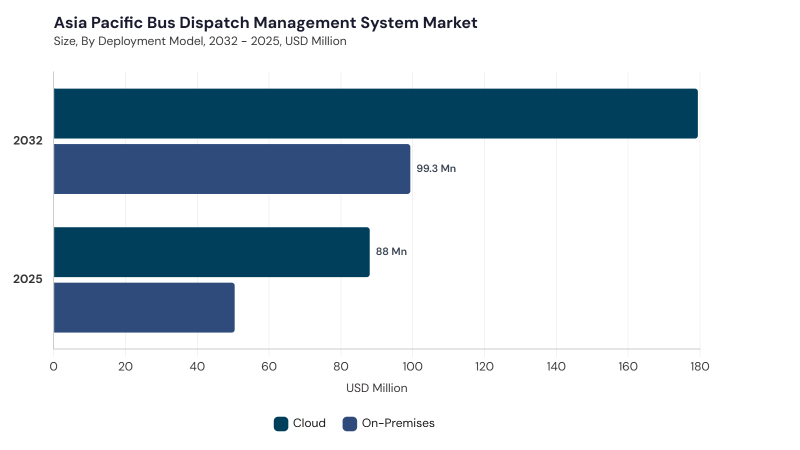
Based on Deployment Model, the market is segmented into Cloud and On-Premises. The Cloud market dominated the Asia Pacific Bus Dispatch Management System Market by Deployment Model in 2025, and would continue to be a dominant market till 2033; thereby, achieving a market value of USD 144.1 Million by 2030, growing at a CAGR of 11.1 % during the forecast period. The On-Premises market is expected to witness a CAGR of 10.5% during (2026 - 2033).
Cloud deployment leads the market as transit operators increasingly prefer scalable, cost-efficient, and remotely accessible platforms for managing bus fleets across multiple routes and locations. Cloud-based dispatch systems allow operators to monitor vehicles, adjust schedules, manage driver communication, access analytics, and update services without heavy dependence on internal IT infrastructure. This model is particularly useful for rapidly growing cities, mid-sized operators, and agencies adopting digital transport solutions under smart city programs. Cloud systems also support integration with mobile apps, passenger information platforms, IoT devices, ticketing systems, and AI-based optimization tools. On-Premises deployment remains important for large transport authorities and government-run operators that require strong control over critical operational data, legacy infrastructure, cybersecurity policies, and localized system performance. In markets with data localization rules, connectivity limitations, or strict internal IT policies, on-premises systems continue to support secure and customized dispatch operations.
Based on Component, the market is segmented into Software and Hardware. The Software market dominated the Asia Pacific Bus Dispatch Management System Market by Component in 2025, and would continue to be a dominant market till 2033; thereby, achieving a market value of USD 149.7 Million by 2030, growing at a CAGR of 10.6 % during the forecast period. The Hardware market is expected to witness a CAGR of 11.5% during (2026 - 2033).
Software holds the leading position as operators require advanced platforms for automated dispatching, route scheduling, real-time fleet tracking, driver communication, passenger information, analytics, reporting, and predictive maintenance. These solutions help transit agencies reduce delays, optimize fleet allocation, improve passenger service, and respond quickly to route disruptions. Software demand is strengthened by AI-based scheduling, cloud dashboards, mobile interfaces, electric fleet modules, and integration with smart city transportation networks. Hardware remains important because dispatch platforms depend on GPS devices, onboard computers, communication modules, driver terminals, digital displays, sensors, cameras, and vehicle monitoring equipment to collect and transmit real-time operational data. As fleets become more connected and digitally managed, coordination between software and hardware is becoming critical for accurate dispatching, passenger communication, vehicle diagnostics, and operational control.
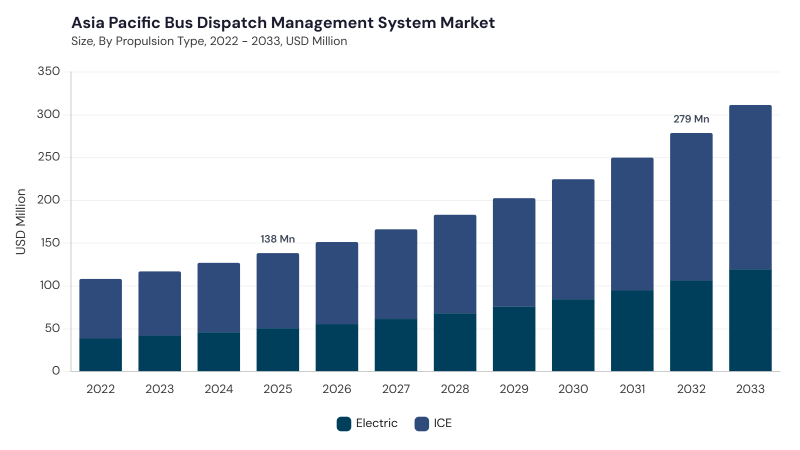
Based on Propulsion Type, the market is segmented into ICE and Electric. ICE buses continue to dominate the market due to the large operational base of diesel, CNG, and conventional buses across developing and developed Asia Pacific countries. Dispatch systems for ICE buses focus on route efficiency, fuel consumption monitoring, driver behavior tracking, maintenance scheduling, emissions control support, and vehicle availability management. These systems help operators improve fleet performance while gradually modernizing legacy bus operations.
The Electric segment is gaining strong momentum as countries in the region invest in zero-emission public transport, battery-electric buses, hybrid fleets, and cleaner urban mobility. Electric bus dispatch systems require additional capabilities such as battery state-of-charge monitoring, energy consumption tracking, route planning based on range, depot charging coordination, and charging infrastructure integration. As mixed fleets become more common, dispatch platforms are evolving to manage both ICE and electric buses within a unified operating environment.
Based on Application, the market is segmented into Fleet Management, Route Optimization, Passenger Information Systems, and Other Application. Fleet Management leads the market because operators need real-time visibility into vehicle location, fleet availability, driver activity, maintenance status, fuel or energy use, and service performance. These systems help reduce downtime, improve dispatch accuracy, strengthen safety monitoring, and maximize fleet utilization across dense and expanding transit networks. Route Optimization is a strong segment as growing urban congestion, fluctuating passenger demand, fuel cost pressure, and sustainability targets increase the need for intelligent routing. AI-enabled route optimization supports dynamic route adjustment, demand forecasting, traffic-aware scheduling, and efficient vehicle allocation.
Passenger Information Systems are gaining importance as commuters expect real-time arrival updates, mobile alerts, delay notifications, digital stop displays, and journey-planning support. Other Application includes emergency response coordination, driver safety monitoring, compliance reporting, workforce scheduling, incident alerts, mission-critical communication, and specialized tools for school, public, and private bus operations.
Free Valuable Insights: The Global Bus Dispatch Management System Market will hit USD 1.1 Billion billion by 2033, at a CAGR of 10.3%
Based on Country, the market is segmented into China, Japan, India, South Korea, Singapore, Malaysia, and Rest of Asia Pacific. The China market dominated the Asia Pacific Bus Dispatch Management System Market by Country in 2025, and would continue to be a dominant market till 2033; thereby, achieving a market value of USD 68.2 Million by 2030, growing at a CAGR of 9.1 % during the forecast period. The Japan market is expected to witness a CAGR of 10.1% during (2026 - 2033). Additionally, The India market is expected to witness a CAGR of 11.7% during (2026 - 2033).
China remains the leading country market due to its large public transport network, rapid urbanization, smart city initiatives, electric bus deployment, and strong adoption of AI-enabled route optimization and cloud-based dispatch systems. Japan contributes through mature transit infrastructure, high service reliability expectations, advanced GPS tracking, safety monitoring, predictive analytics, and localized intelligent transport solutions. India is gaining momentum due to expanding urban mobility needs, public transport modernization, GPS-based fleet tracking, IoT-enabled telemetry, AI-driven dispatch platforms, and demand for cost-effective systems suited to large and diverse bus networks. South Korea supports market growth through smart city investments, connected vehicle technologies, AI-based dispatching, sustainability programs, and integration of electric and hybrid bus operations. Singapore represents an advanced market driven by intelligent transportation systems, real-time passenger information, multimodal integration, electric fleet planning, and high commuter service expectations. Malaysia is developing through public transport modernization, route optimization, real-time communication platforms, ITS adoption, and demand for localized dispatch systems.

By Deployment Model
By Component
By Propulsion Type
By Application
By Country
Set to reach USD 224.7 Million by 2033, growing at 10.9% CAGR during 2026-2033.
China leads with USD 68.2 Million by 2030, growing at 9.1% CAGR during the forecast period.
Cloud deployment model dominates, reaching USD 144.1 Million by 2030 at 11.1% CAGR during 2026-2033.
Software segment reaches USD 149.7 Million by 2030, growing at 10.6% CAGR during 2026-2033.
India is expected to witness a CAGR of 11.7% during 2026-2033.
Hardware segment is expected to witness a CAGR of 11.5% during 2026-2033.
Our team of dedicated experts can provide you with attractive expansion opportunities for your business.




 Unique Offerings