“Global Beauty Tech Market to reach a market value of 234.97 Billion by 2032 growing at a CAGR of 17.5%”
The Global Beauty Tech Market size is estimated at $76.03 billion in 2025 and is expected to reach $234.97 billion by 2032, rising at a market growth of 17.5% CAGR during the forecast period (2025-2032). The strong projected growth of the Global Beauty Tech Market is driven by increasing consumer demand for personalized beauty solutions, rising adoption of AI and AR in skincare and cosmetics, expanding e-commerce platforms, and growing investments by beauty brands in digital tools, smart devices, and virtual try-on technologies.
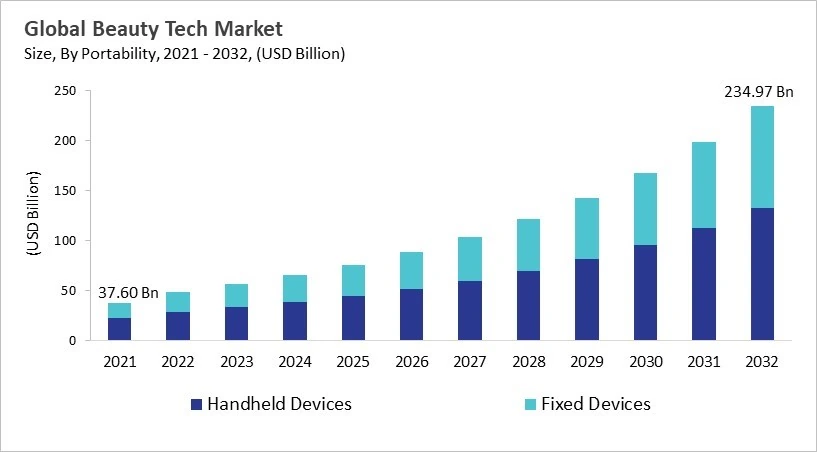
The beauty tech market has developed from basic digital integrations to a highly sophisticated, technology-driven ecosystem. Early advancements were propelled by social media and mobile technology, which resulted in innovations such as AI-based skin diagnostics, AR try-ons, and personalized product recommendations. The market transformed from being product-focused to experience-driven, high-resolution imaging, leveraging machine learning, seamless omnichannel experiences, and data analytics to deliver tailored beauty solutions. Key factors supporting the beauty tech market include widespread adoption of AR in e-commerce, AI-powered personalization, and rising emphasis on transparency and sustainability through technologies such as blockchain for supply chain tracking.
The competitive landscape in the beauty tech market is defined by strong innovation-led competition between regional players and global brands, with differentiation focused on user experience, personalization capabilities, and advanced technologies. Companies are emphasizing growth through strategic partnerships and investments in evolving technologies like AR, AI, and machine learning. Accelerated digital adoption, at-home beauty solutions, and virtual consultations are some of the elements supporting the market expansion. The ecosystem consists of service operators, technology providers, and end-users, forming a competitive market landscape defined by a strong focus on consumer-centric solutions, continuous innovations, and growing partnerships.

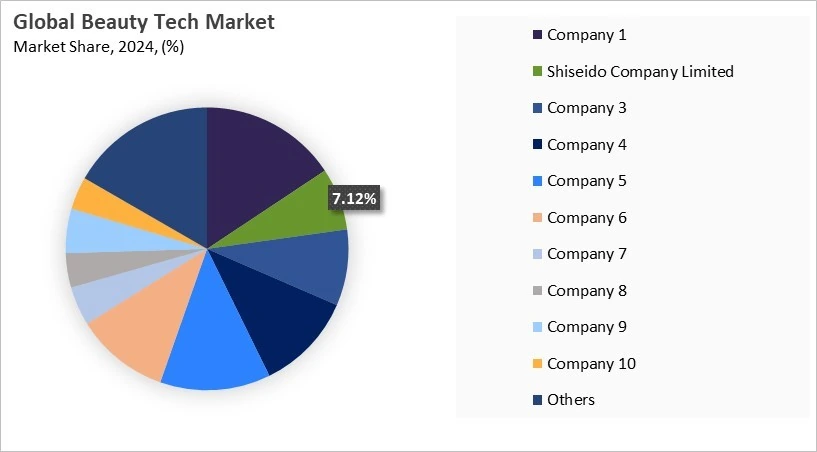
The leading players in the market are competing with diverse innovative offerings to remain competitive in the market. The above illustration shows the percentage of revenue shared by some of the leading companies in the market. The leading players of the market are adopting various strategies to cater demand coming from the different industries. The key developmental strategies in the market are Acquisitions, and Partnerships & Collaborations.
The COVID-19 pandemic hurt the beauty tech market because lockdowns forced salons, stores, and clinics to close, which made people spend less money on things they didn't need. Limited access to beauty services made people less interested in beauty tech devices, which hurt overall sales. At the same time, problems in the global supply chain led to shortages of raw materials, production delays, and higher operating costs. Uncertainty in the economy made people even less confident and less able to spend money, especially in developing areas. This led to more spending on basic goods. This made it less likely that people would buy high-end beauty gadgets like smart skincare devices. Companies also had to deal with money problems that made them less likely to invest in research and development. Because of this, innovation slowed down, which delayed the release of new products and hurt overall market growth during the pandemic. Thus, the COVID-19 pandemic had a negative impact on the market.
Based on portability, the beauty tech market is characterized into handheld devices, and fixed devices. The fixed devices segment attained 42% revenue share in the beauty tech market in 2024. The fixed devices segment plays an important role in the global beauty tech market, particularly in professional and clinical environments. These devices are typically larger, more powerful, and designed for specialized treatments that require precision and consistency.
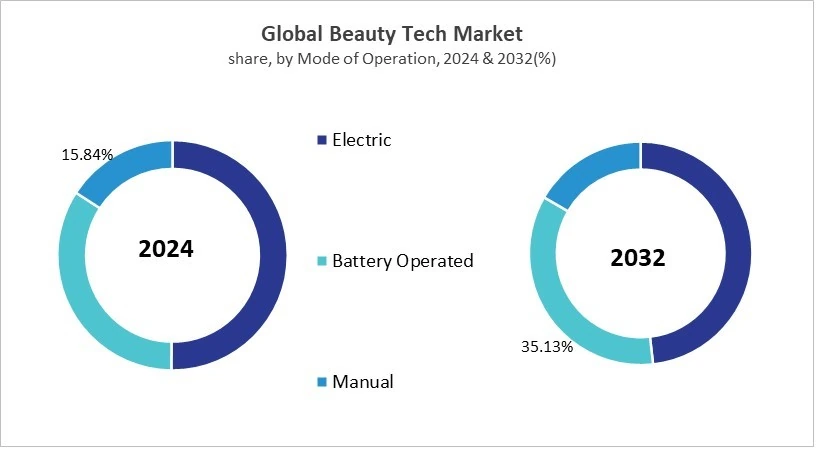
On the basis of mode of operation, the beauty tech market is classified into electric, battery operated, and manual. The battery-operated segment recorded 34% revenue share in the beauty tech market in 2024. The battery-operated segment represents a key category within the global beauty tech market, supported by its portability and convenience. These devices offer flexibility for users who prefer cordless operation, making them suitable for travel and everyday use.
Free Valuable Insights: Beauty Tech Market Size to reach $234.97 by 2032
Region-wise, the beauty tech market is analyzed across North America, Europe, Asia Pacific, and LAMEA. The North America segment recorded 37% revenue share in the beauty tech market in 2024. In the North America and Europe region, the beauty tech market is estimated to grow at a significant rate. This is because of strong consumer awareness, high technological maturity, and early adoption of advanced solutions like AR-based virtual try-on, AI-driven skin diagnostics, and personalized skincare devices. North America’s market is witnessing innovations because of the presence of major beauty brands and technology companies investing largely in R&D, and a well-established e-commerce ecosystem. Furthermore, Europe beauty tech market is predicted to witness a prominent share in the forecast period. The market is driven by demand for transparent and sustainable beauty solutions, with stringent regulatory frameworks encouraging the adoption of ethical and clean technologies. Consumers in these regions emphasize personalized experiences, which has surged the integration of omnichannel strategies combining digital tools with in-store services.
The beauty tech market is anticipated to grow at a steady pace in the Asia Pacific and LAMEA region. The market is driven by expanding middle-class populations, rising digital penetration, and increasing beauty consciousness. Regional nations, including South Korea, Japan, China, and India, are where tech-savvy consumers embrace smart skincare devices, mobile-based beauty applications, and social commerce platforms. Additionally, the LAMEA beauty tech market is also expected to showcase lucrative market opportunities. This is due to expanding internet access and a demographic eager to experiment with digital beauty solutions. Also, these regions offer growth opportunities supported by rising digital engagement and expanding consumer bases.
| Report Attribute | Details |
|---|---|
| Market size value in 2025 | USD 76.03 Billion |
| Market size forecast in 2032 | USD 234.97 Billion |
| Base Year | 2024 |
| Historical period | 2021 to 2023 |
| Forecast Period | 2025 to 2032 |
| Revenue Growth Rate | CAGR of 17.5% from 2025 to 2032 |
| Number of Pages | 682 |
| Tables | 575 |
| Report Coverage | Market Trends, Revenue Estimation and Forecast, Segmentation Analysis, Regional and Country Breakdown, Competitive Landscape, Porter’s 5 Forces Analysis, Company Profiling, Companies Strategic Developments, SWOT Analysis, Winning Imperatives |
| Segments Covered | Portability, Mode of Operation, Distribution Channel, Application, Type, Region |
| Country Scope |
|
| Companies Included | L'Oréal S.A., Shiseido Company Limited, LVMH SE, The Procter & Gamble Company, The Estee Lauder Companies, Inc., Unilever PLC, Amorepacific Corporation, Johnson & Johnson, Koninklijke Philips N.V. and Panasonic Holdings Corporation |
By Portability
By Mode of Operation
By Distribution Channel
By Application
By Type
By Geography
Valued at USD 76.03 billion in 2025, reaching USD 234.97 billion by 2032 at 17.5% CAGR during 2025-2032.
Hair Removal Devices segment leads, growing at 16.6% CAGR during the forecast period.
L'Oréal S.A., Shiseido Company Limited, LVMV SE, The Procter & Gamble Company, and The Estee Lauder Companies dominate.
North America dominates, reaching $82.93 billion by 2032. Europe grows at 17% CAGR during 2025-2032.
Growing consumer demand for personalized solutions, AI/ML integration, and rising emphasis on sustainability drive expansion.
Salon/Clinics segment captures 44% revenue share, reaching $98,536.6 million by 2032.
Our team of dedicated experts can provide you with attractive expansion opportunities for your business.








 Unique Offerings