The sample copy of this report is available for access.
The Asia Pacific Two-Wheeler GPS Tracker Market is expected to reach USD 327.9 million by 2030, growing at a CAGR of 11.3% during (2026 - 2033).
The Asia Pacific Two-Wheeler GPS Tracker Market evolved from basic vehicle-location tracking used for fleet management, theft prevention, and rider safety toward advanced GPS-enabled telematics platforms supporting diverse two-wheeler applications. Early deployment was limited by high device costs and low digital infrastructure penetration, while later advances in GPS module miniaturization, cellular communication, battery efficiency, IoT connectivity, and cloud analytics expanded adoption across metropolitan and emerging markets. The market has shifted from simple location monitoring toward real-time tracking, geofencing, theft alerts, driver behavior monitoring, route optimization, and mobile-app-based visibility. Growing two-wheeler ownership, urbanization, delivery activity, smart transportation initiatives, and regional customization are strengthening tracker adoption across Asia Pacific.
IoT-enabled tracking, electric two-wheeler adoption, regulatory safety initiatives, and AI-driven analytics are shaping current market development. Users increasingly require real-time vehicle visibility, tamper alerts, geofencing, theft-response support, battery monitoring, predictive maintenance, app-based control, and fleet-management integration. Delivery operators, shared mobility providers, and commercial fleets are adopting trackers to improve rider coordination, asset utilization, route planning, and operational accountability, while individual consumers prioritize theft prevention and vehicle recovery. Advances in 4G LTE, low-power IoT, compact electronics, AI analytics, telematics platforms, and cloud-based data services are enhancing product value. However, high cost sensitivity, fragmented regulations, data privacy concerns, rural connectivity gaps, infrastructure limitations, and device power constraints continue to influence adoption.
Based on Sales Channel, the market is segmented into Aftermarket and OEM. The Aftermarket market dominated the Asia Pacific Two-Wheeler GPS Tracker Market by Sales Channel in 2025, and would continue to be a dominant market till 2033; thereby, achieving a market value of USD 220.3 million by 2030, growing at a CAGR of 11.1 % during the forecast period. The OEM market is expected to witness a CAGR of 11.8% during (2026 - 2033).
Aftermarket solutions support existing two-wheeler owners seeking theft deterrence, vehicle recovery, trip visibility, insurance-related security benefits, and fleet monitoring without purchasing new vehicles. Availability through electronics retailers, workshops, accessory channels, and e-commerce platforms strengthens adoption across developed and emerging economies. OEM adoption remains promising as manufacturers introduce embedded connectivity, location services, app-based vehicle management, and connected two-wheeler features into newer models. Expansion of connected motorcycle platforms, electric mobility ecosystems, and factory-integrated telematics is creating stronger opportunities for OEM-based tracking solutions with improved compatibility, warranty support, and seamless user experience.
Based on Product Type, the market is segmented into Hardwired, Portable/Battery-Powered, and Plug-and-Play. The Hardwired market dominated the Asia Pacific Two-Wheeler GPS Tracker Market by Product Type in 2025, and would continue to be a dominant market till 2033; thereby, achieving a market value of USD 183.7 million by 2030, growing at a CAGR of 10.8 % during the forecast period. The Portable/Battery-Powered market is expected to witness a CAGR of 11.8% during (2026 - 2033). Additionally, the Plug-and-Play market is expected to witness highest CAGR of 12.2% during (2026 - 2033).
Hardwired trackers are preferred where permanent installation, stable power access, tamper resistance, and continuous tracking are required for theft prevention, fleet operations, route management, and vehicle diagnostics. Portable/Battery-Powered devices appeal to users seeking removable, flexible, and independently powered trackers that require minimal vehicle modification and can be transferred across different two-wheelers. Plug-and-Play trackers provide a practical balance between ease of installation and powered operation, supporting quick deployment for consumers, small businesses, and fleet users. Improvements in sensor affordability, compact hardware, battery life, mobile connectivity, and user-friendly interfaces are increasing practicality across all product formats.
Based on Connectivity, the market is segmented into 4G LTE, 2G/3G, and Low-Power IoT & Other. The 4G LTE market dominated the Asia Pacific Two-Wheeler GPS Tracker Market by Connectivity in 2025, and would continue to be a dominant market till 2033; thereby, achieving a market value of USD 159.4 million by 2030, growing at a CAGR of 10.8 % during the forecast period. The 2G/3G market is expected to witness a CAGR of 11.7% during (2026 - 2033). Additionally, The Low-Power IoT & Other market is expected to witness highest CAGR of 12.3% during (2026 - 2033).
4G LTE supports real-time tracking, low-latency alerts, smartphone integration, geofencing, cloud connectivity, emergency notifications, and richer telematics functions, especially in urban and commercially active markets. 2G/3G continues to hold relevance in cost-sensitive and infrastructure-limited areas where legacy devices support basic location tracking, SMS alerts, theft recovery, and simple monitoring. Low-Power IoT & Other connectivity, including NB-IoT, LoRaWAN, Sigfox, and related low-power options, is gaining interest for compact, battery-sensitive, and long-duration tracking use cases. These technologies support lower power consumption, extended device life, periodic tracking, and emerging smart-city applications where continuous high-bandwidth transmission is not essential.
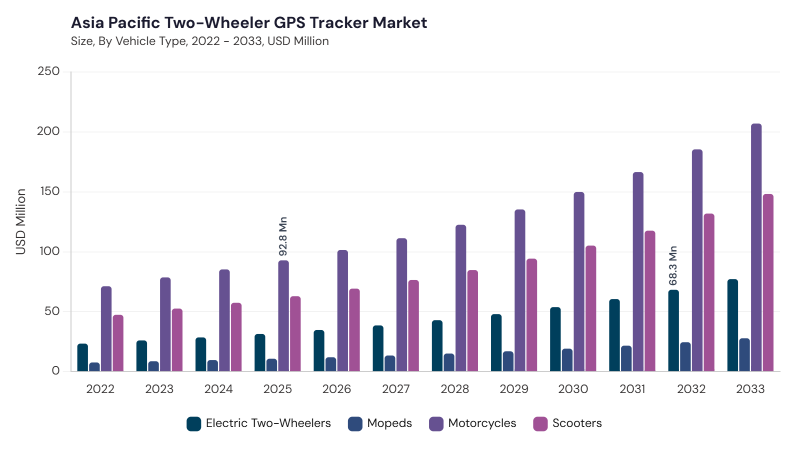
Based on Vehicle Type, the market is segmented into Motorcycles, Scooters, Electric Two-Wheelers, and Mopeds. Motorcycles require reliable GPS tracking for theft prevention, route optimization, fleet use, tamper alerts, speed monitoring, and long-distance mobility support across urban and rural environments. Scooters represent a significant segment due to short-distance commuting, delivery usage, younger rider adoption, and demand for compact, affordable, and app-integrated tracking solutions.
Electric Two-Wheelers are gaining importance as GPS trackers increasingly support battery status, charging cycles, energy consumption, remote diagnostics, fleet utilization, and predictive maintenance. Mopeds maintain a promising role in economical short-range travel and semi-urban mobility, where simple, low-cost, and easy-to-install trackers support basic vehicle security and location visibility.
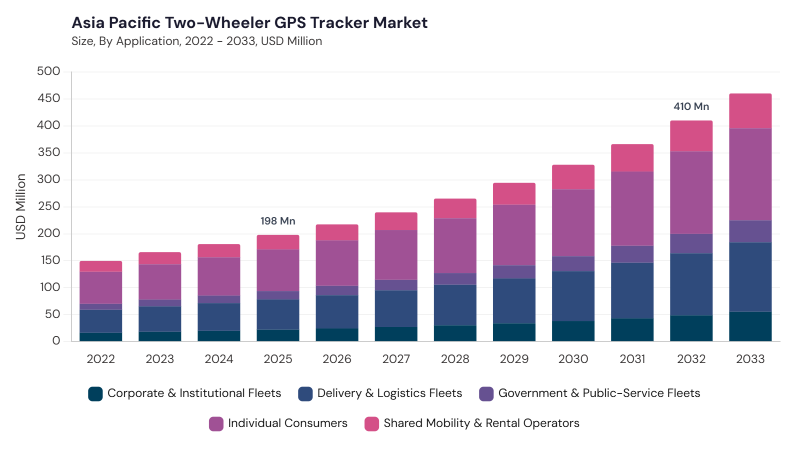
Based on Application, the market is segmented into Individual Consumers, Delivery & Logistics Fleets, Shared Mobility & Rental Operators, Corporate & Institutional Fleets, and Government & Public-Service Fleets. Individual Consumers use GPS trackers for personal vehicle security, geofencing, real-time location access, theft alerts, emergency assistance, and mobile-app-based monitoring. Delivery & Logistics Fleets require route optimization, rider coordination, parcel and food delivery visibility, driver behavior monitoring, and scalable fleet-management integration.
Shared Mobility & Rental Operators rely on trackers for geofencing, asset availability, remote immobilization, user activity tracking, theft control, and fleet utilization analysis. Corporate & Institutional Fleets use GPS tracking for employee mobility, asset monitoring, route compliance, and operational accountability, while Government & Public-Service Fleets apply connected tracking for public safety, inspections, enforcement support, emergency response, and municipal service operations.
Free Valuable Insights: Two-Wheeler GPS Tracker Market is Predicted to reach USD 967.6 Million billion by 2033, at a CAGR of 10.8%
Based on Country, the market is segmented into China, Japan, India, South Korea, Singapore, Malaysia, and Rest of Asia Pacific. The India market dominated the Asia Pacific Two-Wheeler GPS Tracker Market by Country in 2025, and would continue to be a dominant market till 2033; thereby, achieving a market value of USD 109.0 million by 2030, growing at a CAGR of 11.7 % during the forecast period. The South Korea market is expected to witness a CAGR of 14.1% during (2026 - 2033). Additionally, The Australia market is expected to witness a CAGR of 13.8% during (2026 - 2033).
Across Asia Pacific, two-wheeler GPS tracker adoption reflects differences in two-wheeler ownership, smart-city development, digital infrastructure, regulatory emphasis, theft concerns, and electric mobility adoption. China emphasizes BeiDou integration, IoT platforms, smart mobility systems, energy-efficient trackers, electric two-wheeler monitoring, and localized navigation capabilities, while Japan focuses on intelligent transportation, AI analytics, multi-sensor fusion, battery-health tracking, anti-theft features, and secure data handling. India prioritizes affordable IoT-enabled trackers, mobile-app integration, shared mobility, anti-theft compliance, route optimization, and expansion into tier 2 and tier 3 cities, whereas South Korea emphasizes 5G connectivity, real-time telematics, multifunctional IoT devices, smart-city integration, and localized geofencing. Singapore focuses on connected fleet management, delivery mobility, secure cloud connectivity, geofencing, app-based monitoring, and smart-city readiness, while Malaysia emphasizes hybrid GPS-Wi-Fi tracking, anti-theft functions, IoT-based fleet management, smart transportation, and localized service networks. Rest of Asia Pacific continues to advance 4G and emerging 5G connectivity, AI-enabled tracking, affordable consumer devices, mobile integration, geofencing, emergency alerts, and localized solutions for urban and semi-urban mobility.

By Sales Channel
By Product Type
By Connectivity
By Vehicle Type
By Application
By Country
Set to reach $327.9 Million by 2030, growing at 11.3% CAGR during 2026-2033.
India leads with $109.0 million by 2030, growing at 11.7% CAGR during the forecast period.
The dominance of the aftermarket segment, reaching $220.3 million by 2030, is a key growth driver.
The hardwired segment will reach $183.7 million by 2030, growing at a 10.8% CAGR during the forecast period.
The South Korea market is expected to witness a CAGR of 14.1% during 2026-2033.
The Low-Power IoT & Other segment is expected to witness the highest CAGR of 12.3% during 2026-2033.
Our team of dedicated experts can provide you with attractive expansion opportunities for your business.




 Unique Offerings
