The sample copy of this report is available for access.
The Asia Pacific Autonomous Telecom Networks Market is expected to reach USD 6,453.3 million by 2030, growing at a CAGR of 20.5% during the forecast period (2026-2033).
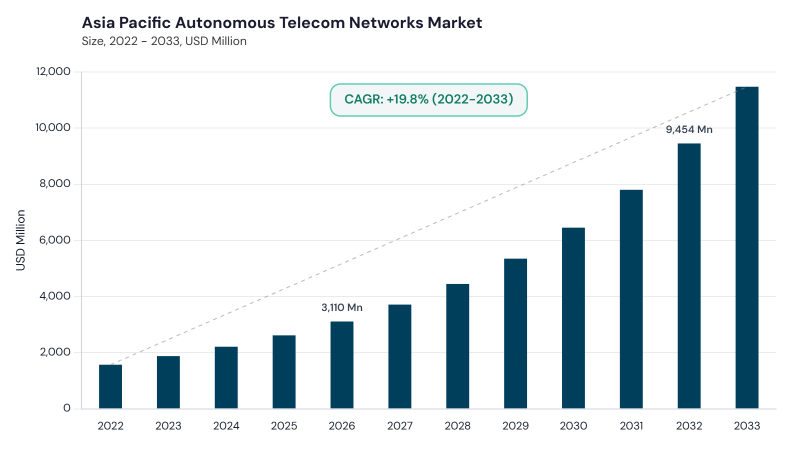
The Asia Pacific Autonomous Telecom Networks Market is witnessing rapid growth owing to increasing deployment of AI-driven network automation, expansion of 5G infrastructure, and rising adoption of intelligent telecom management solutions across the region. Telecom operators are increasingly integrating autonomous capabilities into network operations to improve operational efficiency, reduce downtime, optimize bandwidth allocation, and support growing mobile data traffic generated by cloud computing, IoT devices, and digital services. The growing complexity of telecom infrastructure and increasing demand for self-optimizing and self-healing networks are further driving market expansion across Asia Pacific.
Furthermore, the integration of technologies such as software-defined networking (SDN), network function virtualization (NFV), edge computing, and cloud-native telecom architectures is transforming the telecom ecosystem throughout the region. Countries including China, Japan, India, and South Korea are investing heavily in advanced digital infrastructure and AI-enabled telecom solutions to support smart manufacturing, autonomous mobility, industrial IoT, and enterprise digital transformation initiatives. In addition, telecom providers are increasingly focusing on predictive maintenance, automated orchestration, and AI-powered analytics to improve service quality and operational agility, thereby supporting long-term market growth across Asia Pacific.
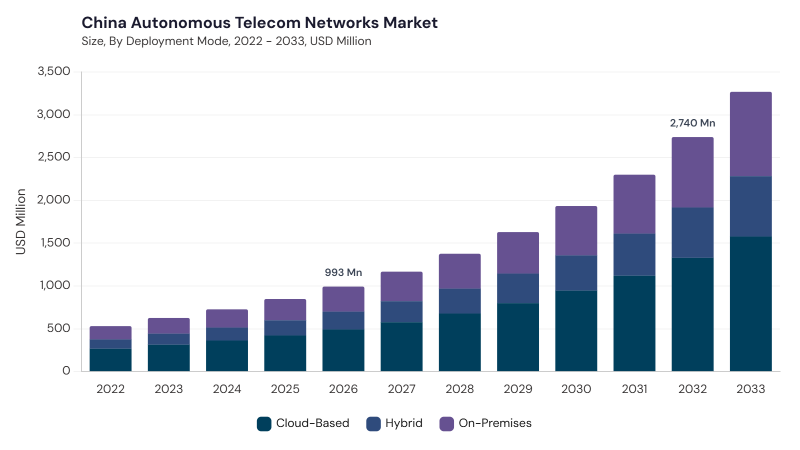
Based on Deployment Mode, the market is segmented into Cloud-Based, On-Premises, and Hybrid. The Cloud-Based segment dominated the Asia Pacific Autonomous Telecom Networks Market in 2025 and would remain dominant by 2030; thereby, achieving a market value of USD 3,172.0 million by 2030. The On-Premises segment is expected to witness a CAGR of 21.0% during the forecast period (2026-2033). Additionally, the Hybrid segment accounted for 20.0% share of the market in 2025 owing to increasing adoption of flexible telecom deployment models.
Based on Network Layer, the market is segmented into Radio Access Network, Core Network, End-to-End Network Orchestration, Transport Network, and Edge Network. The Radio Access Network segment acquired the largest revenue share in the Asia Pacific Autonomous Telecom Networks Market in 2025 and is projected to reach USD 2,289.7 million by 2030. The Edge Network segment is anticipated to register a CAGR of 21.3% during the forecast period (2026-2033). Moreover, the Transport Network segment held a considerable market presence in 2025 due to rising investments in high-capacity telecom infrastructure and bandwidth optimization technologies.
Based on Component, the market is segmented into Solutions and Services. The Solutions segment dominated the Asia Pacific Autonomous Telecom Networks Market in 2025 and would continue to lead the market through the forecast period, thereby reaching a market value of USD 4,029.9 million by 2030. Meanwhile, the Services segment is expected to witness a CAGR of 21.3% during (2026-2033) owing to increasing demand for integration, consulting, deployment, and managed automation services across telecom networks.
Based on End User, the market is segmented into Tier-1 Mobile Network Operators, Tier-2 & Tier-3 Mobile Network Operators, Private Network Owners, Mobile Virtual Network Operators, and Neutral Host Providers. The Tier-1 Mobile Network Operators segment accounted for the highest market share in 2025 owing to large-scale infrastructure investments and extensive subscriber bases across Asia Pacific telecom ecosystems. In addition, the Private Network Owners segment is witnessing increasing adoption due to rising deployment of industrial automation, enterprise private 5G, and smart manufacturing solutions. Furthermore, the Neutral Host Providers segment is expected to witness strong growth during the forecast period supported by increasing demand for shared telecom infrastructure in urban and high-density environments.
Free Valuable Insights: Autonomous Telecom Networks Market is Predicted to reach USD 37,171.8 Million billion by 2033, at a CAGR of 19.7%
China represented the leading market for autonomous telecom networks in Asia Pacific owing to strong investments in AI-powered telecom infrastructure, rapid 5G deployment, and large-scale digital transformation initiatives. The country continues to witness significant adoption of cloud-native networking platforms, intelligent orchestration systems, and automated telecom management solutions across enterprise and carrier environments. Moreover, the expansion of industrial IoT ecosystems, smart city projects, and connected mobility infrastructure is accelerating demand for autonomous telecom networks across China.
Additionally, telecom operators across Asia Pacific are increasingly emphasizing AI-driven operational analytics, self-healing networks, predictive maintenance, and automated resource optimization to improve service reliability and operational efficiency. The growing integration of machine learning, edge computing, and real-time automation technologies is enabling telecom companies to efficiently manage increasingly complex multi-cloud and multi-vendor telecom environments. These factors are expected to continue supporting the long-term expansion of the Asia Pacific Autonomous Telecom Networks Market during the forecast period.

By Deployment Mode
By Network Layer
By Component
By End User
By Country
Market will reach USD 6,453.3 million by 2030, growing at 20.5% CAGR during the forecast period.
Cloud-based deployment dominates the regional market among the three deployment options.
Market covers radio access network, core network, end-to-end orchestration, transport network, and edge computing layers.
Solutions segment leads over services in the regional autonomous telecom networks market.
Our team of dedicated experts can provide you with attractive expansion opportunities for your business.




 Unique Offerings