The Asia Pacific Automotive Intelligent Lighting System Market is expected to reach $2.57 billion by 2027and would witness market growth of 9.4% CAGR during the forecast period (2025-2032).
The China market dominated the Asia Pacific Automotive Intelligent Lighting System Market by Country in 2024, and would continue to be a dominant market till 2032; thereby, achieving a market value of $1,660.7 million by 2032. The Japan market is registering a CAGR of 8.5% during (2025 - 2032). Additionally, The India market would showcase a CAGR of 10.4% during (2025 - 2032). The China and Japan led the Asia Pacific Automotive Intelligent Lighting System Market by Country with a market share of 44.4% and 15.4% in 2024. The Malaysia market is expected to witness a CAGR of 12.5% during throughout the forecast period.
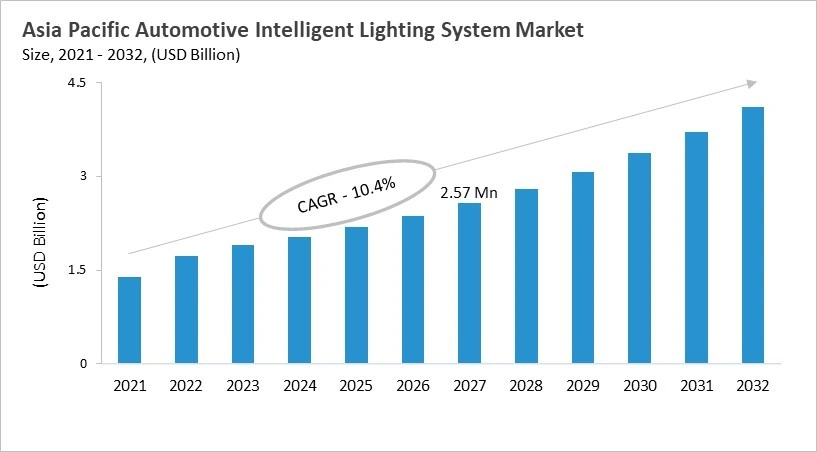
The Asia Pacific Automotive Intelligent Lighting System Market has evolved from basic halogen lighting to advanced LED and OLED technologies driven by safety, efficiency, and design demands. Intelligent lighting systems now feature adaptive brightness, dynamic signaling, and integration with driver assistance systems. Strong R&D investments and advancements in sensors and microcontrollers enable real-time lighting adjustments. Government regulations in countries like Japan, China, and South Korea promote energy-efficient and safety-focused lighting adoption. Additionally, smart manufacturing and digitalization have enabled cost-effective large-scale production. Collaborations between automakers, suppliers, and semiconductor firms further accelerate innovation. As a result, lighting systems are becoming essential for vehicle safety, connectivity, and modern design.
The market is highly competitive, with companies focusing on innovation, cost efficiency, and customization across vehicle segments. Key trends include integration with ADAS, vehicle-to-environment communication, and sustainability-driven developments using eco-friendly materials. Firms invest heavily in R&D, localized production, and strategic partnerships to strengthen market position. Expansion of product portfolios with software and electronic control units enhances system capabilities. Competition is intensified by strict regulations and evolving consumer expectations for advanced features. OEM collaborations provide a strong advantage in early-stage integration. Despite high entry barriers, continuous innovation is driving rapid technological advancement and market growth.
Based on Functionality, the market is segmented into Adaptive Lighting Control, Automatic High Beam (AHB), Weather-Adaptive Lighting, Vehicle-to-Environment Communication Lighting and Other Functionality. Among various South Korea Automotive Intelligent Lighting System Market by Functionality; The Adaptive Lighting Control market achieved a market size of USD $61.8 Million in 2024 and is expected to grow at a CAGR of 10.6 % during the forecast period. The Other Functionality market is predicted to experience a CAGR of 12.3% throughout the forecast period from (2025 - 2032).
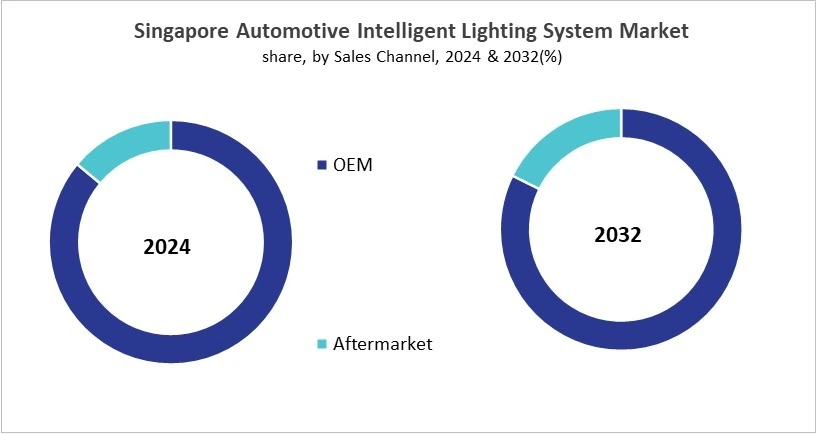
Based on Sales Channel, the market is segmented into OEM and Aftermarket. The report also covers geographical segmentation of Automotive Intelligent Lighting System market. The OEM market segment dominated the Singapore Automotive Intelligent Lighting System Market by Sales Channel is expected to grow at a CAGR of 11.9 % during the forecast period thereby continuing its dominance until 2032. Also, The Aftermarket market is anticipated to grow as a CAGR of 15.8 % during the forecast period during (2025 - 2032).
Free Valuable Insights: Automotive Intelligent Lighting System Market is Predicted to reach USD 14.84 billion by 2032, at a CAGR of 8.6%
China is the biggest market for making and selling cars in the Asia Pacific region, which is why smart lighting technologies are becoming so popular. The rapid growth of the industry, which is being driven by domestic demand and the rise of electric vehicles, has led to more interest in LED, adaptive, and smart lighting systems. Government rules, like CCC certification and GB standards, make sure that safety and quality are up to par. Policies that encourage energy efficiency and cutting down on emissions speed up the switch to LED lighting. A big trend is to connect with ADAS, sensors, and smart vehicle platforms. New technologies like matrix LED and pixel headlights make cars safer and better looking. A lot of competition between companies from other countries and companies in the same country leads to new ideas. China is still a major center for the development of advanced automotive lighting.

By Vehicle Type
By Lighting Type
By Lighting Position
By Functionality
By Sales Channel
By Country
Set to reach $2.57 billion by 2027 at 9.4% CAGR during 2025-2032.
China leads with 44.4% market share in 2024 and will reach $1,660.7 million by 2032.
Increasing vehicle electrification and advanced safety requirements across the region fuel market expansion.
Japan holds 15.4% regional market share and grows at 8.5% CAGR during 2025-2032.
India market expands at 10.4% CAGR during 2025-2032, among the fastest in the region.
Adaptive lighting control reached $61.8 million in 2024, growing at 10.6% CAGR during 2025-2032.
Our team of dedicated experts can provide you with attractive expansion opportunities for your business.




 Unique Offerings