The Asia Pacific Automotive Finance Market is expected to reach USD 138.9 billion by 2030, growing at a CAGR of 7.9% during (2026 – 2033).
The Asia Pacific Automotive Finance Market originated alongside the rapid expansion of the regional automotive sector, initially supported by dealership financing and basic loan products for a growing middle-class consumer base. Early financing activity relied strongly on conventional banks and limited financial product diversity. Over time, rising vehicle ownership, online loan processing, credit scoring algorithms, and the entry of non-traditional finance providers transformed the market. Government support for sustainable mobility and digital finance further accelerated the shift toward modern financing products.
The Asia Pacific Automotive Finance Market is being shaped by rapid urbanization, rising vehicle ownership, electric vehicle adoption, fintech innovation, digital lending platforms, and stronger collaboration between financial institutions and automotive manufacturers. Consumers and businesses are adopting automotive finance to improve vehicle affordability, access flexible repayment options, and support both new and used vehicle purchases. Demand is supported by passenger vehicles, commercial fleets, direct lending, dealership financing, loans, leasing, refinancing, and specialized finance products. Providers are focusing on AI-driven credit assessment, online approvals, mobile applications, green financing, bundled insurance, and maintenance-linked offers.
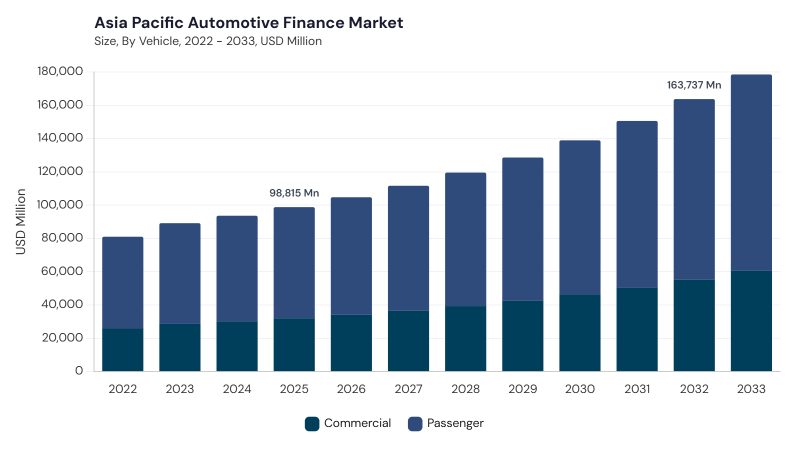
Based on Vehicle, the market is segmented into Passenger and Commercial. The Passenger market dominated the Asia Pacific Automotive Finance Market by Vehicle in 2025, and would continue to be a dominant market till 2033; thereby, achieving a market value of USD 92.6 billion by 2030, growing at a CAGR of 7.6 % during the forecast period. The Commercial market is expected to witness a CAGR of 8.5% during (2026 - 2033).
Passenger leads due to rapid urbanization, rising disposable incomes, increasing vehicle ownership, digital financing access, and government incentives supporting electric vehicle adoption across major economies. This segment benefits from strong demand for personal mobility, attractive repayment schemes, online loan applications, and expanding access to financing in both urban and rural markets. Commercial remains significant as logistics, e-commerce, construction, infrastructure, and fleet modernization activities continue to increase demand for vehicle financing. Financial institutions are offering customized commercial finance products that help businesses manage capital expenditure, improve fleet efficiency, and support operational expansion.
Based on Provider, the market is segmented into Banks, OEMs, and Other Provider. The Banks market dominated the Asia Pacific Automotive Finance Market by Provider in 2025, and would continue to be a dominant market till 2033; thereby, achieving a market value of USD 75.0 billion by 2030, growing at a CAGR of 7.5 % during the forecast period. The OEMs market is expected to witness a CAGR of 8.1% during (2026 - 2033).
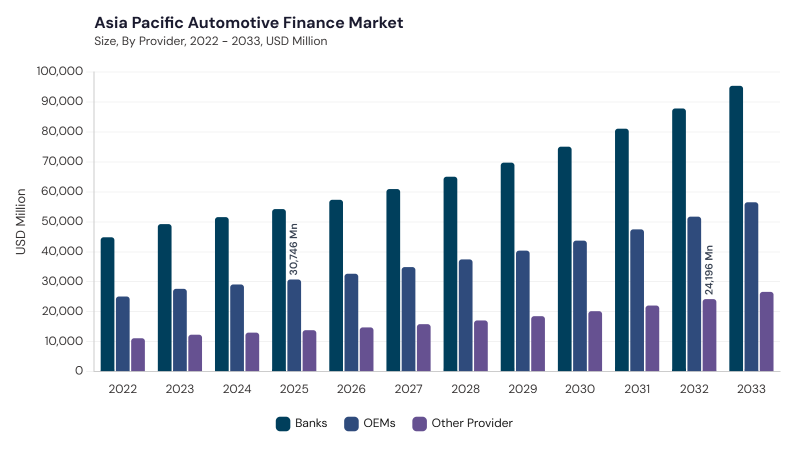
Banks lead due to extensive branch networks, diversified lending portfolios, competitive financing solutions, digital banking adoption, and AI-driven credit assessment capabilities. These providers support individual customers, commercial buyers, new vehicles, used vehicles, and fleet financing through structured credit products. OEMs remain significant as manufacturer-sponsored finance programs, captive finance arms, dealership partnerships, promotional schemes, and bundled ownership solutions strengthen vehicle purchases and brand loyalty. Other Provider includes non-banking financial companies, credit cooperatives, fintech lenders, leasing firms, and insurance-linked finance providers offering flexible approvals, customer-centric lending, and faster digital processing.
Based on Finance, the market is segmented into Direct and Indirect. The Direct market dominated the Asia Pacific Automotive Finance Market by Finance in 2025, and would continue to be a dominant market till 2033; thereby, achieving a market value of USD 72.9 billion by 2030, growing at a CAGR of 7.4 % during the forecast period. The Indirect market is expected to witness a CAGR of 8.5% during (2026 - 2033).
Direct leads as consumers increasingly obtain vehicle financing directly from banks, digital lenders, NBFCs, and financial institutions offering transparent loan structures, competitive interest rates, and faster approval processes. This channel benefits from online loan applications, mobile banking, instant credit evaluation, digital documentation, and improving credit scoring tools across the region. Indirect remains significant as dealership-arranged finance continues to provide convenience at the point of sale through multiple lending options and promotional finance offers. Strong cooperation between dealerships, OEM finance arms, and financial institutions supports integrated purchase experiences for both personal and commercial vehicle buyers.
Based on Purpose, the market is segmented into Loan, Leasing, and Other Purpose. Loan leads due to increasing consumer preference for vehicle ownership, wider access to affordable financing, customized repayment plans, and growing competition among banks, NBFCs, fintech lenders, and automotive finance companies. This segment supports both new and used vehicles while digital loan origination improves accessibility across urban and rural markets.
Leasing remains significant due to rising corporate fleet demand, flexible mobility preferences, regular vehicle upgrades, and lower upfront financial commitments. Other Purpose includes refinancing, balloon payment arrangements, hire purchase agreements, and specialized automotive finance products that support changing mobility needs and varied borrower profiles.
Free Valuable Insights: Automotive Finance Market is Predicted to reach USD 558.1 Billion billion by 2033, at a CAGR of 7.4%
Based on Country, the market is segmented into China, Japan, India, South Korea, Singapore, Malaysia, and Rest of Asia Pacific. The China market dominated the Asia Pacific Automotive Finance Market by Country in 2025, and would continue to be a dominant market till 2033; thereby, achieving a market value of USD 49.2 billion by 2030, growing at a CAGR of 6.4 % during the forecast period. The Japan market is expected to witness a CAGR of 7.2% during (2026 - 2033). Additionally, The India market is expected to witness a CAGR of 8.6% during (2026 - 2033).
China leads due to strong automotive demand, digital finance tools, online credit scoring, EV-focused finance products, regulatory-driven transparency, and expanding participation from banks, captive finance arms, and fintech lenders. Japan supports market growth through diversified financing, CASE-related mobility models, EV loans, leasing, subscription services, and strong integration between automakers and finance providers. India is advancing through NBFC participation, fintech-based loan origination, rural and semi-urban financing expansion, EV-focused credit products, and AI-enabled underwriting. South Korea, Singapore, and Malaysia add momentum through digital platforms, green financing, regulatory modernization, and captive finance activity, while Rest of Asia Pacific benefits from vehicle ownership growth, online approvals, EV financing, and localized finance products.

By Vehicle
By Provider
By Finance
By Purpose
By Country
Set to reach $138.9 Billion by 2030, growing at 7.9% CAGR during 2026-2033.
China leads with a market value of $49.2 billion by 2030, growing at a 6.4% CAGR during the forecast period.
The Passenger segment will dominate, reaching $92.6 billion by 2030 at a 7.6% CAGR during the forecast period.
Banks will achieve a market value of $75.0 billion by 2030, growing at a 7.5% CAGR during the forecast period.
The India market is expected to witness an 8.6% CAGR during 2026-2033.
The Commercial segment is expected to witness an 8.5% CAGR during 2026-2033.
Our team of dedicated experts can provide you with attractive expansion opportunities for your business.




 Unique Offerings