The sample copy of this report is available for access.
“Global 3D Animation Market to reach a market value of USD 66.1 Billion by 2033 growing at a CAGR of 12.1%”
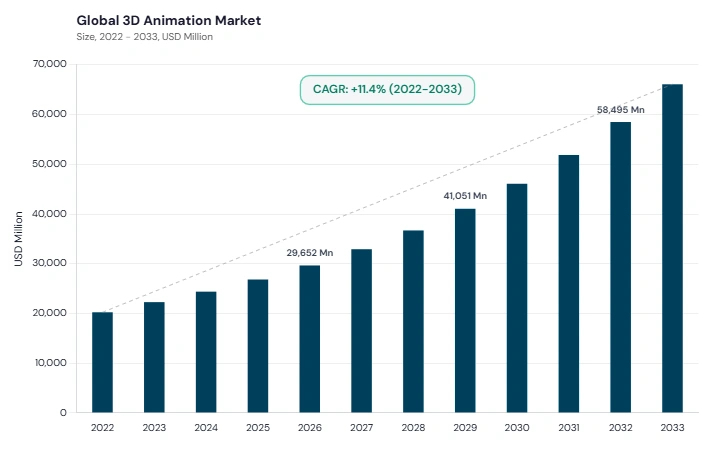
The Global 3D Animation Market size is expected to reach USD 66.1 billion by 2033, rising at a market growth of 12.1% CAGR during the forecast period.
Market expansion is being supported by wider use of 3D content across film, gaming, advertising, simulation, and education. Growing demand for immersive digital experiences is also strengthening adoption across enterprise and consumer-facing applications.
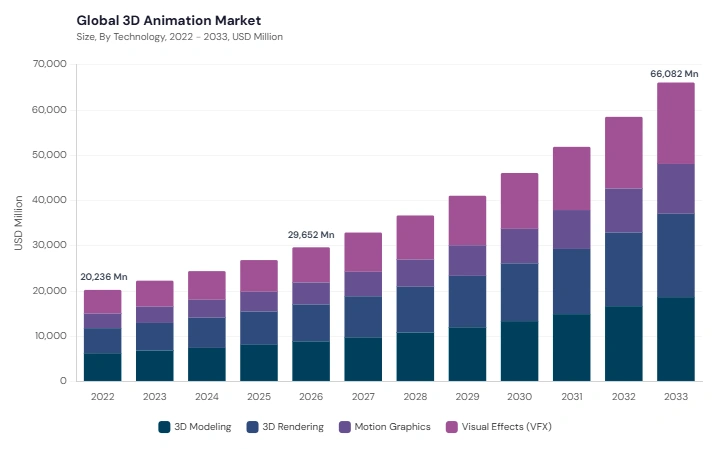
The 3D animation market has evolved from an early graphics-led niche into a mainstream digital content ecosystem. Advances in modeling software, rendering engines, and GPU performance gradually shifted production away from limited studio-only workflows and made high-quality animation more commercially viable across a broader range of industries.
Today, the market serves film, gaming, advertising, education, architecture, healthcare visualization, and simulation use cases. Its expansion is closely tied to rising demand for richer digital storytelling, realistic visual experiences, and scalable production pipelines that support both large studios and smaller creative teams.
Key market participants are strengthening their position through product innovation, AI-enabled workflow improvements, and deeper investment in proprietary animation tools. Partnerships with hardware vendors, software ecosystems, and distribution platforms are helping improve interoperability across production pipelines, while geographic expansion and localized content strategies are supporting broader audience reach and commercial scale.
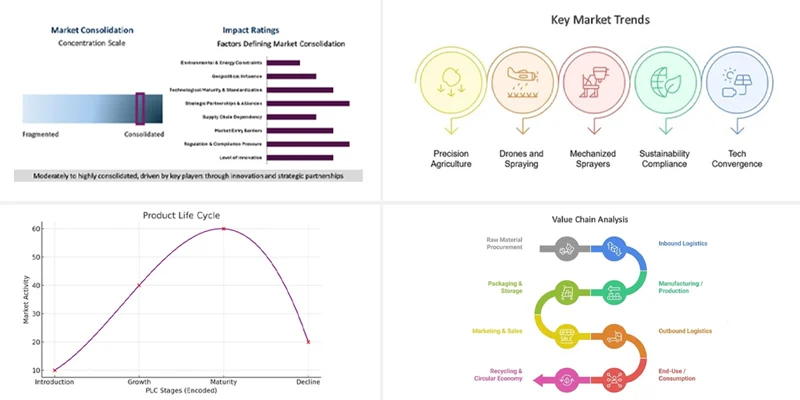

The global 3D animation market is moderately consolidated, with the top ten companies accounting for approximately 73.13% of total market share, while the remaining 26.87% is held by other players. Autodesk leads with about 14.32%, supported by the strong industry presence of Maya and 3ds Max, while Adobe follows through its integrated creative ecosystem and strong position in motion graphics and animation workflows.
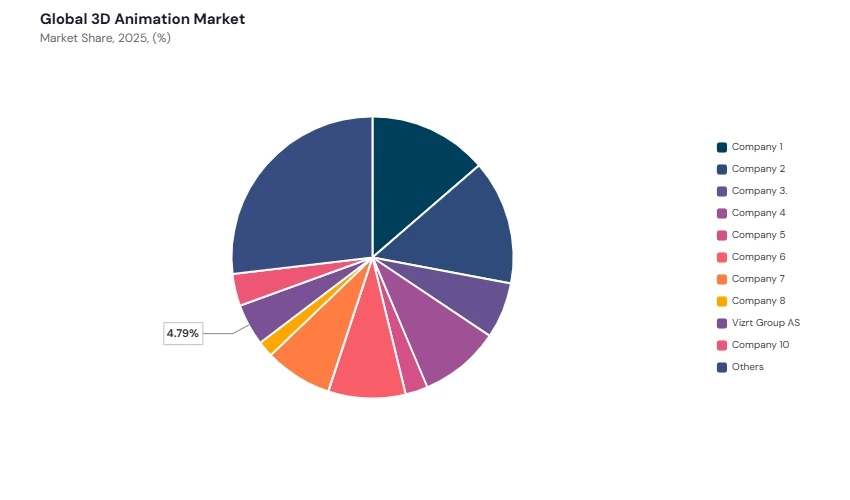
A second tier includes NVIDIA at 9.26%, Maxon, and Side Effects Software, reflecting the importance of GPU acceleration, cinematic production tools, and advanced VFX workflows. Mid-tier and niche participants such as Corel, Vizrt, DeepMotion, Zco Corporation, and Corus Entertainment continue to add competitive depth, especially in broadcasting, AI-driven animation, and specialized visualization. Future share shifts are likely to be influenced by real-time rendering, cloud collaboration, and AI-powered automation, which are broadening the market beyond traditional software-led competition.
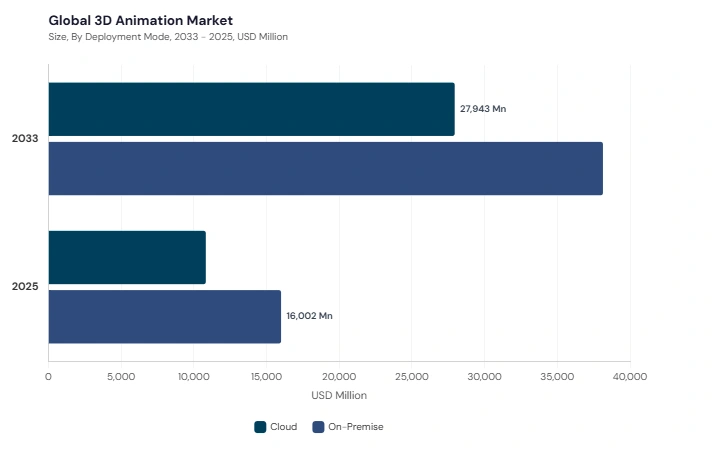
Deployment mode in the 3D animation market is segmented into on-premise and cloud. On-premise remained the leading segment, supported by large studios and enterprise users that require tighter control over rendering infrastructure, asset security, and production customization. These environments are especially important for complex animation workloads and long production cycles. At the same time, cloud deployment is expanding steadily as studios seek remote collaboration, flexible scaling, and lower upfront infrastructure costs. This mix is keeping on-premise in a leading position while making cloud a key growth avenue for more agile production models.
By component, the market is divided into solution and service. The solution segment leads because animation studios and enterprise users continue to invest directly in modeling, rendering, simulation, and production software that drives core content creation. Its position is reinforced by ongoing advances in GPU-backed performance, AI-enhanced workflows, and broader use across gaming, film, design, and simulation. The service segment is also gaining traction as companies increasingly rely on outsourcing, support, consulting, and training to manage workflow complexity and maintain production continuity. Over time, demand for specialized services should rise alongside the market’s growing technical sophistication.
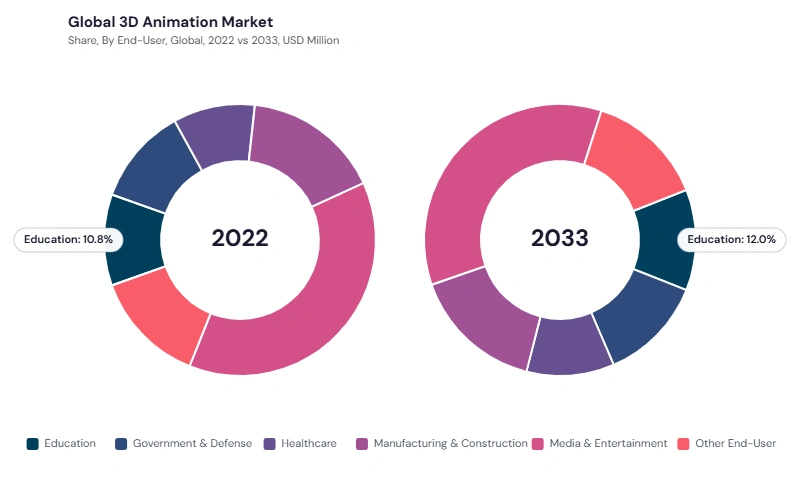
Based on end-use industry, the market includes media & entertainment, manufacturing & construction, government & defense, education, healthcare, and other end-user segments. Media & entertainment remains the leading segment as 3D animation continues to be central to film production, gaming, streaming, advertising, and branded visual storytelling. The market is also seeing faster momentum in industries using animation for simulation, visualization, and digital learning, particularly government & defense, education, and healthcare. As organizations place greater value on immersive and interactive communication, end-use demand is expected to become more diversified while entertainment retains its leadership.
Free Valuable Insights: 3D Animation Market Size to reach $66.1 Billion by 2033
Region-wise, the 3D Animation Market is analyzed across North America, Europe, Asia Pacific, and LAMEA. North America dominated the market in 2025 and was valued at USD 9,899.0 million, supported by strong adoption across film, gaming, advertising, and immersive media production. The region benefits from advanced graphics infrastructure, early use of AI-enabled animation tools, and mature studio ecosystems that continue to drive high-value content creation.
Europe remains an important market shaped by strong creative industries, region-specific storytelling demand, and growing use of real-time rendering and cloud-supported workflows. Asia Pacific is expected to witness strong momentum due to expanding digital media production, gaming growth, and increasing investment in animation talent and content platforms. LAMEA is also emerging steadily, supported by rising demand for culturally relevant animated content, broader access to digital tools, and growing use of animation in education, advertising, and virtual experiences.
The market is highly innovation-led, with competition centered on rendering performance, AI-assisted automation, workflow efficiency, and creative flexibility. Vendors are differentiating through proprietary engines, advanced modeling and simulation capabilities, and cloud-ready production environments that support faster turnaround and more scalable animation delivery.
Integration has become an important competitive factor as studios increasingly require seamless movement across modeling, rigging, rendering, and collaboration tools. Open standards, real-time engines, and cloud-connected production systems are improving interoperability, while pricing flexibility is helping vendors address both enterprise studios and smaller independent creators.
Partnerships continue to shape ecosystem positioning, especially where content production depends on GPUs, cloud infrastructure, and AI toolchains. Regional strategies also matter, as players adapt offerings to local content demand, language needs, and production economics in both mature and emerging markets.
| Report Attribute | Details |
|---|---|
| Market size value in 2026 | USD 29.6 Billion |
| Market size forecast in 2033 | USD 66.1 Billion |
| Base Year | 2025 |
| Historical period | 2022 to 2024 |
| Forecast Period | 2026 to 2033 |
| Revenue Growth Rate | CAGR of 12.1% from 2026 to 2033 |
| Number of Pages | 591 |
| Tables | 750 |
| Report Coverage | Market Trends, Revenue Estimation and Forecast, Segmentation Analysis, Regional and Country Breakdown, Competitive Landscape, Market Share Analysis, Value Chain Analysis, Product Life Cycle, Key Customer Criteria, Winning Imperatives |
| Segments Covered | Component, Deployment Mode, Technology, End-User, Region |
| Country Scope | North America (US, Canada, Mexico, Rest of North America); Europe (Germany, UK, France, Russia, Spain, Italy, Rest of Europe); Asia Pacific (China, Japan, India, South Korea, Singapore, Malaysia, Rest of Asia Pacific); LAMEA (Brazil, Argentina, UAE, Saudi Arabia, South Africa, Nigeria, Rest of LAMEA) |
| Companies Included | Autodesk, Inc.; Adobe, Inc.; NVIDIA Corporation; Maxon Computer GmbH; Side Effects Software; Corel; Vizrt; DeepMotion, Inc.; Zco Corporation; Corus Entertainment |
By Component
By Deployment Mode
By Technology
By End-User
By Geography
Valued at USD 29.6 billion in 2026, it will reach USD 66.1 billion by 2033. Growth rate stands at 12.1% CAGR during 2026-2033.
Solutions segment dominates, projected to achieve USD 33.31 billion by 2033.
Autodesk, Adobe, NVIDIA Corporation, Maxon Computer GmbH, and Side Effects Software hold dominant positions. Other major players include Corel, Vizrt, DeepMotion, Zco Corporation, and Corus Entertainment.
North America leads with USD 23.43 billion by 2033. Europe shows steady growth through creative industries and real-time rendering adoption.
AI integration in production, extended reality technologies adoption, and open universal scene description standardization fuel expansion.
Media & Entertainment leads the market, growing at 12.0% CAGR during the forecast period (2026-2033).
Our team of dedicated experts can provide you with attractive expansion opportunities for your business.








 Unique Offerings