The sample copy of this report is available for access.
“Global Surgical Simulation Market to reach a market value of USD 1,702.4 Million by 2033 growing at a CAGR of 16.2%”
The Global Surgical Simulation Market size is expected to reach USD 1,702.4 million by 2033, rising at a market growth of 16.2% CAGR during the forecast period.
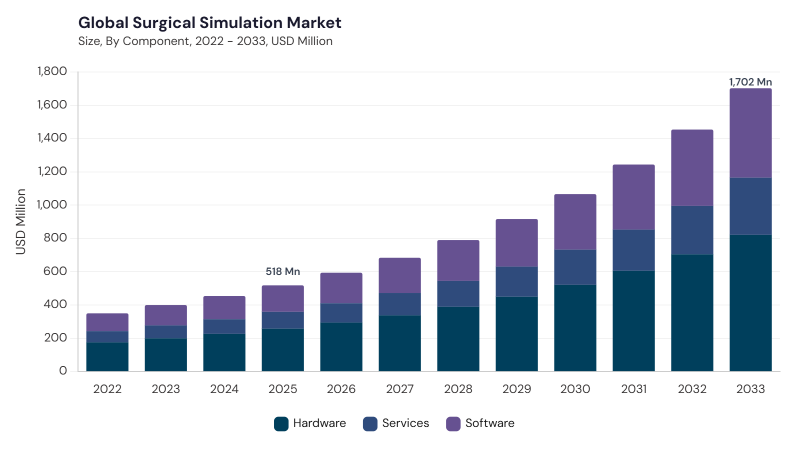
Growth in the market is driven by the increasing adoption of advanced virtual reality (VR), augmented reality (AR), artificial intelligence (AI), and haptic technologies across surgical training and medical education. Rising demand for minimally invasive procedures, growing emphasis on patient safety, and the need for competency-based surgical training are accelerating investments in simulation platforms globally. Furthermore, the integration of cloud-based systems, AI-driven predictive simulations, and digital operating room technologies is improving accessibility, realism, and scalability of surgical training solutions, thereby supporting long-term market expansion.
The Global Surgical Simulation Market has evolved significantly from traditional physical training models to highly immersive and data-driven digital simulation ecosystems. Early surgical training relied heavily on cadaveric learning and apprenticeship-based education; however, advancements in computing technologies, virtual reality, augmented reality, and 3D printing have transformed how surgeons develop and refine clinical skills.
Today, technologies such as artificial intelligence, cloud-based simulation platforms, robotic-assisted systems, and digital twins are at the center of the market’s expansion. Healthcare providers increasingly use simulation technologies to improve preoperative planning, reduce procedural errors, and standardize surgical education across institutions. Academic centers, hospitals, and training institutes are investing heavily in immersive training systems to meet rising competency requirements and support minimally invasive surgical techniques.
The major strategies followed by the market participants are Product Launches and Partnerships & Collaborations as key developmental strategies to keep pace with the changing demands of end users. For instance, in January 2026, Intuitive Surgical, Inc. reported strong adoption of its next-generation da Vinci 5 robotic system featuring enhanced force feedback and improved operational efficiency.

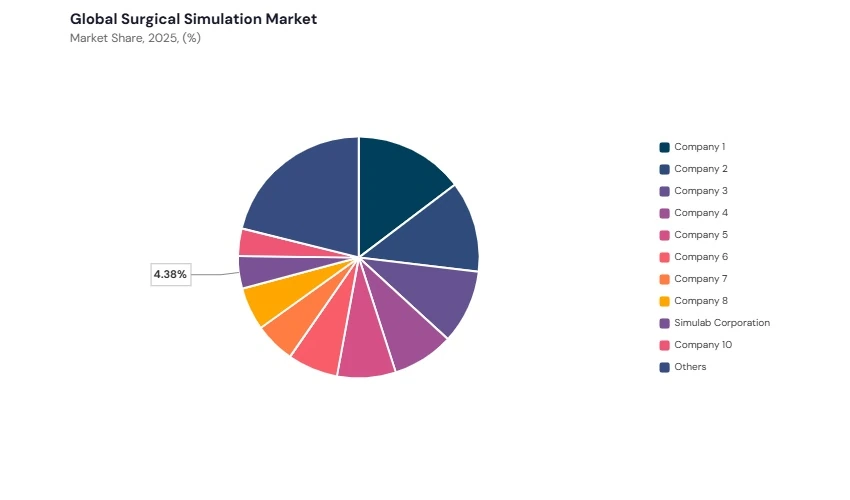
The leading players in the Surgical Simulation Market are competing through technologically advanced and immersive simulation solutions to strengthen their competitive positioning and expand their global presence. Companies including Surgical Science Sweden AB, Laerdal Medical, Mentice AB, 3D Systems, Inc., VirtaMed AG, Intuitive Surgical, and Elevate Healthcare are actively focusing on product innovation, strategic acquisitions, partnerships, and integration of AI, VR, AR, and robotic-assisted technologies to enhance simulation realism and clinical effectiveness. According to the market share analysis, Surgical Science Sweden AB emerged as the leading company in 2025, accounting for more than 14% share of the global market followed by Laerdal Medical and Mentice AB.
The market continues to witness strong competitive activity through collaborations with healthcare institutions, medical universities, and robotic surgery providers aimed at accelerating adoption of simulation-based surgical training. Furthermore, companies are increasingly investing in cloud-based platforms, subscription models, and patient-specific simulation technologies to improve accessibility, scalability, and long-term customer engagement across developed and emerging healthcare markets.
On the basis of component, the surgical simulation market is classified into hardware, software, and services. The Hardware segment recorded the highest revenue share in 2025, accounting for nearly 49.71% of the global market. The segment is expected to reach a market size of USD 821.4 million by 2033, growing at a CAGR of 15.8% during 2026-2033. This dominance is driven by increasing adoption of advanced surgical simulators, VR systems, AR devices, mannequins, and haptic-enabled training platforms across hospitals and academic institutions. Hardware-based solutions provide realistic tactile and procedural experiences that enhance psychomotor skills and surgical precision.
Based on technology, the surgical simulation market is segmented into Physical / 3D-Printed Models, Virtual Reality (VR) Simulation, Augmented Reality (AR) Simulation, Haptic Simulation, and Web-based / Cloud-based Simulation. Physical / 3D-Printed Models dominated the market in 2025 with a revenue share of 43.91% and are projected to achieve a market value of USD 714.5 million by 2033. Meanwhile, the Haptic Simulation segment is expected to witness the highest CAGR of 19.0% during 2026-2033 owing to increasing demand for realistic tactile feedback in precision-based surgical procedures. VR and AR simulations are also witnessing strong growth due to their immersive learning capabilities and expanding use in minimally invasive and robotic-assisted surgery training.
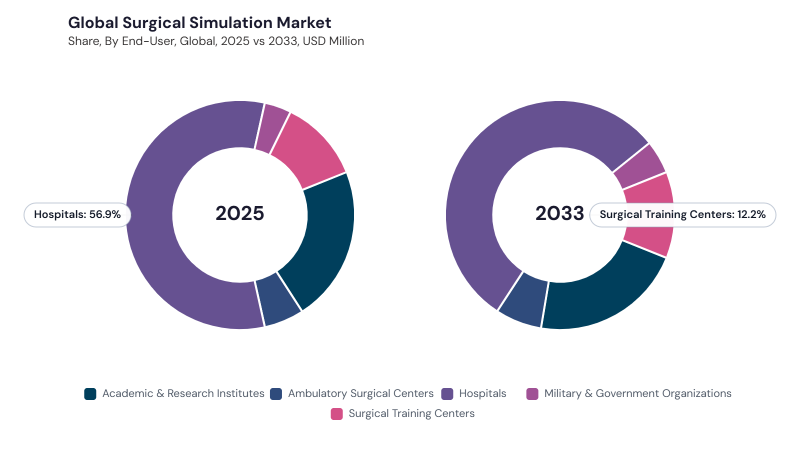
By end-user, the market is divided into Hospitals, Academic & Research Institutes, Surgical Training Centers, Ambulatory Surgical Centers, and Military & Government Organizations. Hospitals accounted for the largest market share in 2025 with 56.94% share and are expected to reach USD 936.4 million by 2033. Additionally, the Surgical Training Centers segment is projected to witness a CAGR of 16.9% during 2026-2033 due to increasing demand for specialized simulation-based surgical education and competency development programs.
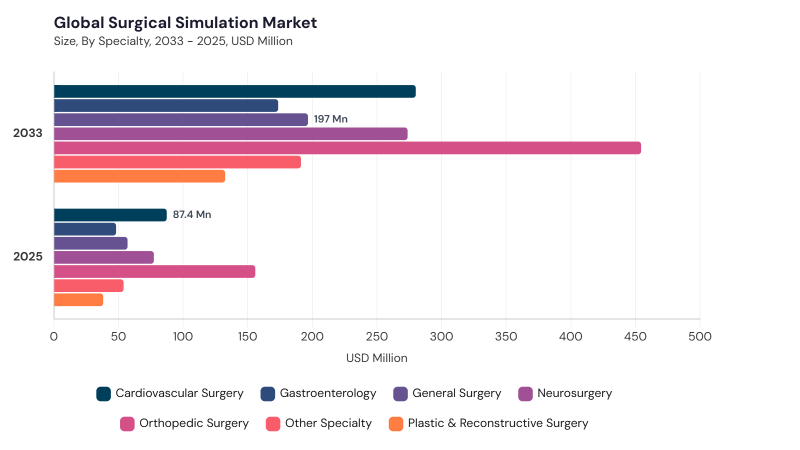
By specialty, the market is segmented into Orthopedic Surgery, Cardiovascular Surgery, Neurosurgery, General Surgery, Gastroenterology, Plastic & Reconstructive Surgery, and Other Specialty. Orthopedic Surgery dominated the market in 2025 with a revenue share of 30.09% and is projected to attain a market value of USD 454.4 million by 2033. Furthermore, the Neurosurgery segment is anticipated to witness one of the highest CAGR rates of 17.3% during 2026-2033 due to increasing adoption of advanced simulation tools for complex neurological procedures and minimally invasive surgeries.
Free Valuable Insights: Surgical Simulation Market Size to reach $1,702.4 Million by 2033
Region-wise, the Surgical Simulation Market is analyzed across North America, Europe, Asia Pacific, and LAMEA. North America recorded the highest revenue share in 2025 with 39.66% share owing to strong healthcare infrastructure, early adoption of advanced simulation technologies, and significant investments in surgical education and robotic-assisted procedures. The region is expected to maintain its dominance throughout the forecast period. Meanwhile, Asia Pacific is projected to witness the fastest CAGR across multiple segments, supported by rising healthcare investments, growing medical education initiatives, and increasing demand for skilled surgical professionals.
Europe remains a significant contributor due to increasing emphasis on patient safety, competency-based surgical training, and integration of advanced healthcare technologies. Asia Pacific is expected to witness the fastest growth during the forecast period, supported by expanding healthcare infrastructure, rising medical education investments, and increasing demand for skilled healthcare professionals. Meanwhile, LAMEA is gradually expanding due to improving healthcare systems and growing awareness regarding simulation-based medical training.
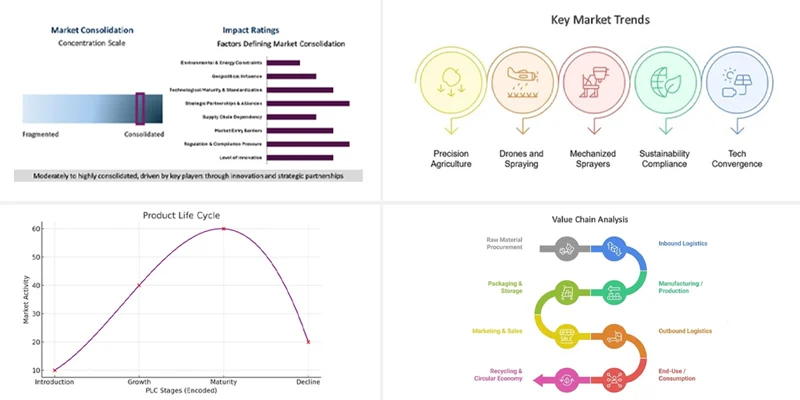
The Surgical Simulation Market is moderately consolidated and highly innovation-driven. Competition centers on the development of immersive, AI-powered, and anatomically accurate simulation platforms that improve surgical training efficiency and clinical outcomes. Vendors differentiate themselves through advanced haptic technologies, VR/AR integration, robotic surgery compatibility, and cloud-enabled learning systems.
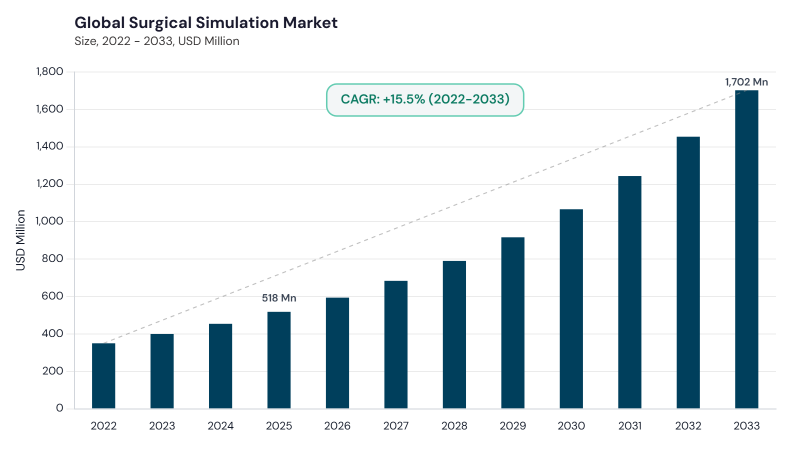
Strategic partnerships, mergers & acquisitions, and continuous product innovation remain key competitive strategies. Companies are increasingly investing in subscription-based models, digital ecosystems, and global training collaborations to improve market penetration and customer engagement.
| Report Attribute | Details |
|---|---|
| Market size value in 2026 | USD 594.08 Million |
| Market size forecast in 2033 | USD 1,702.4 Million |
| Base Year | 2025 |
| Historical period | 2022 to 2024 |
| Forecast Period | 2026 to 2033 |
| Revenue Growth Rate | CAGR of 16.2% from 2026 to 2033 |
| Number of Pages | 762 |
| Tables | 990 |
| Report Coverage | Market Trends, Revenue Estimation and Forecast, Segmentation Analysis, Regional and Country Breakdown, Competitive Landscape, Market Share Analysis, Porter’s 5 Forces Analysis, Company Profiling, Companies Strategic Developments, SWOT Analysis, Winning Imperatives |
| Segments Covered | Component, Technology, End-user, Specialty, Region |
| Country Scope | North America (US, Canada, Mexico, Rest of North America); Europe (Germany, UK, France, Russia, Spain, Italy, Rest of Europe); Asia Pacific (China, Japan, India, South Korea, Singapore, Malaysia, Rest of Asia Pacific); LAMEA (Brazil, Argentina, UAE, Saudi Arabia, South Africa, Nigeria, Rest of LAMEA) |
By Component
By Technology
By End-user
By Specialty
By Geography
Our team of dedicated experts can provide you with attractive expansion opportunities for your business.








 Unique Offerings