“Global Superfoods Market to reach a market value of USD 299.85 Billion by 2032 growing at a CAGR of 6.1%”
The Global Superfoods Market size is expected to reach $299.85 billion by 2032, rising at a market growth of 6.1% CAGR during the forecast period.
These fruits are widely recognized for their high levels of antioxidants, vitamins (especially vitamin C), and fiber, which contribute to overall health and well-being. In addition to their natural health benefits, their appealing taste and versatility make them suitable for incorporation into various forms such as smoothies, snack bars, yogurts, powders, and functional beverages. The consistent demand for natural, flavorful, and health-boosting ingredients continues to drive the popularity of fruit-based superfoods in a variety of applications across global markets.
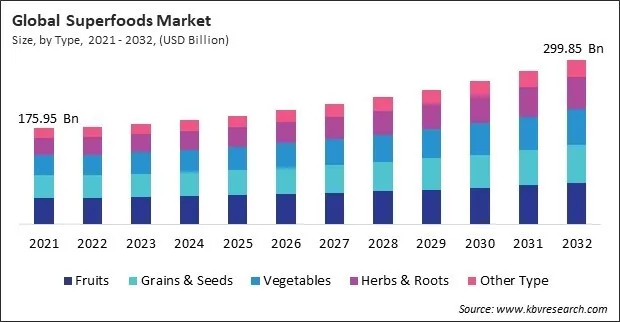
During the COVID-19 pandemic, consumer awareness regarding health and immunity witnessed a substantial upsurge, which had a mild but positive effect on the superfoods market. People became increasingly conscious of preventive healthcare, prompting a greater demand for nutrient-rich, natural products known to boost immunity. Superfoods such as turmeric, ginger, berries, and green tea gained popularity due to their perceived health benefits, particularly their antioxidant and anti-inflammatory properties. Although the pandemic disrupted global supply chains and physical retail operations, it also accelerated the shift toward online retail, which benefitted the superfoods market. Thus, the COVID-19 had a mild positive impact on the market.
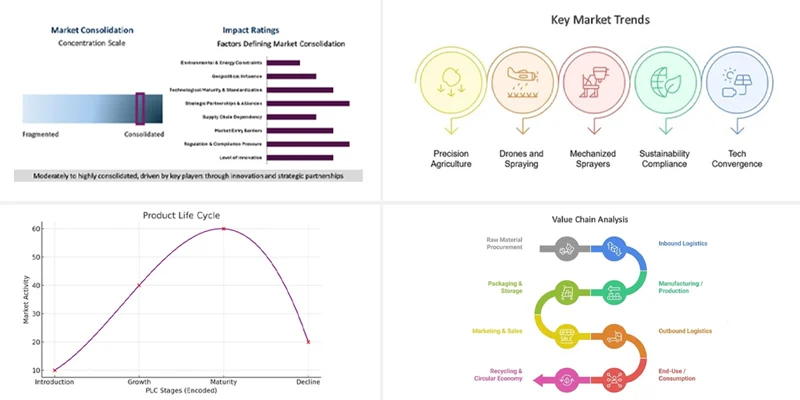

Across the globe, individuals are increasingly seeking ways to take control of their health through proactive and preventive measures, and this shift in consumer mindset has significantly accelerated the demand for superfoods. Traditionally associated with niche health enthusiasts or alternative medicine circles, superfoods have now entered mainstream consumption thanks to heightened awareness of nutrition's role in disease prevention, vitality, and overall wellness. Hence, rising health awareness and a shift towards preventive healthcare have laid a strong and enduring foundation for the growth of the superfoods market.
Additionally, Today’s consumers are scrutinizing food labels more than ever before. The preference has clearly shifted from synthetic and processed ingredients toward those that are natural, minimally processed, and free from additives. This growing inclination for clean label products has directly benefited the superfoods industry, as most superfoods are inherently natural, organic, and often ethically sourced. Therefore, the rising demand for natural, clean-label food products significantly propels the superfoods market, aligning with evolving consumer expectations and regulatory norms.
One of the most significant restraints impeding the growth of the superfoods market is the high cost associated with these products. Superfoods, such as quinoa, chia seeds, acai berries, spirulina, goji berries, and matcha, are often sourced from remote, exotic, or ecologically sensitive regions. The cost of cultivation, harvesting, transportation, storage, and packaging adds considerable value to the final retail price. Hence, the high cost and limited affordability of superfoods remain a major restraint that narrows their accessibility and acceptance across broader consumer segments.
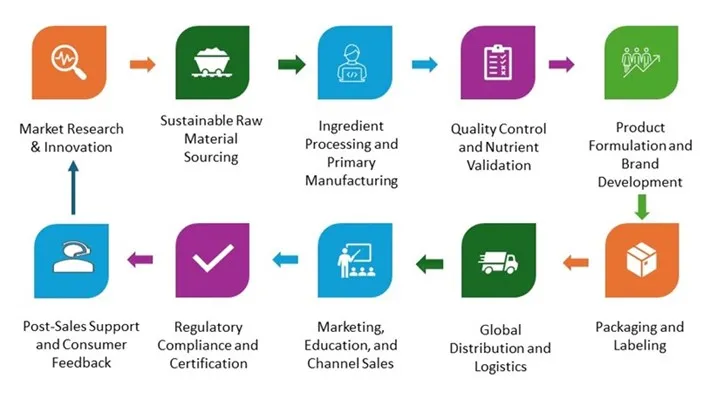
The value chain analysis of the Superfoods market illustrates a comprehensive, cyclical process beginning with Market Research & Innovation, which drives the development of health-centric products. It then moves to Sustainable Raw Material Sourcing, ensuring eco-friendly and ethical supply chains. This is followed by Ingredient Processing and Primary Manufacturing, where raw materials are transformed into usable inputs. Quality Control and Nutrient Validation ensure compliance and effectiveness, paving the way for Product Formulation and Brand Development. Packaging and Labeling align with regulatory standards and consumer appeal, after which products enter Global Distribution and Logistics. The next steps include Marketing, Education, and Channel Sales, followed by Regulatory Compliance and Certification. The cycle concludes with Post-Sales Support and Consumer Feedback, which feeds into future innovation.
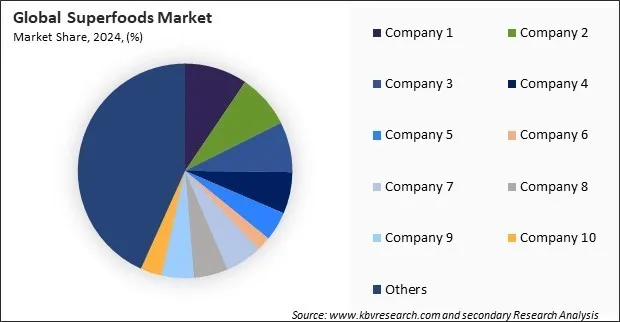
The leading players in the market are competing with diverse innovative offerings to remain competitive in the market. The above illustration shows the percentage of revenue shared by some of the leading companies in the market. The leading players of the market are adopting various strategies in order to cater demand coming from the different industries. The key developmental strategies in the market are Acquisitions, and Partnerships & Collaborations.
Based on type, the superfoods market is characterized into fruits, grains & seeds, vegetables, herbs & roots, and others. The grains & seeds segment procured 23% revenue share in the superfoods market in 2024. The grains and seeds segment comprises powerhouse ingredients known for their exceptional nutritional profiles and health-promoting properties. Popular examples include quinoa, chia seeds, flaxseeds, hemp seeds, and amaranth, all of which are celebrated for their rich content of dietary fiber, plant-based proteins, essential fatty acids, and a host of vitamins and minerals.
| Category | Details |
|---|---|
| Use Case Title | Confidential |
| Date | 2025 |
| Entities Involved | Confidential |
| Objective | Enable data-backed nutritional differentiation for premium grains through digital enrichment scoring. |
| Context and Background | Processed grains like quinoa and amaranth often lose critical micronutrients. With consumer demand for clean-label products growing, nutritional transparency became essential to product positioning. |
| Description | WellGrain collaborated with NutriQuant to develop an AI-powered system that profiles post-processing nutrient density using spectral scans. A “Nutritional Enrichment Score” was assigned to SKUs and displayed on e-commerce listings and physical labels. BigBasket integrated these scores into its search filters, enabling nutrient-based shopping. |
| Key Capabilities Deployed |
|
| Regions Covered |
|
| Benefits |
|
| Source | Confidential |

On the basis of application, the superfoods market is classified into bakery & confectionery, beverages, snacks, and others. The beverages segment recorded 29% revenue share in the superfoods market in 2024. Beverages have become one of the most dynamic platforms for superfoods, offering convenience and targeted health benefits in a consumable form. This segment includes products like smoothies, protein shakes, herbal teas, enhanced waters, and cold-pressed juices infused with ingredients such as matcha, spirulina, turmeric, and moringa.
Free Valuable Insights: Global Superfoods Market size to reach USD 299.85 Billion by 2032
Region-wise, the superfoods market is analyzed across North America, Europe, Asia Pacific, and LAMEA. The North America segment recorded 38% revenue share in the superfoods market in 2024. North America represents a leading region in the superfoods market, driven by a strong consumer focus on health, wellness, and functional nutrition. The region’s advanced food industry, coupled with high disposable incomes and growing awareness of preventive healthcare, supports robust demand for nutrient-rich products.
| Report Attribute | Details |
|---|---|
| Market size value in 2024 | USD 190.17 Billion |
| Market size forecast in 2032 | USD 299.85 Billion |
| Base Year | 2024 |
| Historical Period | 2021 to 2023 |
| Forecast Period | 2025 to 2032 |
| Revenue Growth Rate | CAGR of 6.1% from 2025 to 2032 |
| Number of Pages | 281 |
| Number of Tables | 300 |
| Report coverage | Market Trends, Revenue Estimation and Forecast, Segmentation Analysis, Regional and Country Breakdown, Market Share Analysis, Porter’s 5 Forces Analysis, Company Profiling, Companies Strategic Developments, SWOT Analysis, Winning Imperatives |
| Segments covered | Type, Application, Region |
| Country scope |
|
| Companies Included | Archer Daniels Midland Company, General Mills, Inc., Del Monte Pacific Limited (Nutriasia, Inc.), Sunfood Corporation, OMG! Organic Meets Good, Suncore Foods, Inc., Nutiva, Inc., Creative Nature Ltd., Raw Nutritional, and Healthy Truth |
By Type
By Application
By Geography
This Market size is expected to reach $299.85 billion by 2032.
Rising Health Consciousness and Preventive Healthcare Trends are driving the Market in coming years, however, High Cost of Superfoods and Limited Affordability restraints the growth of the Market.
Archer Daniels Midland Company, General Mills, Inc., Del Monte Pacific Limited (Nutriasia, Inc.), Sunfood Corporation, OMG! Organic Meets Good, Suncore Foods, Inc., Nutiva, Inc., Creative Nature Ltd., Raw Nutritional, and Healthy Truth
The expected CAGR of this Market is 6.1% from 2023 to 2032.
The Fruits segment led the maximum revenue in the Market by Type in 2024, thereby, achieving a market value of $75.48 billion by 2032.
The North America region dominated the Market by Region in 2024, thereby, achieving a market value of $110.22 billion by 2032.
Our team of dedicated experts can provide you with attractive expansion opportunities for your business.







 Unique Offerings