
“Global Sparkling Protein Water Market to reach a market value of USD 627.40 Million by 2033 growing at a CAGR of 8.78%”
The Global Sparkling Protein Water Market is expected to reach USD 627.4 million by 2033, growing at a CAGR of 8.8% during 2026–2033. The report examines market size, growth trends, and opportunities by protein source, protein content, flavor, packaging, distribution channel, and geography.
Sparkling protein water is a packaged, carbonated, water-based beverage containing declared protein. Also described as carbonated protein water or, for qualifying formulations, protein soda, it combines a protein-focused proposition with sparkling refreshment. Products may use whey, collagen, plant-based ingredients, or other protein sources. Clear protein drinks belong within this market only when they meet the carbonated, ready-to-drink product definition. Still protein water, protein powders, creamy shakes, and ordinary sparkling water are separate categories. The actual formulation and format determine inclusion rather than the product name alone.
Sparkling protein water gives suppliers a way to reach buyers seeking protein in a lighter-textured beverage than a creamy shake. Whey Water describes its product as a lightly sparkling protein soda, while Genius Gourmet markets sparkling clear protein drinks. These examples connect protein nutrition with refreshment and a ready-to-drink format. Buyers comparing sparkling protein drinks can assess flavor, sweetness, carbonation, protein per serving, and price. The opportunity for repeat purchasing depends on a satisfying beverage experience as well as the protein headline.
Ready-to-drink sparkling protein water avoids the preparation needed for protein powder and a shaker. Cans and bottles offer defined portions for work breaks, commuting, and other occasions where a packaged drink is convenient. Multipacks can support repeat purchases, while individual units can make initial trial easier. Retail access matters alongside product design: consumers need to understand the drink and find it through suitable channels. Suppliers must balance that convenience with the cost of ingredients, packaging, and distribution to create an appealing purchase proposition.
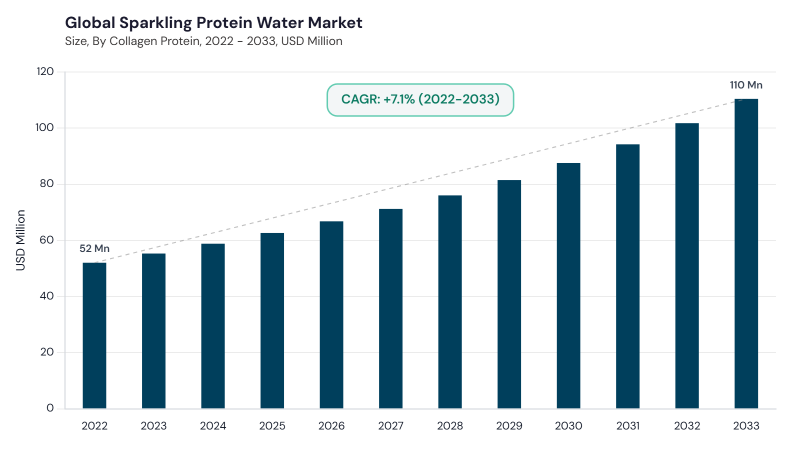
Based on Protein Source, the market is segmented into Whey Protein, Collagen Protein, Plant-Based Protein, Other Protein Source. Whey Protein dominated in 2025 and is projected to reach USD 453.0 million by 2033, growing at a CAGR of 9.4%. Whey Protein is expected to record the highest CAGR of 9.4% during the forecast period.
Whey protein supports clear carbonated formulations, as illustrated by Whey Water’s whey isolate product and Arla Foods Ingredients’ sparkling protein water concept. Collagen, plant-based, and other protein sources offer different formulation routes within the supplied segmentation. Source selection affects ingredient compatibility, sensory performance, and dietary positioning. A clear appearance does not identify the protein source: whey-based water still contains a milk-derived protein. Manufacturers need to explain source-specific characteristics and validate the complete recipe rather than treating all protein ingredients as interchangeable.
Based on Protein Content, the market is segmented into Below 10 g, 10 g to 20 g, Above 20 g. 10 g to 20 g dominated in 2025 and is projected to reach USD 360.1 million by 2033, growing at a CAGR of 9.8%. Above 20 g is expected to record the highest CAGR of 10.5% during the forecast period.
Protein content helps define the drink’s proposition, but serving size provides the basis for comparison. Whey Water states 18 g per 12 oz can, illustrating the 10 g to 20 g category, while the current Genius Gourmet product page describes a 30 g drink, illustrating the Above 20 g category. These examples show why buyers need the actual pack and formulation information. Higher declared protein does not by itself determine taste, value, or suitability for a particular occasion. The report’s content bands should be applied on a consistent serving basis.
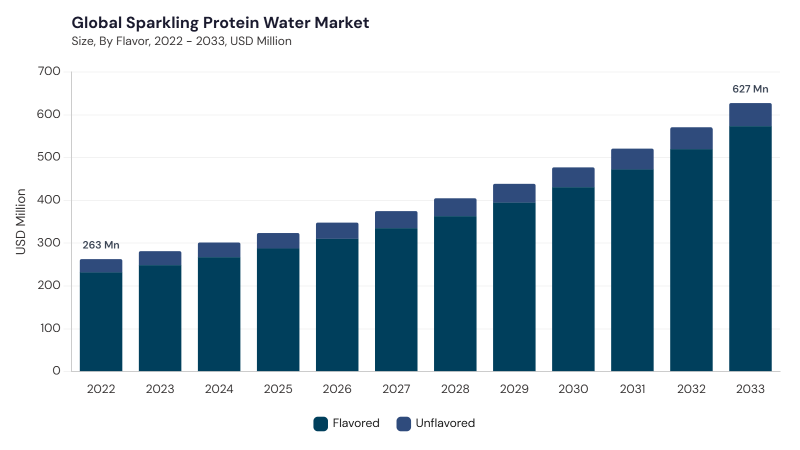
Based on Flavor, the market is segmented into Flavored, Unflavored. Flavored dominated in 2025 and is projected to reach USD 573.4 million by 2033, growing at a CAGR of 9.2%. Flavored is expected to record the highest CAGR of 9.2% during the forecast period.
Flavored sparkling protein water combines protein ingredients with a beverage profile designed to encourage repeat use. Fruit-led options can help suppliers develop recognizable refreshment propositions, while unflavored products address a different preference within the category. Sweetness, acidity, carbonation, aroma, and protein-related aftertaste need to work together in the finished drink. Buyers searching for the best sparkling water may be assessing a different category, so brands need to explain the added-protein proposition clearly. Product testing should assess the complete formula rather than a flavor concept alone.
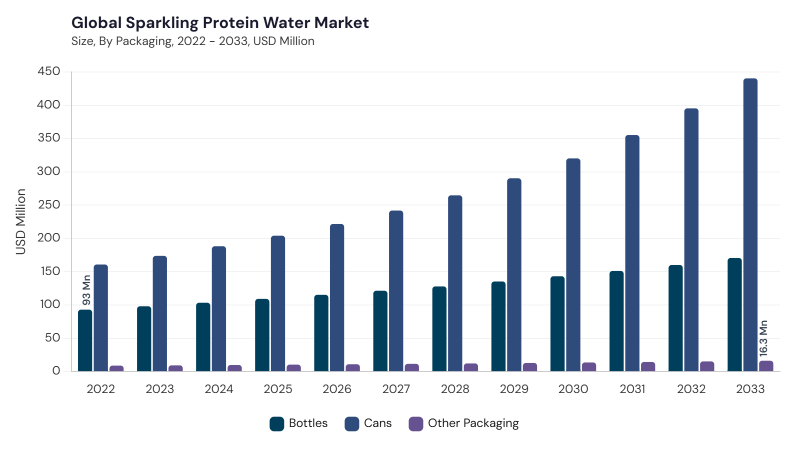
Based on Packaging, the market is segmented into Cans, Bottles, Other Packaging. Cans dominated in 2025 and is projected to reach USD 440.4 million by 2033, growing at a CAGR of 10.3%. Cans is expected to record the highest CAGR of 10.3% during the forecast period.
Cans provide a familiar single-unit format for carbonated protein beverages and can also be offered in multipacks. Bottles create another packaging route, while other packaging remains a separate category in the supplied segmentation. Pack choice needs to account for carbonation retention, product compatibility, transport, and the intended serving occasion. Clear labeling of volume and protein content helps consumers compare packs. Suppliers also need to balance trial-friendly formats with the handling and logistics requirements of repeated retail and online purchases.
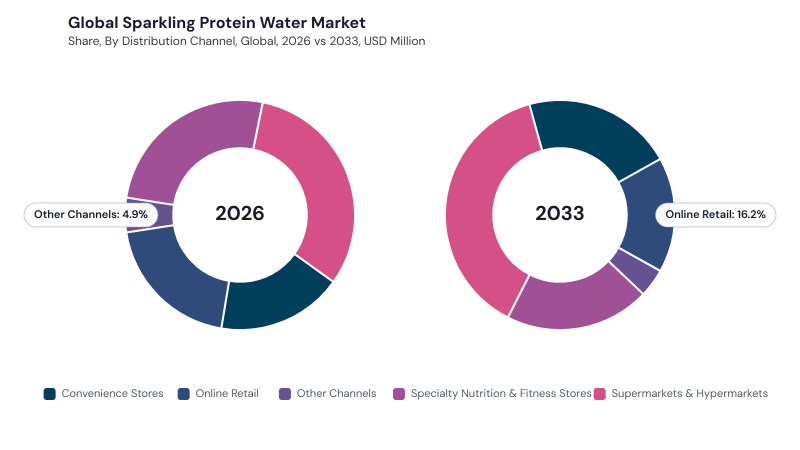
Based on Distribution Channel, the market is segmented into Supermarkets & Hypermarkets, Convenience Stores, Specialty Nutrition & Fitness Stores, Online Retail, Other Channels. Supermarkets & Hypermarkets dominated in 2025 and is projected to reach USD 239.7 million by 2033, growing at a CAGR of 11.7%. Supermarkets & Hypermarkets is expected to record the highest CAGR of 11.7% during the forecast period.
Supermarkets and hypermarkets can introduce sparkling protein water to shoppers comparing functional drinks and everyday refreshment. Convenience stores support immediate consumption, while specialty nutrition and fitness stores provide a more focused selling environment. Online retail allows detailed ingredient and nutrition information alongside multipack options. Costco’s published Genius Gourmet listing confirms a specific retail example, while local availability still depends on the store and delivery area. Brands need clear product descriptions and reliable fulfillment to turn retailer discovery into repeat purchasing.
Free Valuable Insights: Sparkling Protein Water Market Size to reach $627.4 Million by 2033
Region-wise, the Sparkling Protein Water Market is analyzed across North America, Europe, Asia Pacific, LAMEA. North America led in 2025 and is projected to reach USD 256.0 million by 2033, growing at a CAGR of 8.1%. Europe is projected to grow at a CAGR of 7.2%. Asia Pacific is projected to grow at a CAGR of 11.4%. LAMEA is projected to grow at a CAGR of 10.7%.
Regional demand depends on familiarity with protein beverages, preferences for carbonated drinks, price expectations, and retail access. Suppliers may need to adjust flavors, pack sizes, and channel choices for different markets. Across North America, Europe, Asia Pacific, and LAMEA, repeat use depends on the drink fitting local consumption occasions and delivering a consistent experience. Distribution partners and suitable product education can help explain how sparkling protein water differs from ordinary carbonated water and creamy protein shakes. The commercial opportunity combines beverage appeal with accessible purchasing options.
By Protein Source
By Protein Content
By Flavor
By Packaging
By Distribution Channel
By Geography
| Report Attribute | Details |
|---|---|
| Market size value in 2026 | USD 348.1 million |
| Market size forecast in 2033 | USD 627.4 million |
| Base Year | 2025 |
| Historical Period | 2022 to 2024 |
| Forecast Period | 2026 to 2033 |
| Revenue Growth Rate | CAGR of 8.8% from 2026 to 2033 |
| Number of Tables | 690 |
| Number of Figures | 115 |
| Report Coverage | Market Trends, Revenue Estimation and Forecast, Segmentation Analysis, Regional and Country Breakdown, Competitive Landscape |
| Segments Covered | Protein Source, Protein Content, Flavor, Packaging, Distribution Channel and Geography |
| Country Scope |
|
By Geography
The market is expected to reach USD 627.4 million by 2033, growing at 8.8% CAGR during 2026-2033.
Demand for protein in a different drinking format and convenient packaged nutrition are key growth drivers.
Top companies include Cisco, IBM, Microsoft, and Google.
North America leads the market, with significant growth expected by 2033.
The market is growing at 8.8% CAGR during the forecast period (2026-2033).
Ingredients developed for clear carbonated applications are enhancing market growth.
Our team of dedicated experts can provide you with attractive expansion opportunities for your business.




