The sample copy of this report is available for access.
“Global Spare Parts Management Market to reach a market value of USD 2,422.4 Million by 2033 growing at a CAGR of 10.2%”
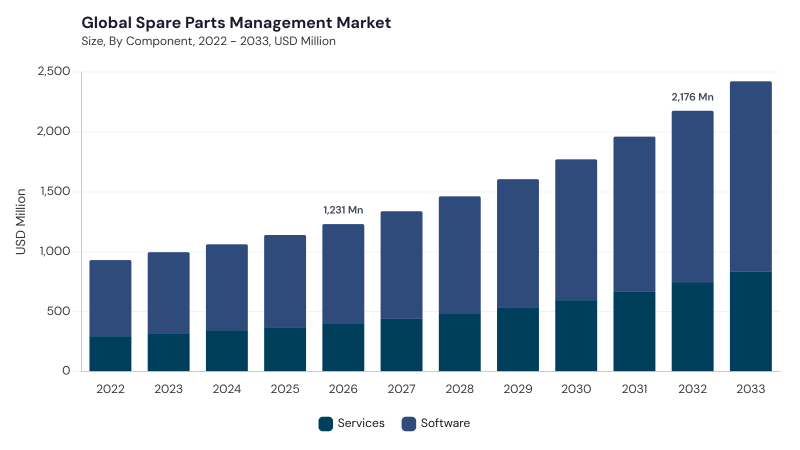
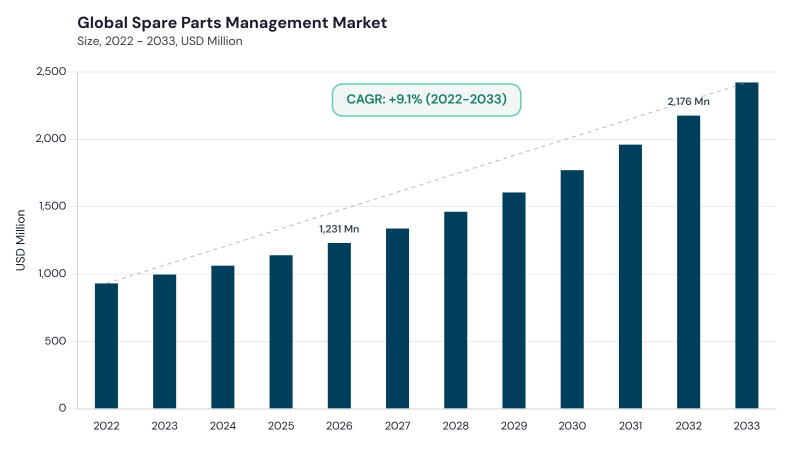
The Global Spare Parts Management Market is expected to reach USD 2422.4 million by 2033, growing at a CAGR of 10.2% during 2026 - 2033.
The Global Spare Parts Management Market has evolved significantly over the years from traditional inventory handling systems into highly digitalized and intelligent supply chain ecosystems designed to optimize asset uptime, reduce operational disruptions, and improve inventory efficiency. Initially, spare parts management relied heavily on manual inventory tracking, reactive procurement, and fragmented supply chain coordination. However, increasing industrial automation, growing equipment complexity, and the rising importance of predictive maintenance accelerated the adoption of integrated software-driven spare parts management solutions.
The Spare Parts Management Market continues to evolve into a highly intelligent and digitally integrated operational ecosystem focused on maximizing equipment uptime, reducing maintenance costs, and optimizing inventory utilization. The integration of artificial intelligence, predictive maintenance systems, cloud computing, digital twins, IoT-enabled monitoring, and real-time analytics is strengthening inventory visibility and enabling proactive spare parts planning across industries.
The market is increasingly driven by the growing need for uninterrupted industrial operations across manufacturing, automotive, aerospace, transportation, mining, and energy sectors. Spare parts management solutions are now being deployed to support inventory optimization, predictive demand forecasting, procurement automation, warehouse management, lifecycle management, and supplier coordination. The emergence of Industry 4.0 technologies, IoT-enabled asset monitoring, AI-driven analytics, and cloud-based supply chain platforms has significantly reshaped the market landscape.
The market is additionally benefiting from increasing investments in industrial automation, connected manufacturing systems, and smart maintenance infrastructures. Rising emphasis on predictive maintenance, sustainability initiatives, supply chain resilience, and operational continuity is accelerating adoption of advanced spare parts management solutions globally.
The major strategies followed by market participants include AI-powered inventory optimization, predictive maintenance integration, digital supply chain transformation, strategic partnerships, cloud-based platform deployment, warehouse automation, and regional expansion of service networks. Companies are increasingly investing in intelligent forecasting systems, automated procurement workflows, and integrated ERP/CMMS platforms to strengthen their competitive positioning.

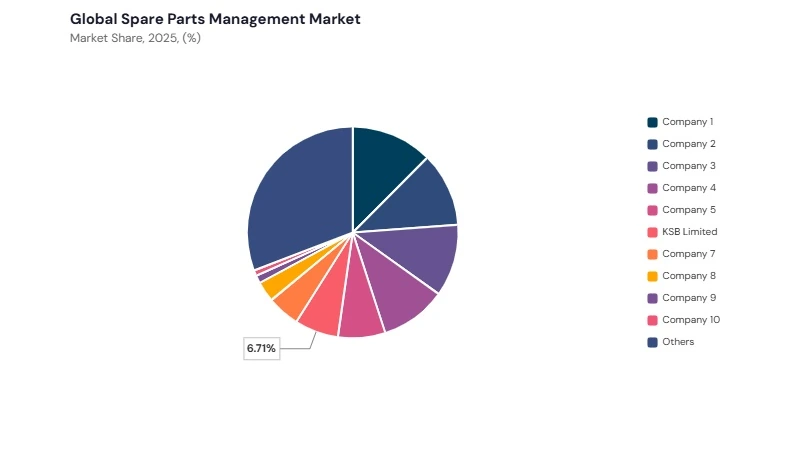
The leading players in the Spare Parts Management Market continue competing through advanced analytics integration, predictive maintenance capabilities, digital inventory optimization, cloud-based supply chain systems, and strategic consulting services. Companies are increasingly focusing on AI-enabled forecasting, automated procurement systems, lifecycle management solutions, and Industry 4.0 integration to improve operational reliability and reduce maintenance downtime.
Schneider Electric SE, Kinaxis, Inc., Deloitte Touche Tohmatsu Limited, Advanced Technology Services, Inc., Linde GmbH, KSB Limited, Argon Consulting S.A.S., Cognascents, Alterity Group, and eDexDeals continue to maintain notable market positions through digital transformation initiatives, predictive maintenance support, consulting expertise, and intelligent inventory management capabilities.
Based on Component, the Spare Parts Management Market is segmented into Software and Services.
The Software market dominated the Global Spare Parts Management Market by Component in 2025, and would continue to be a dominant market till 2033; thereby, achieving a market value of USD 1589.2 million by 2033, growing at a CAGR of 9.8 % during the forecast period. The Services market is expected to witness a CAGR of 11% during (2026 - 2033).
The component outlook reflects increasing enterprise adoption of software-driven inventory optimization, predictive maintenance, and spare parts lifecycle management solutions. Organizations are increasingly investing in AI-enabled inventory tracking systems, cloud-based spare parts management platforms, and predictive analytics tools to improve operational efficiency and reduce equipment downtime. Services continue to play a vital role through consulting, implementation, maintenance support, and inventory optimization initiatives.
Based on Deployment, the Spare Parts Management Market is segmented into Cloud and On-premise.
The Cloud segment acquired the maximum revenue share in the Global Spare Parts Management Market by Deployment in 2025. The On-premise segment continues to maintain notable demand among security-sensitive industries.
The deployment outlook reflects increasing preference for scalable, flexible, and remotely accessible cloud-based solutions capable of supporting real-time inventory visibility and predictive maintenance environments. Cloud deployment continues gaining momentum due to lower infrastructure costs, improved collaboration capabilities, and seamless integration with IoT and ERP systems. On-premise deployment remains relevant among organizations prioritizing data sovereignty, regulatory compliance, and highly customized operational environments.
Based on End Use, the Spare Parts Management Market is segmented into Manufacturing, Automotive, Aerospace & Defense, Energy & Utilities, Transportation & Logistics, Construction & Mining, and Other End Use.
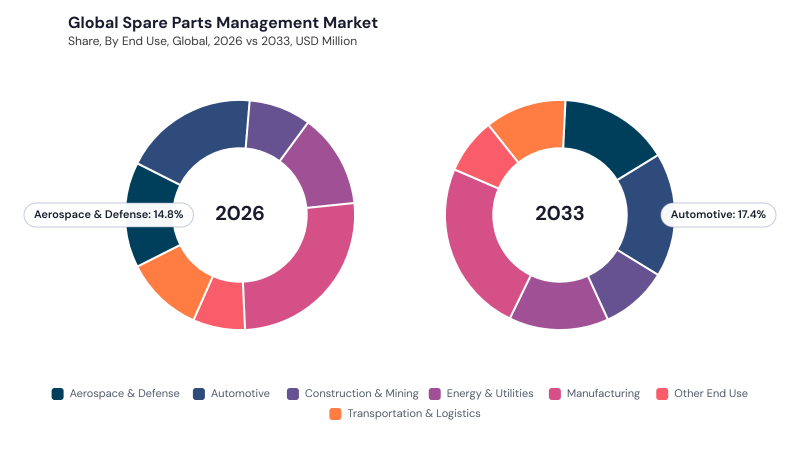
The Manufacturing market dominated the Global Spare Parts Management Market by End Use in 2025, and would continue to be a dominant market till 2033; thereby, achieving a market value of USD 588.3 million by 2033, growing at a CAGR of 9.1% during the forecast period. The Automotive market is expected to witness a CAGR of 8.9% during (2026 - 2033).
The end-use outlook reflects increasing industrial dependence on intelligent spare parts management systems to maintain operational continuity, optimize maintenance schedules, and improve equipment reliability. Manufacturing continues to dominate due to rising automation and predictive maintenance adoption, while automotive and aerospace industries increasingly require advanced lifecycle management and inventory optimization capabilities to support complex operational infrastructures.
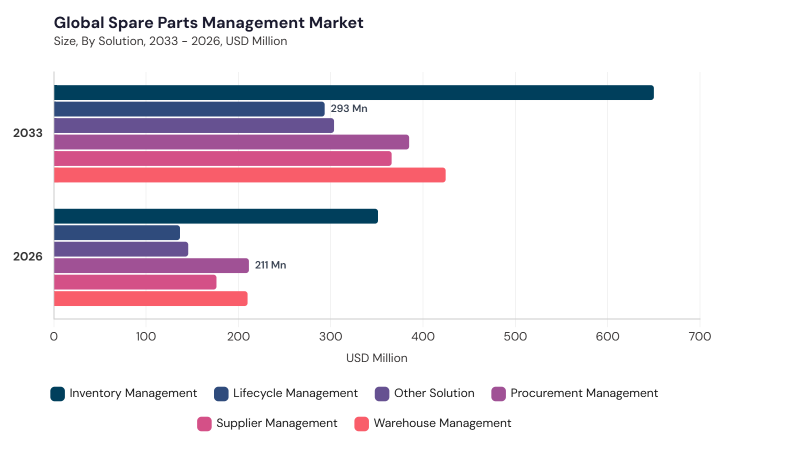
Based on Solution, the Spare Parts Management Market is segmented into Inventory Management, Procurement Management, Warehouse Management, Supplier Management, Lifecycle Management, and Other Solution.
The Inventory Management market dominated the Global Spare Parts Management Market by Solution in 2025, and would continue to be a dominant market till 2033; thereby, achieving a market value of USD 650 million by 2033, growing at a CAGR of 9.2 % during the forecast period. The Procurement Management market is expected to witness a CAGR of 8.9% during (2026 - 2033).
The solution outlook reflects growing enterprise focus on accurate demand forecasting, inventory optimization, procurement automation, and operational cost reduction. Inventory Management continues to dominate due to increasing demand for real-time stock visibility and predictive inventory planning. Organizations are increasingly integrating procurement and warehouse management solutions to streamline supply chain coordination and improve spare parts availability across global operations.
Free Valuable Insights: Spare Parts Management Market Size to reach $2,422.4 Million by 2033
Region-wise, the Spare Parts Management Market is analyzed across North America, Europe, Asia Pacific, and LAMEA.
The North America market dominated the Global Spare Parts Management Market by Region in 2025, and would continue to be a dominant market till 2033; thereby, achieving a market value of USD 856.6 million by 2033, growing at a CAGR of 9.6 % during the forecast period. The Asia Pacific market is expected to witness a CAGR of 10.7% during (2026 - 2033).
The regional outlook reflects growing industrial automation, predictive maintenance adoption, digital transformation initiatives, and increasing focus on supply chain resilience across global markets. North America continues to dominate due to strong industrial infrastructure, advanced technology integration, and high adoption of AI-driven maintenance ecosystems. Asia Pacific is emerging as a high-growth region supported by rapid industrialization, expanding manufacturing activities, and increasing investments in Industry 4.0 technologies.
Spare Parts Management Market Coverage:
| Report Attribute | Details |
|---|---|
| Market size value in 2026 | USD 1,230.9 Million |
| Market size forecast in 2033 | USD 2,422.4 Million |
| Base Year | 2025 |
| Historical period | 2022 to 2024 |
| Forecast Period | 2026 to 2033 |
| Revenue Growth Rate | CAGR of 10.2% from 2026 to 2033 |
| Number of Pages | 665 |
| Tables | 870 |
| Report Coverage | Market Trends, Revenue Estimation and Forecast, Segmentation Analysis, Regional and Country Breakdown, Competitive Landscape, Market Share Analysis, Company Profiling, Companies Strategic Developments, SWOT Analysis, Winning Imperatives |
| Segments Covered | Component, Deployment, End Use, Solution, Region |
| Country Scope |
|
| Companies Included | Schneider Electric SE, Kinaxis, Inc., Deloitte Touche Tohmatsu Limited, Advanced Technology Services, Inc., Linde GmbH, KSB Limited, Argon Consulting S.A.S., Cognascents, Alterity Group, eDexDeals |
By Component
By Deployment
By End Use
By Solution
By Geography
Expected to reach USD 2422.4 million by 2033, growing at 10.2% CAGR during the forecast period (2026-2033).
Software segment leads, projected to reach USD 1589.2 million by 2033, at 9.8% CAGR during the forecast period.
Schneider Electric SE, Kinaxis, Inc., Deloitte Touche Tohmatsu Limited, and Advanced Technology Services lead the market.
Manufacturing segment dominates, expected to reach USD 588.3 million by 2033, growing at 9.1% CAGR during the forecast period.
North America leads, projected to reach USD 856.6 million by 2033, growing at 9.6% CAGR during the forecast period.
Enhanced supply chain visibility through advanced analytics and increasing adoption of predictive maintenance are key growth drivers.
Our team of dedicated experts can provide you with attractive expansion opportunities for your business.








 Unique Offerings