The sample copy of this report is available for access.
“Global Software-Defined Wide Area Network (SD-WAN) Market to reach a market value of 41.80 Billion by 2032 growing at a CAGR of 27.2%”
The Global Software-Defined Wide Area Network (SD-WAN) Market size is estimated at $7.75 billion in 2025 and is expected to reach $41.80 billion by 2032, rising at a market growth of 27.2% CAGR during the forecast period (2025-2032). The need for flexible, software-based networking solutions is growing because businesses are quickly moving to the cloud and going digital. SD-WAN makes it possible to connect to multiple clouds and branches in a cost-effective way, with better security and centralized network management. Because of this, the global SD-WAN market is expected to grow much faster because of more people working from home, the use of 5G, and the rise of edge computing.
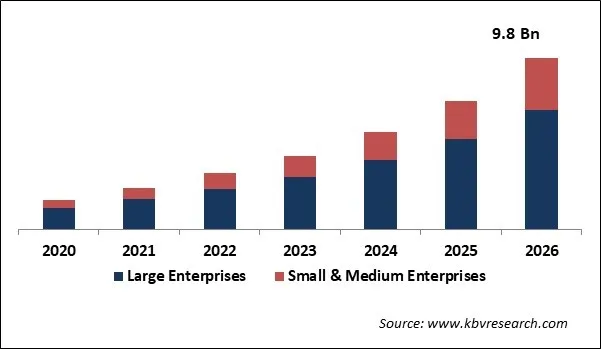
The software-defined wide area network market evolved as part of the broader shift toward software-defined networking. Traditional WAN systems relied on inflexible MPLS circuits, which struggle to support the rising demand for Software-as-a-Service applications and cloud computing. As organizations largely adopted distributed IT environments, SD-WAN solutions emerged to provide application visibility, centralized network control, and improved flexibility. The expansion of public cloud platforms like Microsoft Azure, AWS, and Google Cloud further surged SD-WAN offices, cloud environments, and data centers. Further, digital modernization initiatives and the accelerating remote work environment have increased enterprise investment in networking technologies, thereby surging SD-WAN adoption.
SD-WAN developed connectivity optimization into a comprehensive security and networking platform. Providers began integrating advanced security features like secure web gateways, next-generation firewalls, and zero-trust access capabilities, resulting in the development of Secure Access Service Edge (SASE) architectures. Key elements shaping the market include cloud-native and multi-cloud connectivity optimization, the convergence of networking and cybersecurity, and the integration of edge computing and 5G capabilities. Major companies compete by offering subscription-based services, integrated platforms, and partnerships with telecommunication vendors to expand managed SD-WAN services. Strategic investments in automated orchestration, artificial-intelligence driven analytics, and improved security features further strengthen provider offerings. The SD-WAN market has become a core component of modern enterprise infrastructure, largely adopted across industries like healthcare, retail, banking, manufacturing, and government.
The major strategies followed by the market participants are Partnerships as the key developmental strategy to keep pace with the changing demands of end users. For instance, In April, 2025, Fortinet, Inc. teamed up with Vodafone, a Telecommunications company to offer secure, converged networking solutions, including Fortinet’s Secure SD-WAN and FortiSASE, to support hybrid workforces. The collaboration enhances cybersecurity and connectivity across Europe, Asia, and the U.S., helping enterprises meet compliance, performance, and digital transformation goals worldwide. Moreover, In September, 2024, Hewlett Packard Enterprise Company teamed up with Maxis, a communications service provider to offer AI-powered networking in Malaysia using HPE Aruba Networking Central with AIOps. This collaboration enables secure, intelligent enterprise services, including SD-WAN, private 4G/5G, and business Wi-Fi. It supports digital transformation through automation, analytics, and Zero Trust architecture across edge, campus, and cloud environments.
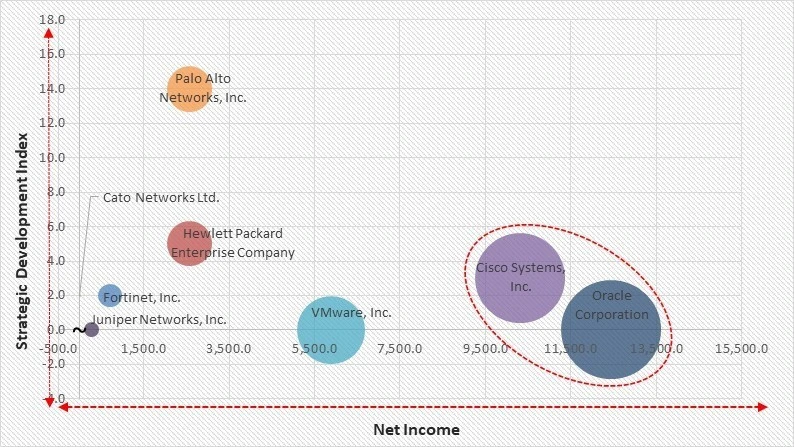
Based on the Analysis presented in the KBV Cardinal matrix; Oracle Corporation, and Cisco Systems, Inc. are the forerunners in the Software-Defined Wide Area Network (SD-WAN) Market. Companies such as VMware, Inc., Palo Alto Networks, Inc., and Hewlett Packard Enterprise Company are some of the key innovators in Software-Defined Wide Area Network (SD-WAN) Market. In July, 2025, Palo Alto Networks, Inc. announced the partnership with GTT, an IT service management company by adding Prisma SASE to its Secure Connect solution. This managed, single-vendor SASE offering combines advanced SD-WAN and cybersecurity capabilities, enabling secure, scalable, and cloud-native networking for global enterprises seeking improved performance, visibility, and Zero Trust architecture.
The COVID-19 pandemic made it harder for the Software-Defined Wide Area Network (SD-WAN) market to grow at first because companies put off investing in IT infrastructure because they weren't sure how the economy would do, and their operations were disrupted. Many businesses put short-term business continuity ahead of long-term networking upgrades, which has made it take longer for new SD-WAN deployments to be adopted. Also, problems with the supply chain and restrictions on movement slowed down the production and distribution of networking hardware, which changed the timelines for deployment. Vendors also had trouble providing on-site installation and integration services because of travel restrictions and a lack of workers. Also, because of money problems, many industries put off big digital transformation projects and infrastructure upgrades. Because of this, the SD-WAN market had some problems at the beginning of the pandemic, but it slowly got better as the pandemic went on. Thus, the COVID-19 pandemic had a negative impact on the market.

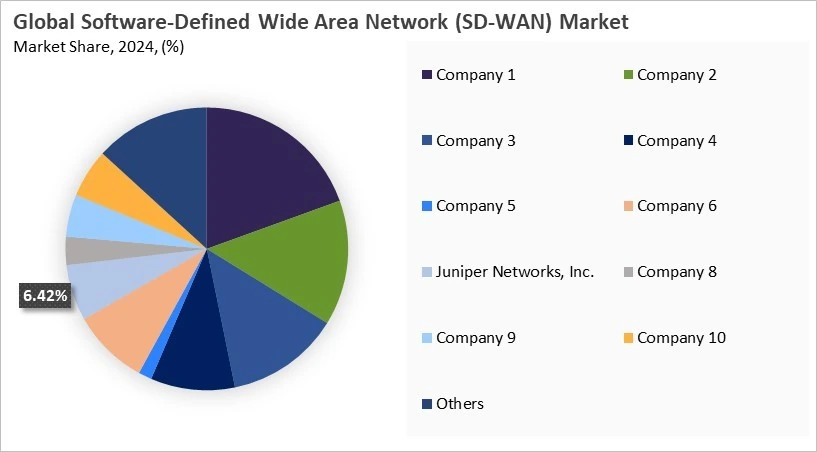
The leading players in the market are competing with diverse innovative offerings to remain competitive in the market. The above illustration shows the percentage of revenue shared by some of the leading companies in the market. The leading players of the market are adopting various strategies in order to cater demand coming from the different industries. The key developmental strategies in the market are Acquisitions, and Partnerships & Collaborations.
Based on Offering, the market is segmented into Solutions, and Services. The services segment supports the deployment, integration, and ongoing management of Software-defined Wide Area Network (SD-WAN) technologies. Organizations often rely on service providers for expertise in planning, implementing, and optimizing SD-WAN infrastructure within complex network environments. These services include consulting, system integration, network design, technical support, and managed networking operations that help businesses maintain stable and secure connectivity.
Based on Organization Size, the market is segmented into Large Enterprises, and Small and Medium-Sized Enterprises (SMEs). Small and medium-sized enterprises are increasingly implementing Software-defined Wide Area Network (SD-WAN) solutions to improve network efficiency and support growing digital operations. SMEs often operate with limited IT resources and require networking solutions that are cost-effective, scalable, and easy to manage. SD-WAN allows these organizations to simplify network management while maintaining reliable connectivity between branch locations, cloud applications, and remote employees.
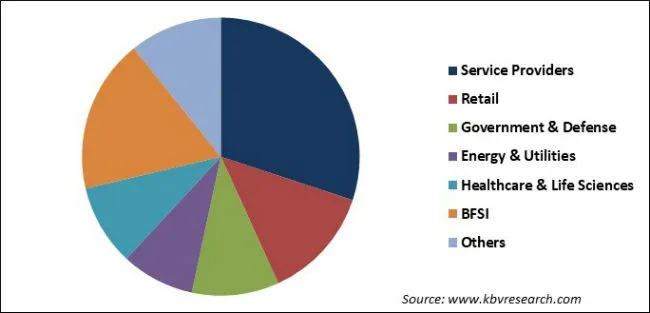
Free Valuable Insights: Software-Defined Wide Area Network (SD-WAN) Market Size to reach $41.80 by 2032
Region-wise, the Software-defined wide area network (SD-WAN) market is analyzed across North America, Europe, Asia Pacific, and LAMEA. The North America segment recorded 38% revenue share in the Software-defined wide area network (SD-WAN) market in 2024. The software-defined wide area network market is predicted to grow at a prominent growth in North America and Europe. The market is driven by strong enterprise IT infrastructure, early adoption of cloud computing, and high investments in digital transformation initiatives and cybersecurity. In North American nations, enterprises across industry verticals like healthcare, retail, banking, and government largely deploy SD-WAN solutions to support remote work infrastructure, multi-cloud environments, and secure branch connectivity. The presence of major cybersecurity and networking vendors, regulatory focus on secure digital ecosystems, and strong broadband infrastructure further accelerate adoption. Moreover, Europe software-defined wide area network market is projected to capture substantial growth. Regional nations like Germany, France, and the UK are experiencing increasing SD-WAN deployment as enterprises modernize legacy WAN architectures. European enterprises are largely prioritizing compliance-driven networking solutions and integrated security frameworks, accelerating the demand for SD-WAN platforms with centralized management capabilities and built-in security.
In the Asia Pacific, the software-defined wide area network is anticipated to expand at a noticeable rate. This expansion is supported by rising cloud adoption, digital economies, and large-scale enterprise network modernization across nations like Japan, India, China, and Australia. Rising adoption of SaaS platforms, rapid expansion of data centers, and growing demand for scalable connectivity across geographically distributed offices are fueling the deployment of SD-WAN. Managed service providers and telecom operators are also integrating SD-WAN into enterprise networking services to support digital transformation across various industries. Additionally, the LAMEA software-defined wide area network market is experiencing accelerated expansion as enterprises seek cost-effective alternatives to traditional MPLS networks. Rising investment in broadband infrastructure, digital government programs, and cloud migration initiatives is encouraging organizations to adopt secure and flexible WAN technologies, thereby offering lucrative market opportunities.
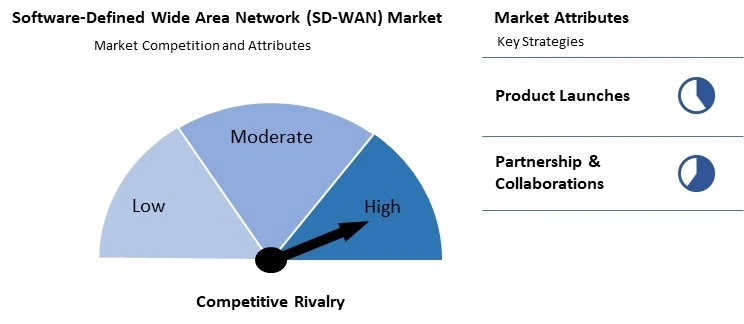
There is a lot of competition in the Software-Defined Wide Area Network (SD-WAN) market. Many technology companies, cloud service providers, and network solution developers are all trying to get businesses to use their products. To improve their position, vendors put a lot of emphasis on innovation, service differentiation, and integrated capabilities. The need for better network automation, better security integration, and seamless multi-cloud connectivity drives competition. Vendors want to offer scalable, flexible, and high-performance networking solutions that can meet the changing needs of businesses. To do this, they use strategic partnerships, platform integration, and ongoing research and development.
| Report Attribute | Details |
|---|---|
| Market size value in 2025 | USD 7.75 Billion |
| Market size forecast in 2032 | USD 41.80 Billion |
| Base Year | 2024 |
| Historical period | 2021 to 2023 |
| Forecast Period | 2025 to 2032 |
| Revenue Growth Rate | CAGR of 27.2% from 2025 to 2032 |
| Number of Pages | 743 |
| Tables | 627 |
| Report Coverage | Market Trends, Revenue Estimation and Forecast, Segmentation Analysis, Regional and Country Breakdown, Competitive Landscape, Market Share Analysis, Porter’s 5 Forces Analysis, Company Profiling, Companies Strategic Developments, SWOT Analysis, Winning Imperatives |
| Segments Covered | Offering, Organization Size, End User, Region |
| Country Scope |
|
| Companies Included | Cisco Systems, Inc., VMware, Inc. (Broadcom Inc.), Fortinet, Inc., Hewlett Packard Enterprise Company, Oracle Corporation, Palo Alto Networks, Inc., Juniper Networks, Inc., Aryaka Networks, Inc., Cato Networks Ltd., and Citrix Systems, Inc. (Cloud Software Group, Inc.) |
By Offering
By Organization Size
By End User
By Geography
Valued at USD 7.75 billion in 2025, reaching USD 41.80 billion by 2032 at 27.2% CAGR during 2025-2032.
Large Enterprises dominates, projected to achieve $28.2 billion by 2032.
Cisco Systems, Inc., VMware, Inc. (Broadcom Inc.), and Fortinet hold the dominant positions.
North America leads with $15.2 billion by 2032; Asia Pacific grows at 27.8% CAGR during 2025-2032.
Solutions segment grows at 26.7% CAGR during the forecast period.
Enterprises segment grows at 27% CAGR during the forecast period.
Our team of dedicated experts can provide you with attractive expansion opportunities for your business.








 Unique Offerings