“Global Serum Body Wash Market to reach a market value of USD 1064.96 Million by 2033 growing at a CAGR of 14%”
The Global Serum Body Wash Market is expected to reach USD 1.1 billion by 2033, growing at a CAGR of 14.0% during (2026 - 2033).
The Serum Body Wash Market brings facial skincare positioning into everyday body cleansing. Its core comprises rinse-off body washes explicitly presented as serum infused, serum based, or using a named serum complex. These products compete by combining cleansing with a targeted cosmetic proposition, such as moisturization, an even-looking tone, or a smoother skin feel. The category offers manufacturers a route to trade consumers up within an established routine, while retaining the convenience of a single shower product. A serum label alone does not establish a standardized ingredient concentration, delivery system, or level of performance.
Serum body wash offers a familiar way to extend skincare interest beyond the face. Consumers can recognize a benefit-led proposition without adding a separate treatment step, giving manufacturers a clear explanation for a higher-value cleansing product. The commercial mechanism is straightforward: a routine purchase gains a more specific purpose and a reason to compare formulations. Unilever's 2024 discussion of Dove's serum-infused launch provides a dated example of this approach. Its relevance lies in product positioning and premiumization, rather than proof that every consumer will pay more for serum terminology. Product discovery also reflects interest in serum oil body wash and advanced repair serum body wash, with branded searches showing mixed trajectories. These signals highlight the importance of benefit-led differentiation and format innovation rather than demonstrating uniform growth in consumer demand.
Hydration and Nourishment's 47.92% allocation makes everyday comfort the largest supplied benefit group. This creates a broad entry point for products that combine cleansing with a moisturized after-feel. Repeat-use products benefit when the value proposition is easy to understand and the sensory experience is dependable. Brands can emphasize lather, rinsing, fragrance, and softness alongside their serum story, helping customers assess the product during normal use. The revenue opportunity depends on maintaining that experience across batches and pack sizes, with claims proportionate to the evidence for the finished formulation.
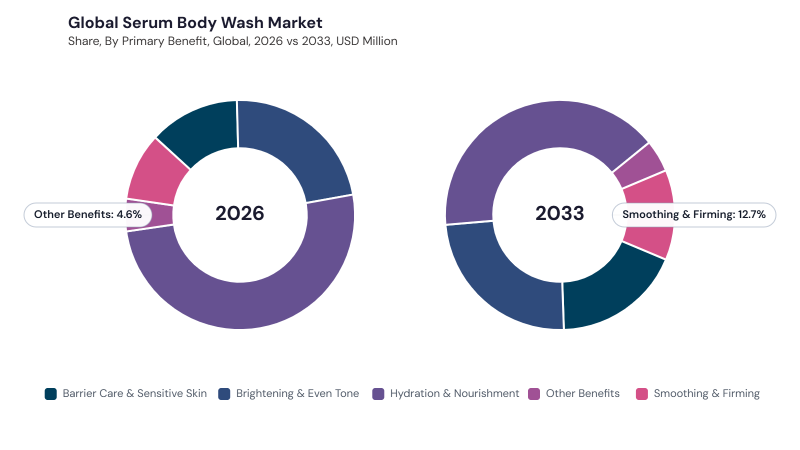
Based on Primary Benefit, the market is segmented into Hydration & Nourishment, Brightening & Even Tone, Barrier Care & Sensitive Skin, Smoothing & Firming, Other Benefits. Hydration & Nourishment dominated in 2025 and is projected to reach USD 431.4 million by 2033, growing at a CAGR of 10.4%. Barrier Care & Sensitive Skin is expected to record the highest CAGR of 19.8% during the forecast period.
Hydration and nourishment provide a broad commercial foundation for serum-infused body washes formulated with humectants and emollients. Brightening and even-tone products extend the category into appearance-led body care, while barrier care and sensitive skin formulations offer differentiation through mild cleansing systems and carefully selected serum complexes. Smoothing and firming products target consumers seeking improved skin feel and appearance within their shower routine. Other benefit-led variants enable more specialized positioning. Across these segments, the ability to substantiate cosmetic benefits in a rinse-off formulation is important for premium pricing and repeat purchases.
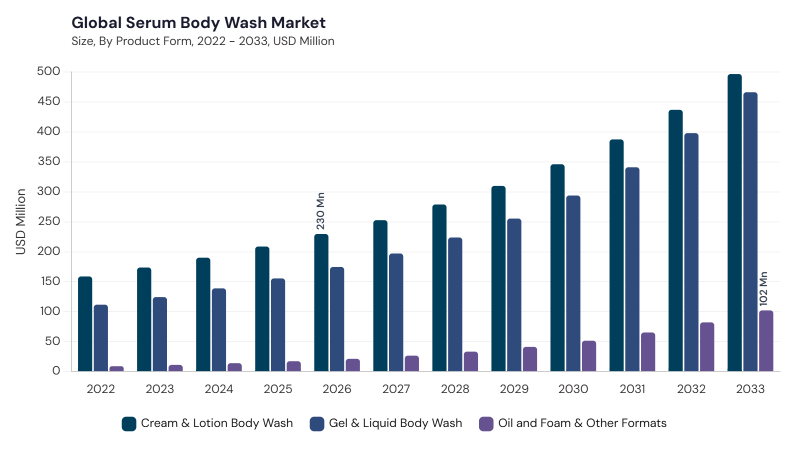
Based on Product Form, the market is segmented into Cream & Lotion Body Wash, Gel & Liquid Body Wash, Oil and Foam & Other Formats. Cream & Lotion Body Wash dominated in 2025 and is projected to reach USD 496.6 million by 2033, growing at a CAGR of 11.6%. Oil and Foam & Other Formats is expected to record the highest CAGR of 25.1% during the forecast period.
Cream and lotion serum body washes support moisturizing positioning through richer textures and a conditioned after-feel. Gel and liquid body washes offer a contrasting proposition based on lighter textures, lather and convenient dispensing. Oil-based serum body washes create opportunities for premium sensory experiences, while foam and other formats allow brands to differentiate application and packaging. Rising search interest in serum oil body wash highlights the relevance of this format to product discovery, although it does not establish sales growth. Formulation stability, surfactant compatibility and packaging costs influence the commercial viability of these innovations.
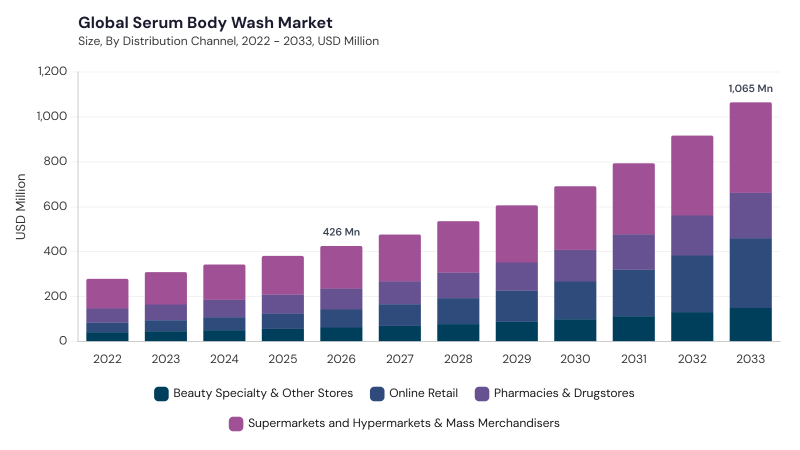
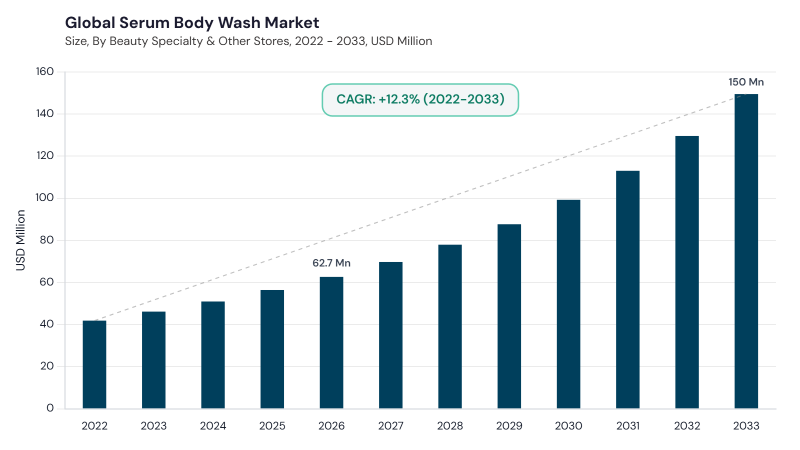
Based on Distribution Channel, the market is segmented into Supermarkets and Hypermarkets & Mass Merchandisers, Pharmacies & Drugstores, Online Retail, Beauty Specialty & Other Stores. Supermarkets and Hypermarkets & Mass Merchandisers dominated in 2025 and is projected to reach USD 403.2 million by 2033, growing at a CAGR of 11.4%. Online Retail is expected to record the highest CAGR of 21.3% during the forecast period.
Supermarkets, hypermarkets and mass merchandisers provide serum body wash brands with access to routine personal care purchases and opportunities to encourage trial through promotions and shelf visibility. Pharmacies and drugstores are particularly relevant to sensitive skin and barrier care positioning, while beauty specialty stores support premium serum complexes and benefit-led assortments. Online retail enables detailed ingredient communication, comparison of targeted formulations and routine-based bundles. Digital discovery of branded serum body washes can support customer acquisition, but repeat purchasing remains dependent on product performance, affordability and availability.
Free Valuable Insights: Serum Body Wash Market Size to reach $1.1 Billion by 2033
Region-wise, the Serum Body Wash Market is analyzed across North America, Europe, Asia Pacific, LAMEA. North America led in 2025 and is projected to reach USD 375.6 million by 2033, growing at a CAGR of 12.1%. Europe is projected to grow at a CAGR of 15.6%. Asia Pacific is projected to grow at a CAGR of 14.1%. LAMEA is projected to grow at a CAGR of 19.0%.
North America offers opportunities for serum body wash through established personal care retail networks and benefit-led premiumization. In Europe, formulation transparency, mild cleansing and substantiated cosmetic claims can influence product differentiation. Asia Pacific provides opportunities to adapt serum-infused body cleansing to established skincare preferences, local price points and digital beauty retail. In LAMEA, expansion potential depends on accessible pack sizes, distribution reach and formulations suited to local consumer preferences. Across regions, the transfer of facial skincare concepts into body cleansing provides a route to portfolio expansion without requiring consumers to adopt an entirely separate treatment routine.
By Primary Benefit
By Product Form
By Distribution Channel
By Geography
| Report Attribute | Details |
|---|---|
| Market size value in 2026 | USD 425.6 million |
| Market size forecast in 2033 | USD 1.1 billion |
| Base Year | 2025 |
| Historical Period | 2022 to 2024 |
| Forecast Period | 2026 to 2033 |
| Revenue Growth Rate | CAGR of 14.0% from 2026 to 2033 |
| Number of Tables | 480 |
| Number of Figures | 81 |
| Report Coverage | Market Trends, Revenue Estimation and Forecast, Segmentation Analysis, Regional and Country Breakdown, Competitive Landscape |
| Segments Covered | Primary Benefit, Product Form, Distribution Channel and Geography |
| Country Scope |
|
By Geography
Expected to reach USD 1.1 billion by 2033, with a 14.0% CAGR during 2026-2033.
Hydration & Nourishment leads, projected to hit USD 431.4 million by 2033.
Top companies hold dominant positions in this space.
Cream & Lotion Body Wash leads, expected to reach USD 496.6 million by 2033.
Supermarkets and Hypermarkets & Mass Merchandisers lead, projected to reach USD 403.2 million by 2033.
Demand for comfortable everyday cleansing and targeted benefits are key growth drivers.
Our team of dedicated experts can provide you with attractive expansion opportunities for your business.