“Global Reconciliation Software Market to reach a market value of USD 6.33 Billion by 2032 growing at a CAGR of 12.9%”
The Global Reconciliation Software Market size is expected to reach USD 6.33 billion by 2032, rising at a market growth of 12.9% CAGR during the forecast period.
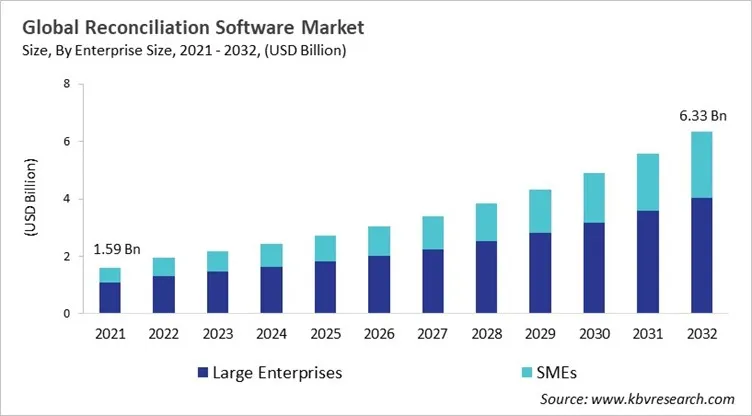
The reconciliation software market has recently developed into a cloud-driven, highly-automated ecosystem at the core of modern financial control. Reconciliation software has gained significant importance with the increasing regulatory scrutiny over financial reporting. The acceptance of APIs, cloud computing, and standard data formats like ISO 20022 has allowed automatic variance detection, and real-time processing, and continuous monitoring across complex financial systems. These advancements, along with digital banking and real-time payments, have transitioned reconciliation from periodic checks to continuous assurance, supporting transparency, operational efficiency, and compliance across enterprises.
The reconciliation software market is expected to grow significantly backed by elements including ecosystem integration, data standardization, and artificial intelligence. Machine learning and AI improve accuracy by autonomously intensifying mismatches and anticipating anomalies, while standardized financial data under ISO 20022 enhances automatic matching and interoperability. Moreover, reconciliation functions are largely embedded within treasury, payment systems, and ERP through API-driven, cloud-native architectures. Key players focus on integrating real-time visibility, strong governance frameworks, and AI-based automation to deliver secure, compliant, and scalable solutions. The market remains competitive with innovation, regulatory adaptability, and support for multi-entity environments-positioning reconciliation software as a crucial part of financial integrity in the digital economy.
The major strategies followed by the market participants are Product Launches as the key developmental strategy to keep pace with the changing demands of end users. For instance, In September, 2025, BlackLine, Inc. unveiled Verity AI, integrating advanced AI tools within its Studio360 platform to reinforce finance process integrity, automate reconciliation, and generate intelligent insights. Built on a unified data layer, Verity aims to offer transparent, auditable AI tailored for the Office of the CFO. Additionally, In September, 2025, Prophix Software Inc. unveiled Prophix One Agents, a new suite of autonomous finance agents that automate complex tasks (budgeting, reporting, modeling) with built-in audit trails and transparency. These agents reduce manual workload in financial operations and support CFOs in scaling strategic insight across planning, closing, and reporting.
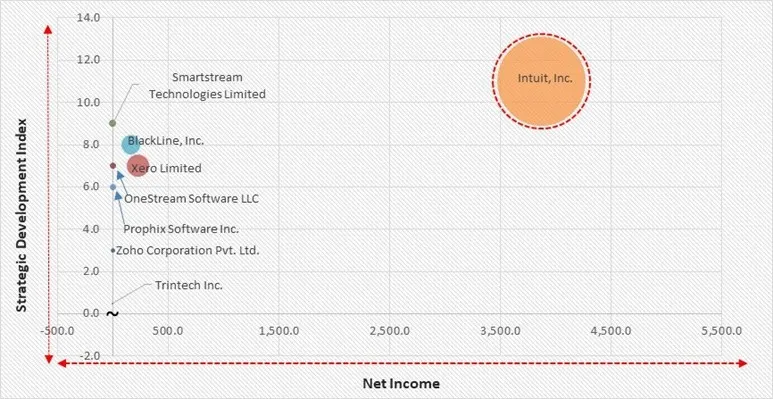
Based on the Analysis presented in the KBV Cardinal matrix; Intuit, Inc. is the forerunner in the Reconciliation Software Market. Companies such as Xero Limited, BlackLine, Inc., and Smartstream Technologies Limited are some of the key innovators in Reconciliation Software Market. In July 2025, Intuit, Inc. unveiled a new suite of AI agents integrated into QuickBooks to automate accounting workflows, including transaction categorization and reconciliation. These agents collaborate with human experts to provide real-time insights, reduce manual effort, and improve financial accuracy for businesses.
The COVID-19 pandemic hurt the reconciliation software market because it slowed down the economy, cut IT budgets, and delayed automation projects, which made growth harder in 2020 and 2021. Many businesses put off making investments in favor of survival measures like working from home and managing cash flow. Operational problems showed how weak manual reconciliation processes are when people are working from home and transaction volumes change. Delays in implementation, fewer new clients, and financial stress on vendors all made the market move even more slowly. Overall, budget problems and operational problems put a temporary stop to the industry's growth. Thus, the COVID-19 pandemic had a negative impact on the market.

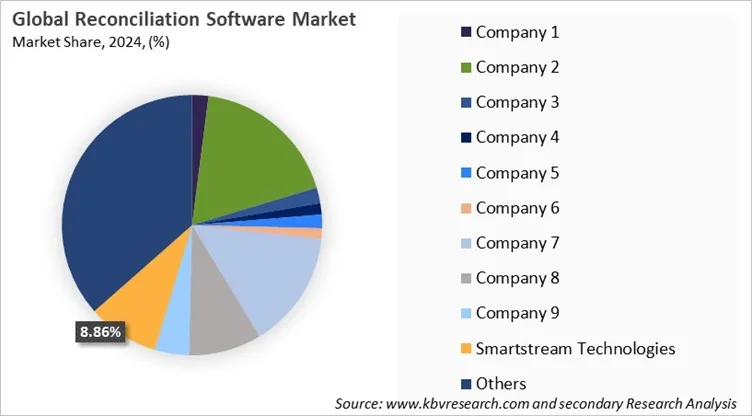
The leading players in the market are competing with diverse innovative offerings to remain competitive in the market. The above illustration shows the percentage of revenue shared by some of the leading companies in the market. The leading players of the market are adopting various strategies in order to cater demand coming from the different industries. The key developmental strategies in the market are Acquisitions, and Partnerships & Collaborations.
Free Valuable Insights: Global Reconciliation Software Market size to reach USD 6.33 Billion by 2032
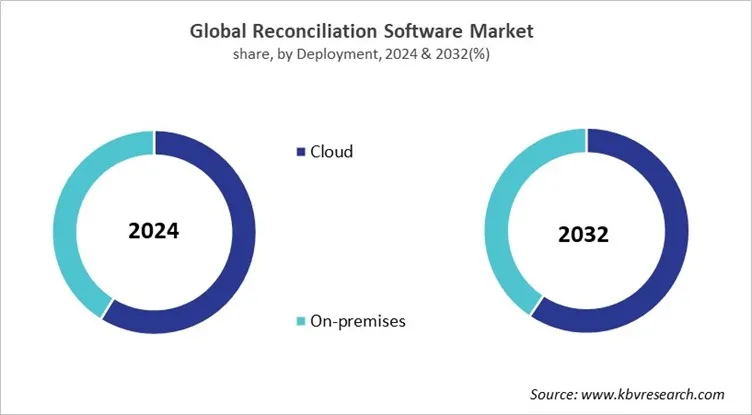
On the basis of deployment, the Reconciliation Software Market is classified into cloud and on-premises. Enterprises operating in highly regulated industries, such as banking, insurance, and government, often prefer on-premises solutions due to concerns over data sovereignty, compliance mandates, and internal security protocols. These deployments allow organizations to host the software on their own servers, giving them the ability to customize configurations, enforce strict access controls, and manage upgrades and maintenance according to internal IT policies.
Based on enterprise size, the reconciliation software market is characterized into large enterprises and SMEs. The SMEs segment attained 33% revenue share in the Reconciliation Software Market in 2024. These organizations, often characterized by lean finance teams and growing transaction volumes, are recognizing the inefficiencies and risks associated with manual reconciliation using spreadsheets or disconnected systems. Modern reconciliation solutions tailored for SMEs focus on ease of deployment, intuitive interfaces, and cost-effective cloud-based delivery models that reduce upfront infrastructure investment.
Region-wise, the reconciliation software market is analyzed across North America, Europe, Asia Pacific, and LAMEA. The North America segment recorded 37% revenue share in the reconciliation software market in 2024. The reconciliation software market is predicted to procure a prominent share in North America and Europe. This is due to well-established financial ecosystems, early adoption of automation in financial operations, and stringent regulatory mandates. The North American nations, such as Canada and the US, are experiencing strong demand from fintechs, corporates, and banks looking for real-time transaction monitoring and compliance with evolving accounting standards like GAAP and SOX. The growth of digital payments, cloud-based reconciliation platforms, and open banking has surged acceptance across both non-financial and financial industries. Furthermore, Europe’s regulatory frameworks, such as GDPR and PSD2, have raised the focus on transparent financial reporting, encouraging financial institutions to invest in AI-based reconciliation tools that improve auditability and accuracy.
In the Asia Pacific and LAMEA regions, the reconciliation software market is anticipated to grow at a high rate. This is driven by expanding banking penetration, rapid digital transformation, and the modernization of financial infrastructure. Regional nations like China, Singapore, and India are adopting automated reconciliation systems to manage high transaction volumes and regulatory compliance in rapidly growing financial markets. The region’s growing fintech ecosystem and acceptance of real-time payments are further raising demand for cloud-native and scalable reconciliation platforms. Moreover, the LAMEA region is expected to have growth backed by financial institutions and enterprises in these regions, modernizing their accounting systems, enhancing operational transparency, and transitioning towards automation to support cross-border activities and digital banking.
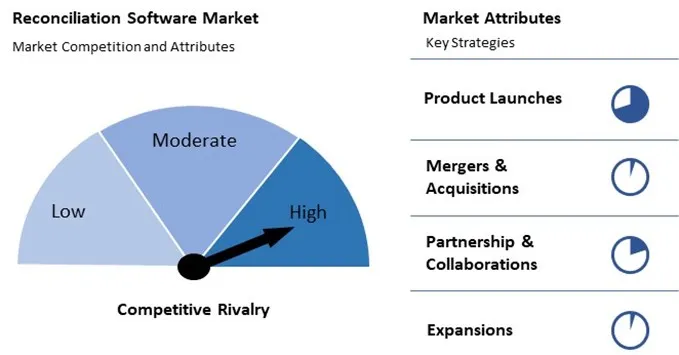
The market competition in the Reconciliation Software Market is intense, driven by the rising need for automation, accuracy, and compliance in financial processes. Companies compete on features such as scalability, integration capabilities, real-time processing, and advanced analytics. Continuous technological innovation, including AI and machine learning, heightens competition as vendors strive to enhance efficiency and reduce manual errors. The market also sees pressure from emerging cloud-based solutions and growing customer demand for cost-effective, secure, and customizable reconciliation platforms.
| Report Attribute | Details |
|---|---|
| Market size value in 2025 | USD 2.71 Billion |
| Market size forecast in 2032 | USD 6.33 Billion |
| Base Year | 2024 |
| Historical Period | 2021 to 2023 |
| Forecast Period | 2025 to 2032 |
| Revenue Growth Rate | CAGR of 12.9% from 2025 to 2032 |
| Number of Pages | 443 |
| Number of Tables | 355 |
| Report coverage | Market Trends, Revenue Estimation and Forecast, Segmentation Analysis, Regional and Country Breakdown, Competitive Landscape, Market Share Analysis, Porter’s 5 Forces Analysis, Company Profiling, Companies Strategic Developments, SWOT Analysis, Winning Imperatives |
| Segments covered | Enterprise Size, Deployment, Industry, Region |
| Country scope |
|
| Companies Included | Solvexia Pty Ltd, BlackLine, Inc., Prophix Software Inc., Xero Limited, Zoho Corporation Pvt. Ltd., Intuit, Inc. (Quickbooks), Trintech Inc., OneStream Software LLC, API Software Limited (AutoRek) and Smartstream Technologies Limited |
By Enterprise Size
By Deployment
By Industry
By Geography
This Market size is expected to reach USD 6.33 Billion by 2032.
The reconciliation software market is projected to grow at a CAGR of 12.9% between 2025 and 2032.
Regulatory and compliance pressure, combined with rising transaction volumes, business complexity, and globalization, is driving the need for more robust internal controls.
Solvexia Pty Ltd, BlackLine, Inc., Prophix Software Inc., Xero Limited, Zoho Corporation Pvt. Ltd., Intuit, Inc. (Quickbooks), Trintech Inc., OneStream Software LLC, API Software Limited (AutoRek) and Smartstream Technologies Limited
The BFSI segment is generating the maximum revenue share in the Global Reconciliation Software Market by Industry in 2024, growing at a CAGR of 12.2 % during the forecast period.
The North America region dominated the Global Reconciliation Software Market by Region in 2024, and would continue to be a dominant market till 2032; thereby, achieving a market value of $2.26 billion by 2032.
Our team of dedicated experts can provide you with attractive expansion opportunities for your business.








 Unique Offerings