The sample copy of this report is available for access.
“Global Radio Frequency Duplexer Market to reach a market value of USD 10.34 billion by 2033 growing at a CAGR of 12.2%”
The Global Radio Frequency Duplexer Market size is expected to reach USD 10.34 billion by 2033, rising at a market growth of 12.0% CAGR during the forecast period.
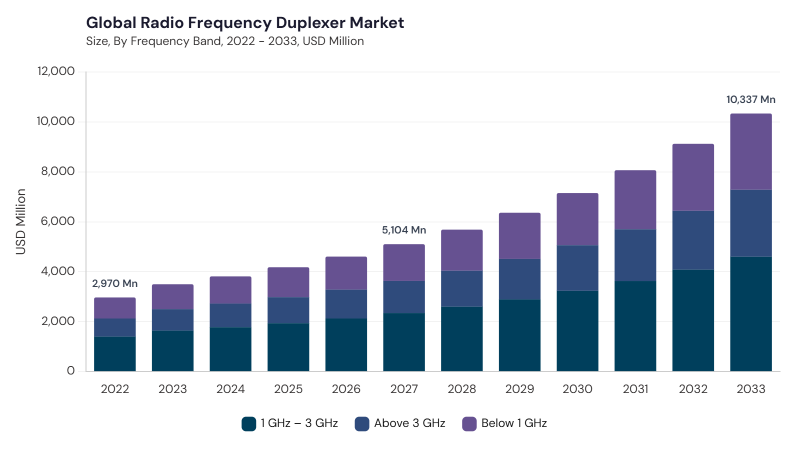
The market is witnessing strong growth due to increasing deployment of 5G networks, rising smartphone penetration, and growing demand for high-performance RF front-end components. Expanding wireless communication infrastructure and increasing adoption of IoT-connected devices are further supporting market expansion.
The radio frequency duplexer market has evolved significantly alongside advancements in wireless communication technologies. Duplexers play a critical role in enabling simultaneous transmission and reception of signals using a shared antenna, making them essential components in smartphones, telecom infrastructure, automotive communication systems, aerospace applications, and industrial IoT networks. The transition from traditional communication systems to advanced 4G LTE and 5G architectures has accelerated the need for compact, energy-efficient, and high-performance duplexers.
The market continues to benefit from increasing investments in telecom infrastructure, rising adoption of connected devices, and growing demand for multi-band communication systems. Manufacturers are focusing on improving frequency selectivity, reducing insertion loss, and enhancing integration capabilities to support evolving wireless standards and high-speed connectivity requirements across global industries.
Companies operating in the radio frequency duplexer market are focusing on innovation in SAW and BAW technologies to improve signal quality, miniaturization, and frequency efficiency. Strategic collaborations with telecom equipment providers, smartphone OEMs, and semiconductor manufacturers are helping companies strengthen product integration capabilities and accelerate commercialization. Market participants are also expanding manufacturing capacities and regional distribution networks to support growing demand from 5G infrastructure, IoT applications, and automotive communication systems.
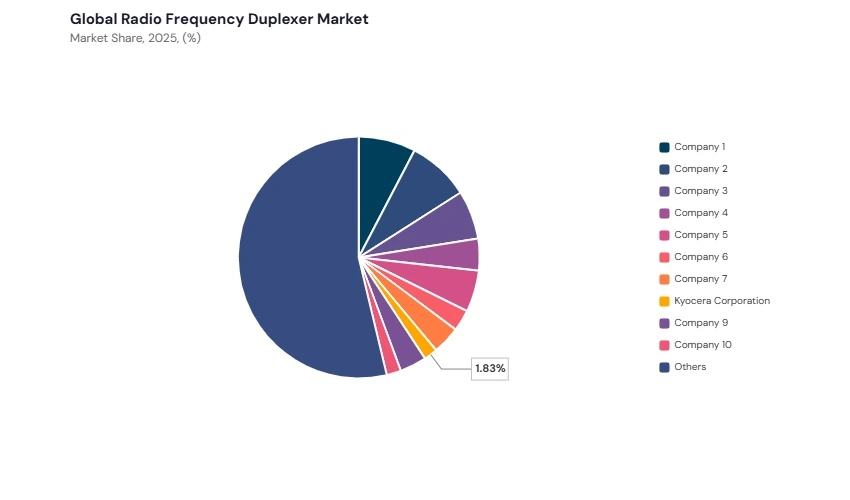
The radio frequency duplexer market is highly consolidated, with leading companies accounting for a major share of global revenue. Murata Manufacturing dominated the market with approximately 16.65% share, supported by strong capabilities in SAW and BAW technologies and extensive partnerships with smartphone manufacturers. Broadcom and Qorvo also maintain strong market positions due to advanced RF filtering solutions and robust intellectual property portfolios.
Skyworks, TDK, and Qualcomm continue to strengthen their presence through integrated RF front-end modules and chipset-level optimization strategies. Mid-tier companies including Taiyo Yuden, Kyocera, CTS Corporation, and Tai-Saw Technology contribute through specialized ceramic and acoustic filter technologies targeting niche and regional applications.
The market is expected to witness increasing competition driven by advancements in AI-assisted RF design, cloud-enabled simulation platforms, and integration of duplexers within next-generation communication systems. Growing demand for 5G infrastructure, IoT devices, and connected automotive technologies is expected to create opportunities for both established players and specialized manufacturers.

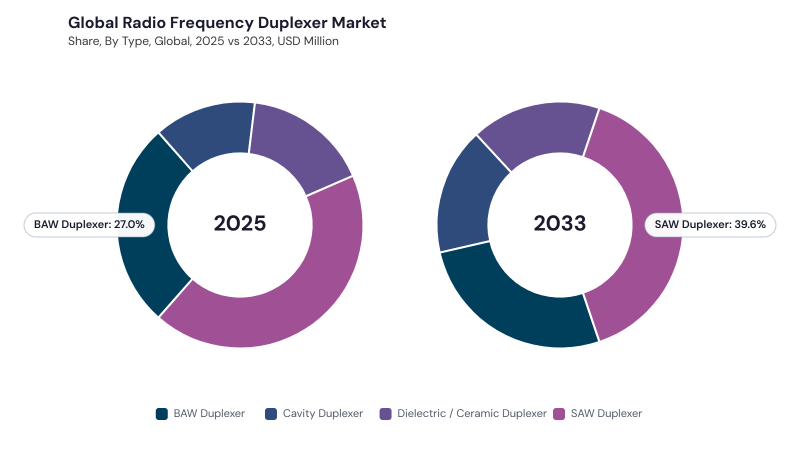
On the basis of type, the radio frequency duplexer market is classified into SAW Duplexer, BAW Duplexer, Cavity Duplexer, and Dielectric / Ceramic Duplexer. The SAW Duplexer segment acquired the largest revenue share of 43.02% in 2025 owing to its cost-effectiveness, compact size, and extensive deployment across smartphones, tablets, and consumer electronics. The segment is projected to reach USD 4.09 billion by 2033. Meanwhile, the BAW Duplexer segment accounted for 27.02% share in 2025 and is expected to witness strong growth due to increasing adoption in high-frequency 5G communication systems and advanced wireless infrastructure applications.
Based on frequency range, the radio frequency duplexer market is segmented into Below 1 GHz, 1 GHz – 3 GHz, and Above 3 GHz. The 1 GHz – 3 GHz segment recorded the largest revenue share of 46.42% in 2025 driven by extensive utilization in LTE, 4G, and early-stage 5G communication networks. The segment is projected to maintain its dominance during the forecast period due to growing deployment of multi-band wireless communication systems globally. The Above 3 GHz segment is also expected to witness strong growth supported by increasing adoption of mmWave and high-frequency 5G technologies.
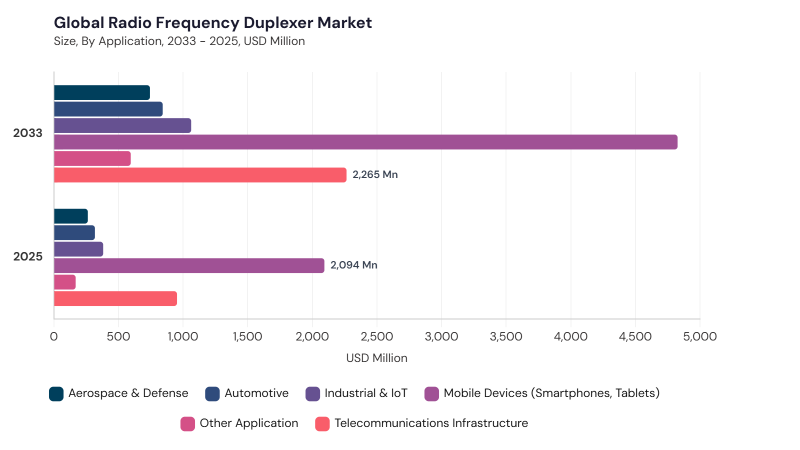
By application, the radio frequency duplexer market is divided into Mobile Devices (Smartphones, Tablets), Telecommunications Infrastructure, Automotive, Aerospace & Defense, Industrial & IoT, and Other Application. The Mobile Devices segment dominated the market with a revenue share of 50.08% in 2025 owing to rising smartphone penetration, increasing mobile data consumption, and growing demand for multi-band wireless connectivity. The segment is projected to garner a market value of USD 3.83 billion by 2032, witnessing strong demand with increasing deployment of 5G-enabled smartphones globally. Telecommunications Infrastructure also accounted for a significant market share of 22.81% in 2025 supported by expanding telecom network investments and rapid deployment of advanced wireless infrastructure.
The competitive landscape of the radio frequency duplexer market is characterized by strong focus on innovation, RF integration, and advanced filter technologies. Leading companies are investing heavily in AI-enabled simulation tools, compact RF front-end modules, and high-frequency communication solutions to support 5G and future wireless standards. Increasing demand for multi-band connectivity is encouraging companies to develop highly integrated and energy-efficient duplexers.
Integration and interoperability remain key competitive factors as manufacturers aim to improve compatibility with evolving communication standards and network architectures. Partnerships with smartphone manufacturers, telecom operators, and semiconductor companies are helping market participants strengthen ecosystem presence and improve product adoption across consumer electronics and infrastructure applications.
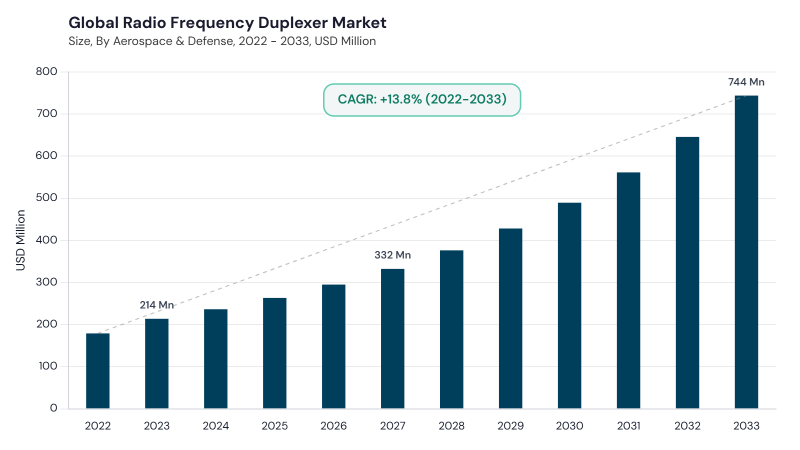
Regional expansion and pricing strategies continue to shape market dynamics. Asia Pacific remains a major manufacturing hub due to cost advantages and strong electronics demand, while North America and Europe focus on premium high-performance solutions for advanced communication infrastructure and aerospace applications.
| Report Attribute | Details |
|---|---|
| Market size value in 2026 | USD 4.60 billion |
| Market size forecast in 2033 | USD 10.34 billion |
| Base Year | 2025 |
| Historical period | 2022 to 2024 |
| Forecast Period | 2026 to 2033 |
| Revenue Growth Rate | CAGR of 12.2% from 2026 to 2033 |
| Number of Pages | 611 |
| Tables | 690 |
| Report Coverage | Market Trends, Revenue Estimation and Forecast, Segmentation Analysis, Regional and Country Breakdown, Competitive Landscape, Market Share Analysis, Company Profiling, Companies Strategic Developments, SWOT Analysis, Winning Imperatives |
| Segments Covered | Type, Frequency Band, Application, Region |
| Country Scope |
|
| Companies Included | Murata Manufacturing Co., Ltd., Broadcom Inc., Qorvo, Inc., Skyworks Solutions, Inc., TDK Corporation, Qualcomm Incorporated, Taiyo Yuden Co., Ltd., Kyocera Corporation, CTS Corporation, Tai-Saw Technology Co., Ltd. |
By Type
By Frequency Band
By Application
By Region
By Geography
Valued at USD 4.60 billion in 2026, it will reach USD 10.34 billion by 2033, growing at 12.2% CAGR during 2026-2033.
SAW Duplexer dominates with 43.03% market share, projected to hit USD 4.09 billion by 2033 at 11.1% CAGR during the forecast period.
Murata Manufacturing Co., Ltd., Broadcom Inc., and Qorvo, Inc. hold the leading positions in this space.
Asia Pacific leads with 39.73% market share, reaching USD 4.22 billion by 2033 at 12.6% CAGR during the forecast period.
Mobile Devices captures 50.09% market share, projected to reach USD 4.83 billion by 2033 at 11.2% CAGR during the forecast period.
1 GHz – 3 GHz band leads with 46.42% share, targeting USD 4.60 billion by 2033 at 11.6% CAGR during the forecast period.
Our team of dedicated experts can provide you with attractive expansion opportunities for your business.








 Unique Offerings