“Global Probiotic Water Market to reach a market value of USD 3382.34 Million by 2033 growing at a CAGR of 12%”
The Global Probiotic Water Market is expected to reach USD 3.4 billion by 2033, growing at a CAGR of 12.0% during (2026 - 2033).
The Probiotic Water Market combines a water-based drinking format with a live-culture proposition. It offers manufacturers a way to connect routine refreshment with a functional ingredient story, while giving consumers an alternative to dairy drinks, concentrated shots, or supplements. The working category covers eligible still and sparkling water beverages marketed with probiotics. It does not automatically include every fermented drink, prebiotic soda, or juice containing cultures. A clear boundary matters because adjacent beverages can compete for the same purchase occasion without belonging to the same measured market. Within functional hydration, clear differentiation between live probiotic cultures and prebiotic ingredients is important for product discovery and brand positioning. Consumer interest in probiotic water benefits creates a need for transparent communication of culture identity and evidence-supported claims, rather than generalized promises about gut health.
Probiotic water places a culture-related proposition within a familiar beverage occasion. A consumer can consider it as a flavored refreshment without moving into the format of a capsule, concentrated shot, or dairy drink. This gives brands an accessible way to explain the product and creates a potential reason to trade up from ordinary flavored water. The commercial driver is the combination of a desirable drinking experience and an understandable ingredient proposition. Repeat demand still depends on taste, price, convenience, and confidence in the product information, rather than on functional terminology alone. Category education can help beverage manufacturers distinguish probiotic water from adjacent products such as probiotic dairy drinks, supplements and fermented beverages, without implying equivalent functional effects.
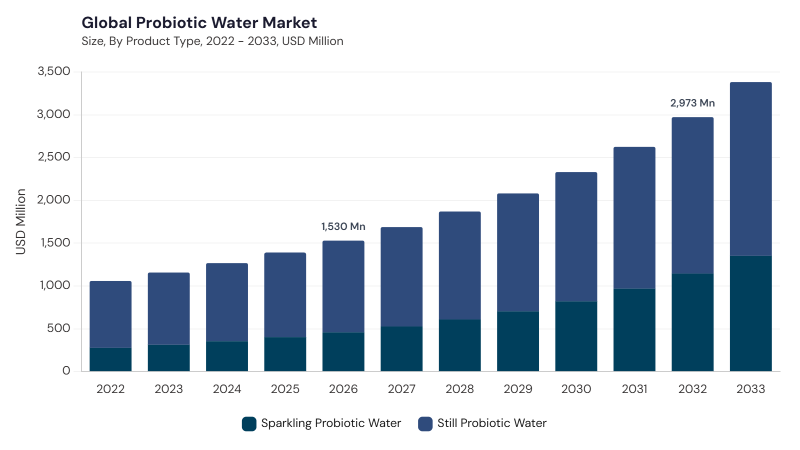
Still Probiotic Water's 69.31% allocation provides the largest supplied product base, while the sparkling segment offers a separate route to refreshment. The two formats allow manufacturers to serve different sensory preferences without assuming that all customers want carbonation. A focused assortment can make the choice clear through flavor, pack presentation, and intended occasion. Developers must ensure that each format works with the selected culture and processing approach. Format breadth can support commercial reach, but additional variants should be justified by repeat demand and manageable production requirements rather than range expansion for its own sake.
Based on Product Type, the market is segmented into Still Probiotic Water, Sparkling Probiotic Water. Still Probiotic Water dominated in 2025 and is projected to reach USD 2.0 billion by 2033, growing at a CAGR of 9.6%. Sparkling Probiotic Water is expected to record the highest CAGR of 16.7% during the forecast period.
Still probiotic water offers a familiar hydration format that can be positioned for everyday consumption, with flavored and unflavored variants supporting different preferences. Sparkling probiotic water provides an alternative for consumers seeking carbonation and a functional refreshment experience. Manufacturers can differentiate these products through sweetness levels, carbonation intensity and convenient packaging, while ensuring that processing and storage conditions remain compatible with the selected live probiotic cultures. The expansion of sparkling formats creates opportunities to compete for refreshment occasions traditionally served by flavored sparkling water and soft drinks.
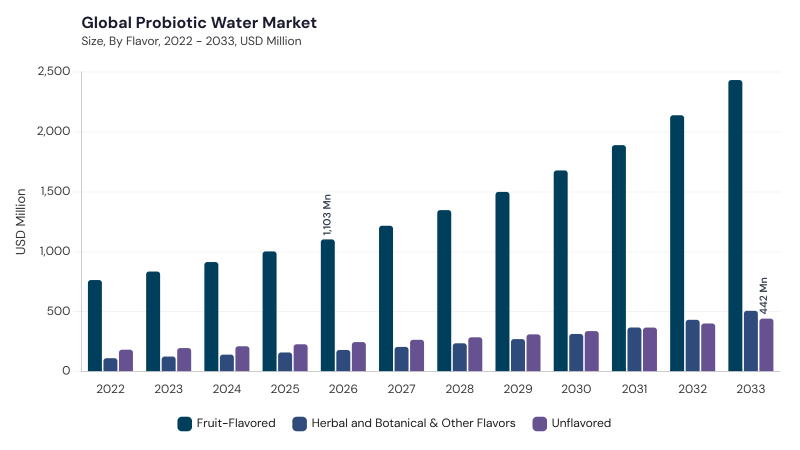
Based on Flavor, the market is segmented into Fruit-Flavored, Unflavored, Herbal and Botanical & Other Flavors. Fruit-Flavored dominated in 2025 and is projected to reach USD 2.4 billion by 2033, growing at a CAGR of 12.0%. Herbal and Botanical & Other Flavors is expected to record the highest CAGR of 15.9% during the forecast period.
Fruit-flavored probiotic water allows manufacturers to balance the sensory characteristics of live-culture formulations with familiar citrus, berry and tropical flavor profiles. Unflavored products offer a simpler hydration proposition for consumers who prefer neutral taste and minimal flavor additions. Herbal and botanical variants create opportunities for premium positioning through ingredients such as mint, ginger and botanical extracts, subject to formulation compatibility. Flavor innovation can encourage trial and portfolio differentiation, although repeat purchasing depends on taste consistency, pricing and the overall drinking experience.
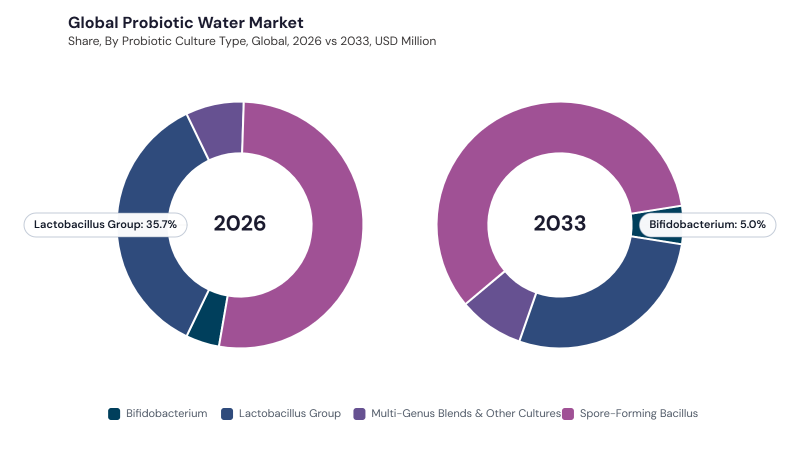
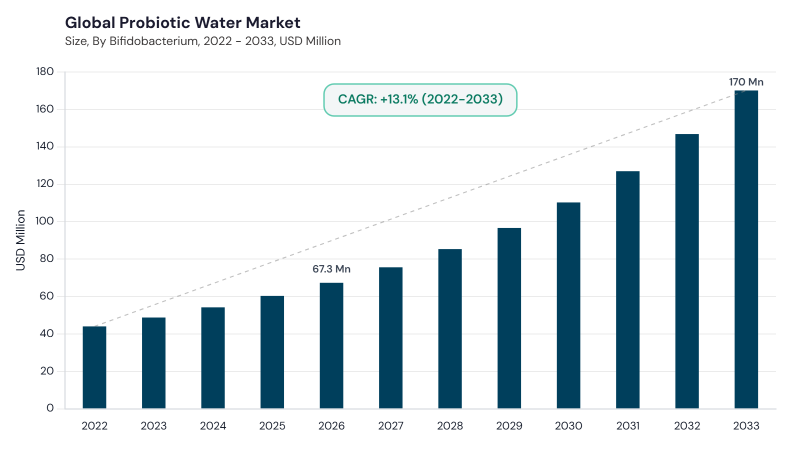
Based on Probiotic Culture Type, the market is segmented into Spore-Forming Bacillus, Lactobacillus Group, Bifidobacterium, Multi-Genus Blends & Other Cultures. Spore-Forming Bacillus dominated in 2025 and is projected to reach USD 2.0 billion by 2033, growing at a CAGR of 13.8%. Bifidobacterium is expected to record the highest CAGR of 14.2% during the forecast period.
Spore-forming Bacillus cultures offer formulation advantages because selected strains can tolerate processing and storage stresses more effectively than many non-spore-forming cultures. Lactobacillus Group and Bifidobacterium formulations provide opportunities for strain-specific differentiation, but viability can depend on acidity, oxygen exposure, temperature and shelf-life conditions. Multi-genus blends allow manufacturers to develop differentiated culture combinations while increasing formulation and quality-control complexity. Competitive positioning in probiotic water increasingly depends on transparent strain identification, substantiated claims and the ability to maintain appropriate viable culture levels throughout the stated shelf life.
Based on Distribution Channel, the market is segmented into Supermarkets & Hypermarkets, Convenience Stores, Online Retail, Specialty & Other Channels. Supermarkets & Hypermarkets dominated in 2025 and is projected to reach USD 1.5 billion by 2033, growing at a CAGR of 11.6%. Online Retail is expected to record the highest CAGR of 18.4% during the forecast period.
Supermarkets and hypermarkets provide probiotic water brands with opportunities to reach mainstream bottled-water and functional-beverage shoppers through shelf placement, promotional offers and multipacks. Convenience stores support immediate-consumption occasions, particularly through chilled single-serve products. Online retail enables direct-to-consumer brands to communicate culture information, offer variety packs and encourage planned replenishment. Specialty and other channels can support targeted discovery among wellness-oriented consumers. Distribution strategies must account for product-specific storage requirements, shelf life, shipping costs and the price premium over conventional bottled water.
Free Valuable Insights: Probiotic Water Market Size to reach $3.4 Billion by 2033
Region-wise, the Probiotic Water Market is analyzed across North America, Europe, Asia Pacific, LAMEA. North America led in 2025 and is projected to reach USD 1.7 billion by 2033, growing at a CAGR of 10.2%. Europe is projected to grow at a CAGR of 13.7%. Asia Pacific is projected to grow at a CAGR of 14.8%. LAMEA is projected to grow at a CAGR of 12.9%.
North America benefits from established functional beverage retail channels and opportunities to differentiate probiotic water from conventional flavored water. In Europe, product development must account for applicable nutrition and health claim requirements alongside consumer preferences for functional refreshments. Asia Pacific offers expansion opportunities through localized fruit and botanical flavors, convenient packaging and familiarity with adjacent probiotic beverage categories. In LAMEA, selective entry through urban retail networks and affordable pack formats can support category development. Across regions, culture stability, distribution infrastructure and consumer understanding remain important considerations for sustainable expansion.
By Product Type
By Flavor
By Probiotic Culture Type
By Distribution Channel
By Geography
| Report Attribute | Details |
|---|---|
| Market size value in 2026 | USD 1.5 billion |
| Market size forecast in 2033 | USD 3.4 billion |
| Base Year | 2025 |
| Historical Period | 2022 to 2024 |
| Forecast Period | 2026 to 2033 |
| Revenue Growth Rate | CAGR of 12.0% from 2026 to 2033 |
| Number of Tables | 540 |
| Number of Figures | 91 |
| Report Coverage | Market Trends, Revenue Estimation and Forecast, Segmentation Analysis, Regional and Country Breakdown, Competitive Landscape |
| Segments Covered | Product Type, Flavor, Probiotic Culture Type, Distribution Channel and Geography |
| Country Scope |
|
By Geography
Expected to reach USD 3.4 billion by 2033, growing at 12.0% CAGR during the forecast period (2026-2033).
Still Probiotic Water leads, projected to hit USD 2.0 billion by 2033.
Top companies include PepsiCo, KeVita, and GT's Living Foods.
Fruit-Flavored products dominate, expected to reach USD 2.4 billion by 2033.
North America leads with a projected market value of USD 1.7 billion by 2033.
Supermarkets & Hypermarkets lead, expected to reach USD 1.5 billion by 2033.
Our team of dedicated experts can provide you with attractive expansion opportunities for your business.