The Global Tele-monitoring Services Market will hit USD 91.10 billion by 2032, at a CAGR of 17.9%
Special Offering :
Industry Insights | Market Trends | Highest number of Tables | 24/7 Analyst Support
Tele-monitoring Services Market Growth, Trends and Report Highlights
According to a new report, published by KBV research, The Global Tele-monitoring Services Market size is expected to reach $91.10 billion by 2032, rising at a market growth of 17.9% CAGR during the forecast period.
The Tele-monitoring Services Market has evolved significantly over recent decades, emerging as an essential segment within the broader healthcare technology landscape. Initially limited by technological constraints, tele-monitoring services began primarily as rudimentary forms of patient tracking using basic devices to capture vital signs remotely. Over time, advances in information and communication technology, coupled with widespread adoption of internet connectivity and mobile devices, propelled the market into a comprehensive digital health service ecosystem.
The Wearables / Remote Sensors segment registered the maximum revenue in the Global Tele-monitoring Services Market by Device in 2024, thereby, achieving a market value of $50.3 billion by 2032. These devices include smartwatches, fitness trackers, biosensors, and other connected medical devices that can measure vital signs such as heart rate, blood pressure, oxygen saturation, glucose levels, and physical activity. The increasing adoption of these technologies is driven by their ability to provide accurate and timely health data, allowing healthcare providers to make informed decisions and deliver proactive care.
The Remote Patient Monitoring (RPM) is poised to grow at a CAGR of 17.4 % during the forecast period. The remote patient monitoring (RPM) segment is a key component of the Tele-monitoring Services Market, enabling continuous tracking of patient health outside traditional healthcare settings. It uses connected devices and digital platforms to collect and transmit real-time data such as vital signs and disease-specific metrics. RPM supports early detection of health issues and timely medical intervention, improving overall patient outcomes.
The Insurance Reimbursement segment captured the maximum revenue in the Global Tele-monitoring Services Market by Payment Model in 2024, thereby, achieving a market value of $29.4 billion by 2032. The insurance reimbursement segment plays a significant role in the Tele-monitoring Services Market by enabling broader access to remote healthcare solutions through coverage provided by public and private insurers. This model allows patients to utilize tele-monitoring services with reduced financial burden, encouraging adoption across diverse patient groups. Healthcare providers increasingly integrate tele-monitoring into standard care pathways as reimbursement policies evolve to support digital health services.
The Providers segment is experiencing a CAGR of 17.1 % during the forecast period. The providers segment represents a major end user of tele-monitoring services, including hospitals, clinics, ambulatory care centers, and home healthcare agencies. These entities utilize tele-monitoring solutions to enhance patient care, improve clinical outcomes, and optimize healthcare delivery processes. By integrating remote monitoring technologies into their systems, providers can continuously track patient health data, enable early diagnosis, and reduce hospital readmissions.
The Primary Care segment led the maximum revenue in the Global Tele-monitoring Services Market by Application in 2024, thereby, achieving a market value of $23.3 billion by 2032. The primary care segment is a key application area in the Tele-monitoring Services Market, focusing on general health management and early diagnosis of medical conditions. Tele-monitoring services in primary care enable continuous tracking of vital signs, routine health parameters, and patient wellness through connected devices and digital platforms.
The Tele-Hospitals segment is growing at a CAGR of 17.5 % during the forecast period. The tele-hospitals segment represents a critical facility type in the Tele-monitoring Services Market, where remote monitoring technologies are integrated within hospital and clinical environments. This segment enables healthcare providers to monitor patients both within hospital settings and after discharge through centralized digital platforms. Tele-hospitals utilize advanced infrastructure, including connected medical devices, electronic health records, and real-time data analytics, to ensure continuous patient supervision and timely medical intervention.
Full Report: https://www.kbvresearch.com/tele-monitoring-services-market/
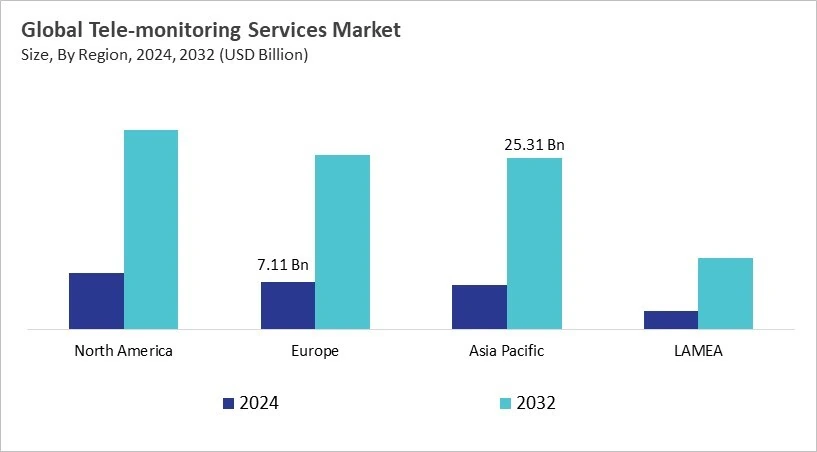
The North America region dominated the Global Tele-monitoring Services Market by Region in 2024, and would continue to be a dominant market till 2032; thereby, achieving a market value of $29.5 billion by 2032. The Europe region is anticipated to grow at a CAGR of 17.7% during (2025 - 2032). Additionally, The Asia Pacific region would witness a CAGR of 18.5% during (2025 - 2032).
List of Key Companies Profiled
- OMRON HEALTHCARE Co., Ltd. (Omron Corporation)
- Koninklijke Philips N.V.
- Teladoc Health, Inc.
- Twilio, Inc.
- Medtronic PLC
- GE HealthCare Technologies, Inc.
- American Well Corporation (Amwell)
- Athenahealth, Inc.
- Abbott Laboratories
- MDLive, Inc.
Tele-monitoring Services Market Report Segmentation
By Device
- Wearables / Remote Sensors
- Mobile Devices
By Service
- Remote Patient Monitoring (RPM)
- Chronic Disease Management
- Post-Operative Monitoring
By Payment Model
- Insurance Reimbursement
- Self-Pay (Out-of-Pocket)
- Employer-Sponsored
- Other Payment Model
By End Use
- Providers
- Patients
- Payers
- Other End Use
By Application
- Primary Care
- Cardiology
- Mental Health
- Dermatology
- Other Application
By Facility
- Tele-Hospitals
- Tele-Home
By Geography
- North America
- US
- Canada
- Mexico
- Rest of North America
- Europe
- Germany
- UK
- France
- Russia
- Spain
- Italy
- Rest of Europe
- Asia Pacific
- China
- Japan
- India
- South Korea
- Singapore
- Malaysia
- Rest of Asia Pacific
- LAMEA
- Brazil
- Argentina
- UAE
- Saudi Arabia
- South Africa
- Nigeria
- Rest of LAMEA
Related Reports: