According to a new report, published by KBV research, The Global Energy Tracking and Monitoring System Market size is expected to reach $38.41 billion by 2032, rising at a market growth of 7.1% CAGR during the forecast period.
Energy tracking and monitoring systems comprise digital hardware and software solutions designed to measure, analyze, and optimize energy consumption across industrial, commercial, utility, and residential sectors. These systems include smart meters, sub-metering devices, industrial control-integrated monitoring tools, cloud-based analytics platforms, and IoT-enabled sensors.
The Cloud segment captured the maximum revenue in the Global Energy Tracking and Monitoring System Market by Deployment in 2024, thereby, achieving a market value of $23.7 billion by 2032. Cloud-based deployment models are increasingly preferred by organizations seeking scalable, flexible, and remotely accessible energy management solutions. These platforms enable real-time monitoring of energy consumption across multiple facilities through centralized dashboards accessible from any internet-enabled device. The growing adoption of digital transformation strategies across industries has accelerated the demand for cloud-hosted energy tracking systems that minimize infrastructure complexity.
The Hardware segment is experiencing a CAGR of 6.4 % during the forecast period. Hardware components form the foundational layer of energy monitoring infrastructure, enabling accurate measurement, data acquisition, and transmission of energy consumption information. This segment includes smart meters, sensors, data loggers, controllers, and communication devices that capture real-time electricity, gas, water, and thermal energy usage across industrial, commercial, and residential facilities. Increasing emphasis on energy efficiency and operational transparency has driven widespread deployment of advanced metering infrastructure and IoT-enabled sensing devices.
The Industrial segment led the maximum revenue in the Global Energy Tracking and Monitoring System Market by Application in 2024, thereby, achieving a market value of $14.5 billion by 2032. Industrial facilities are typically energy-intensive environments where continuous monitoring is essential to ensure operational efficiency and cost optimization. Manufacturing plants, refineries, power generation units, and heavy processing industries rely on advanced energy tracking systems to measure consumption at machine, process, and facility levels. These systems enable real-time visibility into electricity, fuel, steam, and compressed air usage, helping operators detect inefficiencies and reduce wastage.
The Manufacturing segment is growing at a CAGR of 5.6 % during the forecast period. Manufacturing facilities operate energy-intensive machinery and continuous production lines that require precise monitoring to maintain efficiency and cost control. Energy tracking systems enable plant managers to measure consumption at equipment, process, and facility levels, helping identify inefficiencies and reduce operational waste. Integration with industrial automation platforms and production management systems enhances visibility into real-time performance metrics.
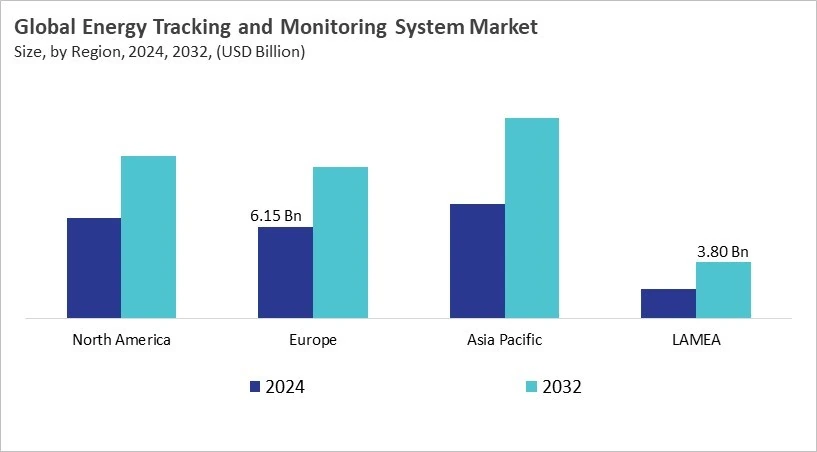
The Asia Pacific region dominated the Global Energy Tracking and Monitoring System Market by Region in 2024, and would continue to be a dominant market till 2032; thereby, achieving a market value of $13.5 billion by 2032. The Europe region is anticipated to grow at a CAGR of 6.7% during (2025 - 2032). Additionally, The North America region would witness a CAGR of 6.4% during (2025 - 2032).
By Deployment
By Component
By Application
By End-User
By Geography
 Unique Offerings

