The North America Energy Tracking and Monitoring System Market is expected to reach $7.82 billion by 2027 and would witness market growth of 6.4% CAGR during the forecast period (2025-2032).
The US market dominated the North America Energy Tracking and Monitoring System Market by Country in 2024, and would continue to be a dominant market till 2032; thereby, achieving a market value of $8,229.9 million by 2032. The Canada market is experiencing a CAGR of 9% during (2025 - 2032). Additionally, The Mexico market would exhibit a CAGR of 8.2% during (2025 - 2032). The US and Canada led the North America Energy Tracking and Monitoring System Market by Country with a market share of 79.2% and 10.5% in 2024.
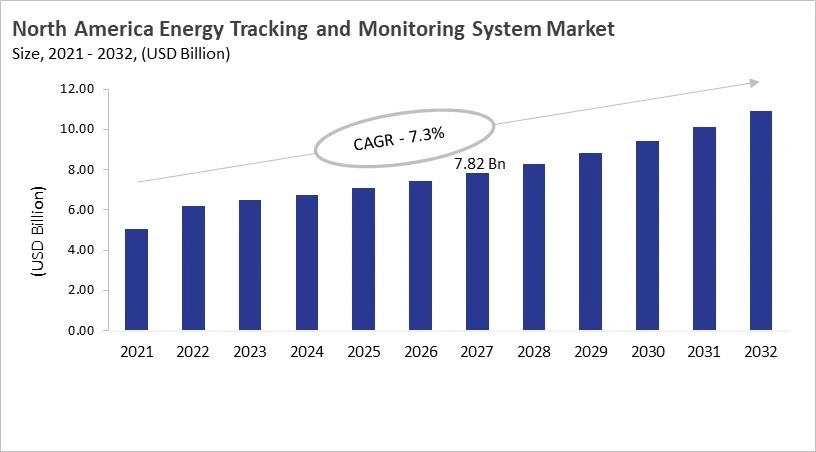
The North American Energy Tracking and Monitoring System market has grown due to stricter federal energy efficiency rules, more companies promising to reduce their carbon emissions, and the implementation of more renewable portfolio standards. State-level renewable energy certificate (REC) registries were established following policy changes implemented with the assistance of agencies such as the U.S. Environmental Protection Agency and the U.S. Department of Energy. These registries set up structured ways to stop double-counting and make sure that renewable electricity markets are credible. As time went on, these systems became regional electronic registries that worked with advanced Energy Management Information Systems (EMIS). This made it possible to monitor consumption in real time, diagnose performance issues, and report to regulators. Digitalization, smart metering, and cloud-based analytics have made utilities, businesses, and government buildings much more open, compatible, and compliant with each other.
Some important trends in the market are the move toward more detailed, time-based tracking of energy attributes, the growth of advanced digital monitoring platforms, and better compliance integration driven by policy. More and more, businesses put interoperability, standardized frameworks like ISO 50001 and DOE's 50001 Ready program, and registry operations that are safer for cybersecurity at the top of their lists. This is to keep data safe and easy to audit. Competition is less about price and more about how advanced the technology is, how accurate the reporting is, how scalable the system is, and how well it can work with federal and state compliance platforms. In general, the market shows that policies are driving a digital ecosystem that values openness, efficiency, and trustworthy governance of carbon reduction.
Based on Deployment, the market is segmented into Cloud, and On-Premises. Among various US Energy Tracking and Monitoring System Market by Deployment; The Cloud market achieved a market size of USD $3372.6 Million in 2024 and is expected to grow at a CAGR of 5.3 % during the forecast period. The On-Premises market is predicted to experience a CAGR of 6.4% throughout the forecast period from (2025 - 2032).
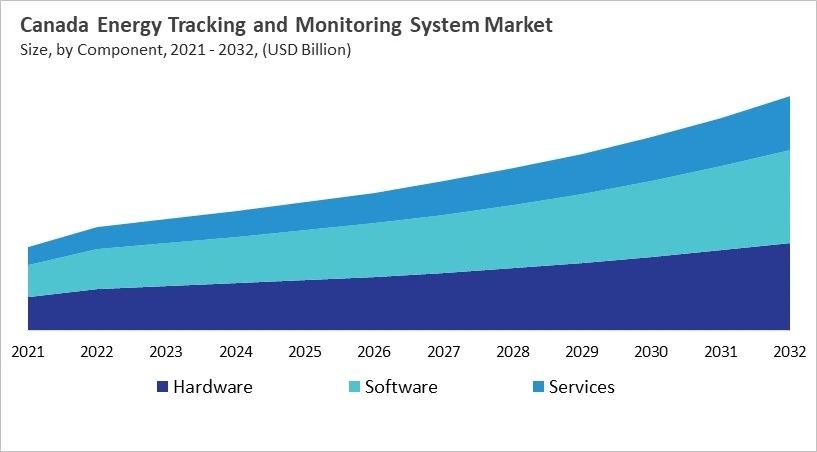
Based on Component, the market is segmented into Hardware, Software, and Services. The Hardware market segment dominated the Canada Energy Tracking and Monitoring System Market by Component is expected to grow at a CAGR of 8.3 % during the forecast period thereby continuing its dominance until 2032. Also, The Services market is anticipated to grow as a CAGR of 9.8 % during the forecast period during (2025 - 2032).
Free Valuable Insights: The Global Energy Tracking and Monitoring System Market will hit USD 38.41 billion by 2032, at a CAGR of 7.1%
The market for the United States Energy Tracking and Monitoring System is very advanced. This is due to efforts to modernize the grid, expand renewable energy, and strong regulatory oversight from groups like the Federal Energy Regulatory Commission and the North American Electric Reliability Corporation. Smart meters, AMI, and SCADA systems are now widely used, which has improved real-time visibility in utilities, factories, office buildings, and data centers. The U.S. Department of Energy and other federal programs are speeding up the use of advanced monitoring platforms that can handle distributed energy resources and load variability. These platforms are needed to meet grid resilience and decarbonization goals. The market is very focused on innovation, as seen by the use of IoT sensors, AI-driven analytics, cloud-based platforms, and digital substations. Schneider Electric, Siemens, Honeywell, GE Grid Solutions, and Eaton are some of the biggest technology companies in the world. They are at the top of the competitive landscape, which means that technology will keep getting better and companies will work together strategically across the energy value chain.

By Deployment
By Component
By Application
By End-User
By Country
Our team of dedicated experts can provide you with attractive expansion opportunities for your business.




 Unique Offerings