According to a new report, published by KBV research, The Global Digital Inspection Market size is expected to reach $36.15 billion by 2032, rising at a market growth of 6.3% CAGR during the forecast period.
The Global Digital Inspection Market has evolved from rudimentary manual checks to highly automated, data-driven systems that underpin modern quality assurance, safety, and compliance processes across industries. At its core, digital inspection refers to the application of advanced sensing, imaging, data analytics, and automation technologies to inspect products, assets, and infrastructure with greater precision and efficiency than traditional human-centric methods.
The 2D segment captured the maximum revenue in the Global Digital Inspection Market by Dimension in 2024, thereby, achieving a market value of $20.0 billion by 2032. The 2D segment of the Digital Inspection Market plays a critical role in supporting routine quality control and compliance requirements across a wide range of industries. This segment is widely adopted due to its straightforward implementation, reliable performance, and ability to deliver consistent inspection outcomes for planar surfaces and standardized components. Digital inspection systems based on two-dimensional imaging are commonly used for defect detection, measurement verification, labeling accuracy, and surface consistency checks.
The Machine Vision segment is experiencing a CAGR of 5.7 % during the forecast period. The Machine Vision segment forms a core technological foundation within the Digital Inspection Market, driven by its ability to automate visual inspection tasks with high speed and consistency. This segment is extensively used for applications such as surface inspection, defect detection, pattern recognition, and dimensional verification across industrial environments. Machine vision systems integrate cameras, sensors, lighting, and intelligent software to capture and analyze visual data in real time, enabling manufacturers to identify deviations early in the production process.
The Hardware segment led the maximum revenue in the Global Digital Inspection Market by Component in 2024, thereby, achieving a market value of $16.5 billion by 2032. The Hardware segment represents a fundamental component of the Digital Inspection Market, encompassing physical inspection equipment such as cameras, sensors, scanners, lighting systems, and measurement devices. These hardware elements form the backbone of digital inspection solutions by enabling accurate data capture from products, components, and surfaces. The reliability and performance of inspection hardware directly influence the effectiveness of inspection outcomes, making this segment critical for industrial quality assurance.
The Manufacturing segment is growing at a CAGR of 5.5 % during the forecast period. The Manufacturing segment represents a major application area within the Digital Inspection Market, driven by the need for consistent quality control, process optimization, and defect reduction across production environments. Digital inspection solutions are widely used to monitor product dimensions, surface integrity, assembly accuracy, and compliance with predefined specifications. The adoption of automated inspection systems supports high-volume production by reducing manual intervention and minimizing human error.
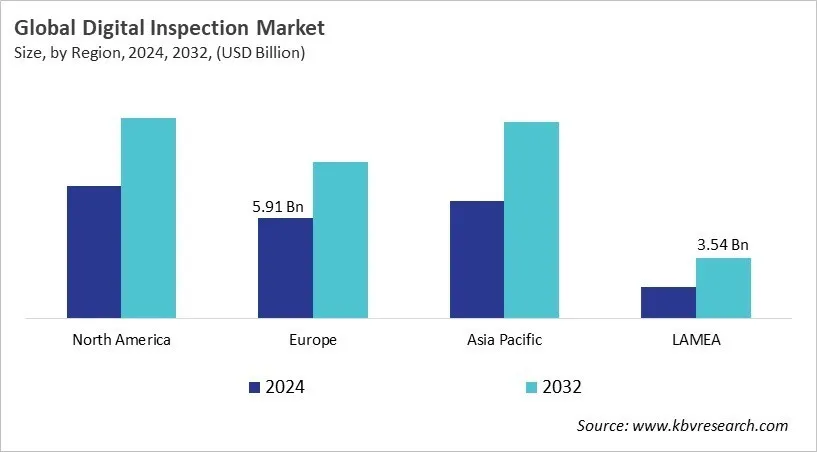
The North America region dominated the Global Digital Inspection Market by Region in 2024, and would continue to be a dominant market till 2032; thereby, achieving a market value of $11.8 billion by 2032. The Asia Pacific region is anticipated to grow at a CAGR of 6.8% during (2025 - 2032). Additionally, The Europe region would witness a CAGR of 5.9% during (2025 - 2032).
By Dimension
By Technology
By Component
By Vertical
By Geography




 Unique Offerings

