The Worldwide Automotive Heat Exchanger Market is projected to reach USD 32.69 billion by 2032, at a CAGR of 4.9%
Special Offering :
Industry Insights | Market Trends | Highest number of Tables | 24/7 Analyst Support
Automotive Heat Exchanger Market Growth, Trends and Report Highlights
According to a new report, published by KBV research, The Global Automotive Heat Exchanger Market size is expected to reach $32.69 billion by 2032, rising at a market growth of 4.9% CAGR during the forecast period.
The Automotive Heat Exchanger Market originated alongside the early automotive industry's efforts to manage engine temperatures and enhance vehicle performance. Initially, heat exchangers were primarily simple radiators relying on air-cooled fins and rudimentary liquid cooling systems designed for internal combustion engines (ICE). Over time, as vehicle powertrains evolved and demands for efficiency and emissions reduction increased, the market witnessed significant technological advancements.
The Liquid-to-Air segment is experiencing a CAGR of 4.5 % during the forecast period. This segment represents the largest share due to its superior thermal efficiency and widespread use in engine cooling and battery thermal management systems. Increasing demand for high-performance vehicles and advanced cooling requirements is driving adoption. Technological advancements in compact and lightweight heat exchangers further support growth.
The ICE segment led the maximum revenue in the Global Automotive Heat Exchanger Market by Propulsion in 2024, thereby, achieving a market value of $24.3 billion by 2032. This segment represents the largest share driven by the continued dominance of internal combustion engine vehicles globally. High demand for radiators, intercoolers, and oil coolers sustains growth. However, ongoing emission regulations are encouraging improvements in thermal efficiency technologies.
The Passenger Cars segment is growing at a CAGR of 4.6 % during the forecast period. This segment represents the largest share driven by high production volumes and increasing consumer demand for personal mobility. Integration of advanced climate control and engine cooling systems supports growth. Continuous innovation in compact and efficient heat exchangers further enhances adoption.
Full Report: https://www.kbvresearch.com/automotive-heat-exchanger-market/
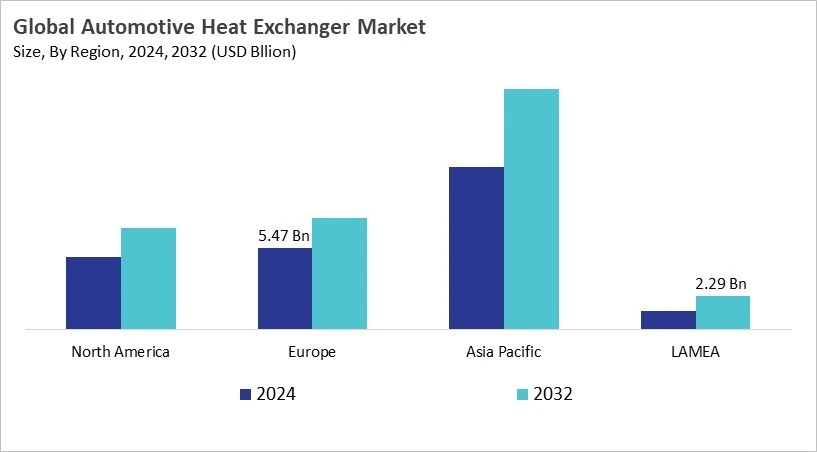
The Asia Pacific region dominated the Global Automotive Heat Exchanger Market by Region in 2024, and would continue to be a dominant market till 2032; thereby, achieving a market value of $16.1 billion by 2032. The Europe region is expected to witness a CAGR of 4.1% during (2025 - 2032). Additionally, The North America region is expected to witness a CAGR of 4.4% during (2025 - 2032).
List of Key Companies Profiled
- Denso Corporation
- Valeo SA
- Marelli Holdings Co., Ltd.
- Mahle GmbH (Mahle Stiftung GmbH)
- Hanon Systems (Hahn & Co. Auto Holdings Co., Ltd.)
- T.RAD Co., Ltd.
- hejiang Yinlun Machinery Co., Ltd.
- Weifang Hengan Radiator Group Co., Ltd.
- Modine Manufacturing Company
- Banco Products (India) Ltd.
Automotive Heat Exchanger Market Report Segmentation
By Type
- Liquid-to-Air
- Air-to-Air
By Propulsion
- ICE
- Electric
By Vehicle Type
- Passenger Cars
- Commercial Vehicles
By Geography
- North America
- US
- Canada
- Mexico
- Rest of North America
- Europe
- Germany
- UK
- France
- Russia
- Spain
- Italy
- Rest of Europe
- Asia Pacific
- China
- Japan
- India
- South Korea
- Singapore
- Malaysia
- Rest of Asia Pacific
- LAMEA
- Brazil
- Argentina
- UAE
- Saudi Arabia
- South Africa
- Nigeria
- Rest of LAMEA
Related Reports: