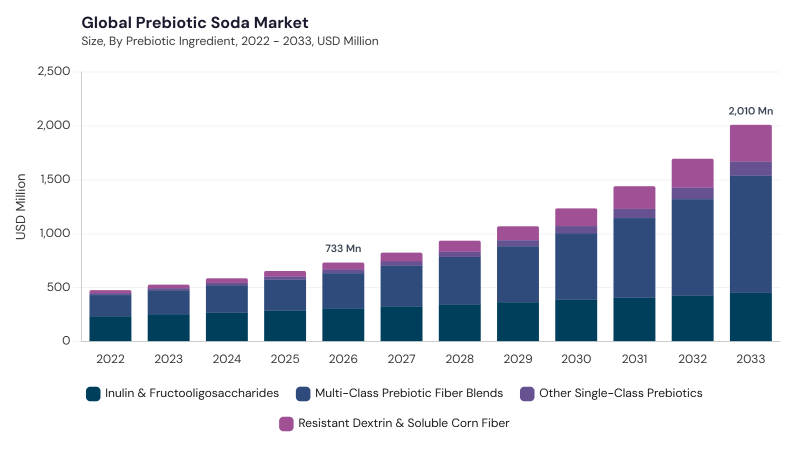
“Global Prebiotic Soda Market to reach a market value of USD 2010.29 Million by 2033 growing at a CAGR of 15.5%”
The Global Prebiotic Soda Market is expected to reach USD 2.0 billion by 2033, growing at a CAGR of 15.5% during (2026 - 2033).
Prebiotic soda is a carbonated soft-drink category formulated and marketed around prebiotic ingredients while retaining familiar soda flavors and drinking occasions. Products can contain individual ingredients or blends alongside sweeteners, fruit components, acids, and flavorings. This report follows the supplied soda segmentation rather than all fiber beverages, kombucha, probiotic drinks, or functional sparkling waters. The commercial use of a prebiotic claim is also separate from verifying a health effect for a finished product. ISAPP's scientific framework emphasizes evidence relevant to the substance, dose, formulation, and intended use rather than the presence of a fiber name alone.
Prebiotic soda offers brands a way to retain recognizable carbonation and flavor while introducing a distinct ingredient story. Customers can evaluate it within existing refreshment occasions rather than learn an entirely new product format. The appeal depends on the complete beverage, including taste, price, label information, and availability. A prebiotic message can support trial, but it does not by itself establish a health result or guarantee repeat purchasing. The commercial driver is a relevant product proposition that consumers understand and enjoy, with claims proportionate to the evidence for the actual formulation.
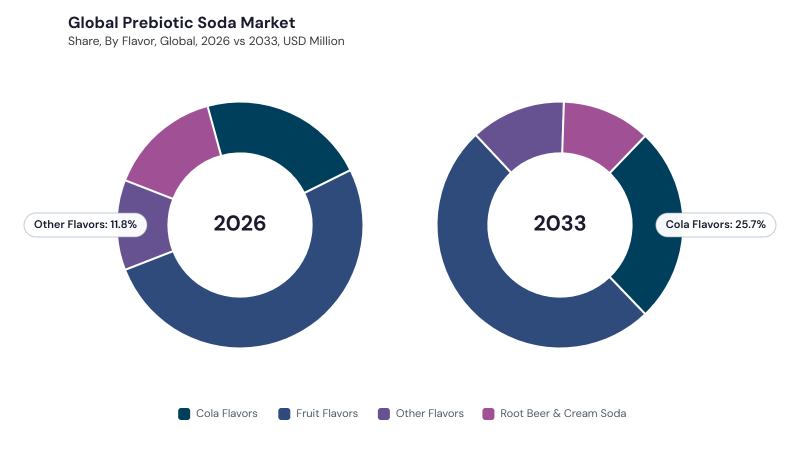
Fruit Flavors represented 54.96% of the supplied 2025 mix, while Cola Flavors held 19.21%. These categories give manufacturers several routes to address soda preferences and encourage trial through familiar tastes. Coca-Cola's Simply Pop announcement provides a dated fruit-oriented example, while Health-Ade's SunSip announcement includes cream soda within a broader lineup. Demand depends on the finished flavor and drinking experience rather than the number of variants alone. An expanded range can create purchasing options, but a launch announcement does not establish sustained sales or a particular future share.
Digital interest in prebiotic soda brands such as Poppi, Olipop and Bloom Pop highlights the role of brand recognition in category discovery. Search activity around Pepsi prebiotic soda and Coca-Cola’s new prebiotic soda line also illustrates attention to mainstream beverage participation. These patterns suggest that competitive differentiation involves both functional ingredient positioning and familiar soda flavors, while search interest alone does not establish market share or sales performance.
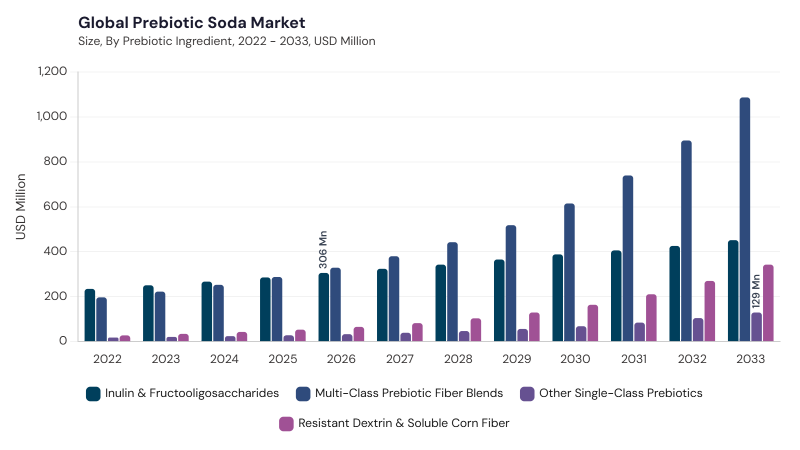
Based on Prebiotic Ingredient, the market is segmented into Multi-Class Prebiotic Fiber Blends, Inulin & Fructooligosaccharides, Resistant Dextrin & Soluble Corn Fiber, Other Single-Class Prebiotics. Multi-Class Prebiotic Fiber Blends dominated in 2025 and is projected to reach USD 1.1 billion by 2033, growing at a CAGR of 18.6%. Resistant Dextrin & Soluble Corn Fiber is expected to record the highest CAGR of 26.7% during the forecast period.
Multi-class prebiotic fiber blends allow beverage developers to combine ingredients with different formulation characteristics, balancing fiber content, sweetness, mouthfeel and stability in carbonated beverages. Inulin and fructooligosaccharides offer recognizable ingredient positioning, while resistant dextrin and soluble corn fiber provide alternative formulation routes where solubility and sensory performance are important. Other single-class prebiotics offer opportunities for differentiated recipes, subject to ingredient availability, cost and substantiation of prebiotic claims. Competition increasingly depends on delivering a consistent soda experience alongside transparent ingredient labeling and appropriate evidence for the intended serving size.
Based on Packaging, the market is segmented into Cans, Glass Bottles, Plastic Bottles & Other Packaging. Cans dominated in 2025 and is projected to reach USD 1.9 billion by 2033, growing at a CAGR of 15.9%. Plastic Bottles & Other Packaging is expected to record the highest CAGR of 21.3% during the forecast period.
Aluminum cans support the positioning of prebiotic soda alongside conventional carbonated soft drinks, offering convenient single-serve consumption, multipack merchandising and protection from light. Glass bottles provide opportunities for premium positioning in specialty retail and foodservice, although weight and breakage can increase distribution costs. Plastic bottles and other packaging can support resealable formats and different consumption occasions, provided the packaging maintains carbonation and product stability. Packaging decisions therefore influence shelf visibility, logistics costs, price positioning and the ability of brands to expand across retail channels.
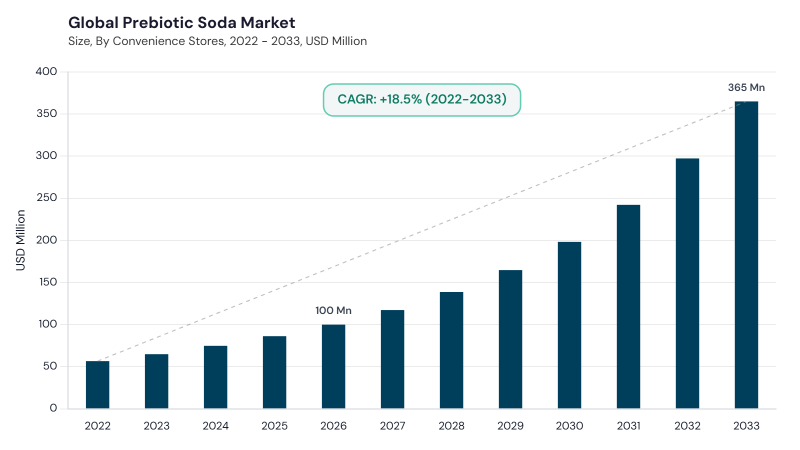
Based on Distribution Channel, the market is segmented into Supermarkets and Hypermarkets & Club Stores, Convenience Stores, Health Food & Specialty Stores, Online Retail, Other Channels. Supermarkets and Hypermarkets & Club Stores dominated in 2025 and is projected to reach USD 1.0 billion by 2033, growing at a CAGR of 19.5%. Other Channels is expected to record the highest CAGR of 21.5% during the forecast period.
Supermarkets, hypermarkets and club stores provide opportunities to move prebiotic soda beyond specialist wellness aisles into mainstream beverage assortments, with multipacks supporting repeat purchases. Convenience stores address immediate refreshment occasions through chilled single-serve products. Health food and specialty stores can support discovery of ingredient-led beverages, while online retail enables assortment trials, variety packs and direct-to-consumer replenishment. Other channels, including suitable foodservice outlets, offer additional consumption occasions. Retail expansion depends on competitive pricing, shelf productivity, distribution reliability and the ability to convert initial curiosity into repeat demand.
Based on Flavor, the market is segmented into Fruit Flavors, Cola Flavors, Root Beer & Cream Soda, Other Flavors. Fruit Flavors dominated in 2025 and is projected to reach USD 1.0 billion by 2033, growing at a CAGR of 15.1%. Cola Flavors is expected to record the highest CAGR of 18.2% during the forecast period.
Fruit-flavored prebiotic sodas benefit from familiar citrus and berry profiles that can complement the acidity of carbonated formulations. Rising search interest in Poppi cherry limeade, strawberry lemon and orange illustrates the relevance of differentiated fruit combinations to product discovery. Cola flavors offer an opportunity to compete for traditional soda occasions, with increased interest in Pepsi prebiotic cola indicating attention to this positioning. Root beer and cream soda can address classic and nostalgic flavor preferences, while other flavors provide room for seasonal and localized innovation. Manufacturers must balance sweetness, acidity and fiber-related mouthfeel to sustain repeat purchases across these variants.
Free Valuable Insights: Prebiotic Soda Market Size to reach $2.0 Billion by 2033
Region-wise, the Prebiotic Soda Market is analyzed across North America, Europe, Asia Pacific, LAMEA. North America led in 2025 and is projected to reach USD 1.5 billion by 2033, growing at a CAGR of 12.7%. Europe is projected to grow at a CAGR of 30.8%. Asia Pacific is projected to grow at a CAGR of 31.7%. LAMEA is projected to grow at a CAGR of 28.8%.
North America benefits from an established carbonated beverage retail ecosystem and the visibility of specialist prebiotic soda brands. In Europe, opportunities depend on retailer acceptance, ingredient communication and compliance with applicable nutrition and health claim requirements. Asia Pacific offers expansion potential through localized fruit flavors, convenient packaging and partnerships with established beverage distributors. In LAMEA, selective entry through urban retail and specialty channels may support category development, although affordability and distribution costs remain important considerations. The higher projected growth rates outside North America should be interpreted in the context of smaller starting market bases.
By Prebiotic Ingredient
By Packaging
By Distribution Channel
By Flavor
By Geography
| Report Attribute | Details |
|---|---|
| Market size value in 2026 | USD 733.1 million |
| Market size forecast in 2033 | USD 2.0 billion |
| Base Year | 2025 |
| Historical Period | 2022 to 2024 |
| Forecast Period | 2026 to 2033 |
| Revenue Growth Rate | CAGR of 15.5% from 2026 to 2033 |
| Number of Tables | 630 |
| Number of Figures | 106 |
| Report Coverage | Market Trends, Revenue Estimation and Forecast, Segmentation Analysis, Regional and Country Breakdown, Competitive Landscape |
| Segments Covered | Prebiotic Ingredient, Packaging, Distribution Channel, Flavor and Geography |
| Country Scope |
|
By Geography
Expected to reach USD 2.0 billion by 2033, growing at 15.5% CAGR during 2026-2033.
Multi-Class Prebiotic Fiber Blends leads with 59.81%, reaching USD 1.1 billion by 2033.
Top companies include those dominating the market landscape.
North America leads with a market value of USD 1.5 billion by 2033.
Interest in familiar soda ingredients and diverse flavor options drive market growth.
Cans dominate with 94.08% share, reaching USD 1.9 billion by 2033.
Our team of dedicated experts can provide you with attractive expansion opportunities for your business.