“Global Object Storage Infrastructure Market to reach a market value of USD 34988.60 Million by 2033 growing at a CAGR of 16%”
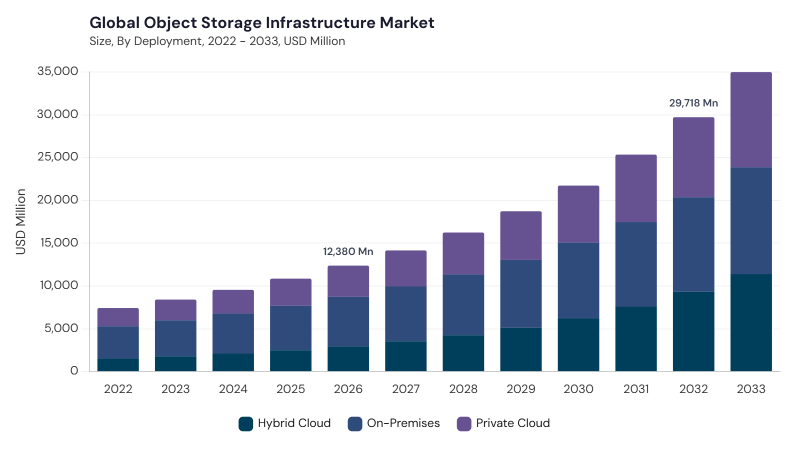
The Global Object Storage Infrastructure Market is expected to reach USD 35.0 billion by 2033, growing at a CAGR of 16.0% during (2026 - 2033).
Object storage infrastructure provides systems for storing and accessing data as objects with associated metadata and identifiers. It differs from the block and file access models, although a wider platform can support several models together. SNIA's object-storage explanation provides technical context for this distinction. The commercial scope here covers attributable hardware, software, and services supporting object storage. It should not automatically include all storage infrastructure, backup applications, cloud consumption, or analytics software merely because those products interact with an object repository. Consistent valuation is especially important when software and hardware are sold as an integrated system.
Organizations can need persistent repositories for backup data, content, archives, and analytical datasets. Object infrastructure provides one approach where its access model fits those uses. The commercial driver is a workable repository with the capacity, retrieval behavior, and integration required by the application. It does not follow that every workload or data type should use the same storage model. Buyers need to understand how the object system participates in the complete workflow. The supplied Application shares identify eligible categories without demonstrating that every stored dataset is used in only one way.
Customers may need to add storage over time or manage repositories across more than one location. NetApp StorageGRID and Cloudian HyperStore publish propositions addressing scalable or distributed object-storage environments. [3,4] Demand arises where those capabilities match an organization's operating requirements. Expansion still has dependencies, including the chosen hardware, protection configuration, network, and administrative process. A scale-out proposition does not establish unlimited performance or effortless growth for every customer. Suppliers need to explain the actual supported construction and the work required to expand it while maintaining an operated service.
Based on Component, the market is segmented into Hardware, Software, Services. Hardware dominated in 2025 and is projected to reach USD 17.2 billion by 2033, growing at a CAGR of 14.2%. Software is expected to record the highest CAGR of 18.7% during the forecast period.
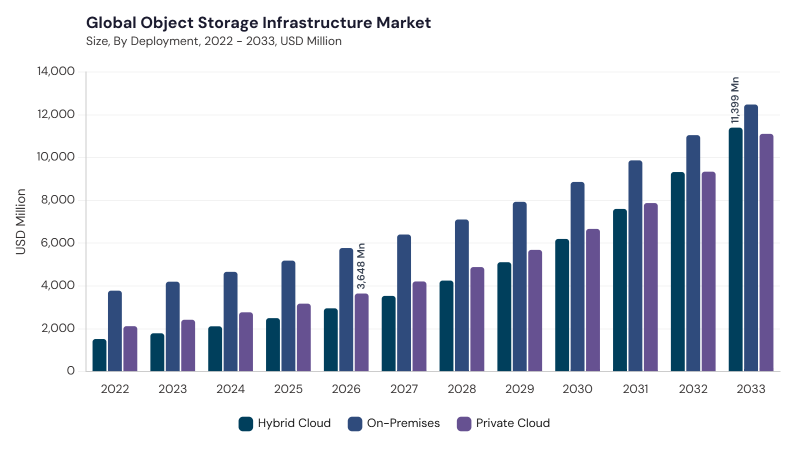
Based on Deployment, the market is segmented into On-Premises, Private Cloud, Hybrid Cloud. On-Premises dominated in 2025 and is projected to reach USD 12.5 billion by 2033, growing at a CAGR of 11.6%. Hybrid Cloud is expected to record the highest CAGR of 21.3% during the forecast period.
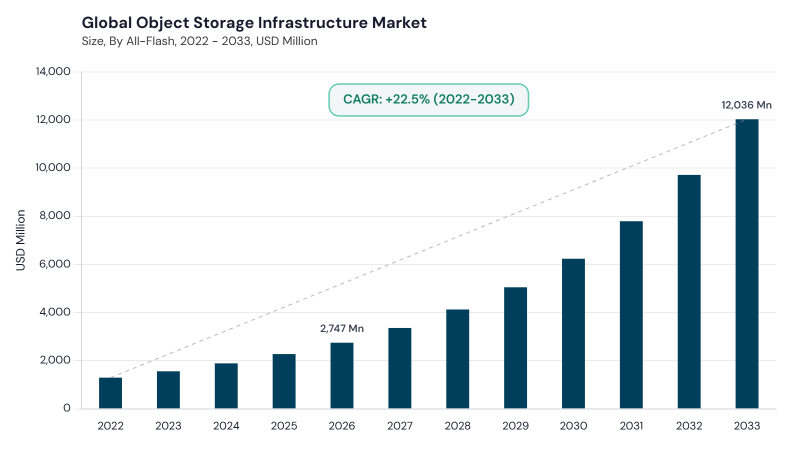
Based on Storage Media, the market is segmented into HDD-Based, All-Flash, Hybrid Storage. HDD-Based dominated in 2025 and is projected to reach USD 15.5 billion by 2033, growing at a CAGR of 11.9%. All-Flash is expected to record the highest CAGR of 23.5% during the forecast period.
Based on Enterprise Size, the market is segmented into Large Enterprises, SMEs. Large Enterprises dominated in 2025 and is projected to reach USD 24.5 billion by 2033, growing at a CAGR of 14.7%. SMEs is expected to record the highest CAGR of 19.6% during the forecast period.
Based on Application, the market is segmented into Backup & Recovery, Archiving & Compliance, Data Lakes & Analytics, AI & ML Data Repositories, Media & Content Storage, Other Applications. Backup & Recovery dominated in 2025 and is projected to reach USD 7.4 billion by 2033, growing at a CAGR of 13.0%. AI & ML Data Repositories is expected to record the highest CAGR of 24.8% during the forecast period.
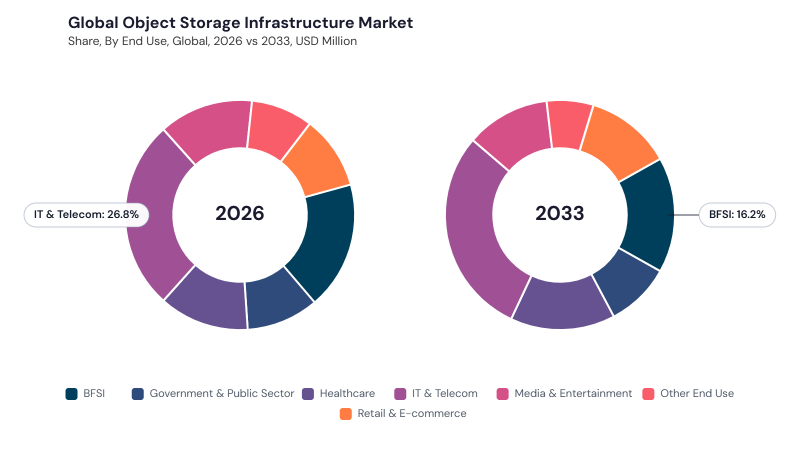
Based on End Use, the market is segmented into IT & Telecom, BFSI, Healthcare, Media & Entertainment, Retail & E-commerce, Government & Public Sector, Other End Use. IT & Telecom dominated in 2025 and is projected to reach USD 10.3 billion by 2033, growing at a CAGR of 17.5%. Retail & E-commerce is expected to record the highest CAGR of 18.7% during the forecast period.
Free Valuable Insights: Object Storage Infrastructure Market Size to reach $35.0 Billion by 2033
Region-wise, the Object Storage Infrastructure Market is analyzed across North America, Europe, Asia Pacific, LAMEA. North America led in 2025 and is projected to reach USD 12.0 billion by 2033, growing at a CAGR of 13.7%. Europe is projected to grow at a CAGR of 14.3%. Asia Pacific is projected to grow at a CAGR of 19.3%. LAMEA is projected to grow at a CAGR of 20.2%.
By Component
By Deployment
By Storage Media
By Enterprise Size
By Application
By End Use
By Geography
| Report Attribute | Details |
|---|---|
| Market size value in 2026 | USD 12.4 billion |
| Market size forecast in 2033 | USD 35.0 billion |
| Base Year | 2025 |
| Historical Period | 2022 to 2024 |
| Forecast Period | 2026 to 2033 |
| Revenue Growth Rate | CAGR of 16.0% from 2026 to 2033 |
| Number of Tables | 930 |
| Number of Figures | 155 |
| Report Coverage | Market Trends, Revenue Estimation and Forecast, Segmentation Analysis, Regional and Country Breakdown, Competitive Landscape |
| Segments Covered | Component, Deployment, Storage Media, Enterprise Size, Application, End Use and Geography |
| Country Scope |
|
By Geography
Expected to reach USD 35.0 billion by 2033, growing at 16.0% CAGR during 2026-2033.
Hardware leads, projected to hit USD 17.2 billion by 2033, representing 55.24% in 2025.
Top companies include Cisco, IBM, Microsoft, and Google.
On-Premises leads, expected to reach USD 12.5 billion by 2033, holding 46.83% in 2025.
Demand for repositories serving several data workflows and backup infrastructure requirements are key growth drivers.
North America leads, projected to achieve USD 12.0 billion by 2033.
Our team of dedicated experts can provide you with attractive expansion opportunities for your business.