The sample copy of this report is available for access.
The North America Wi-Fi Range Extender Market is projected to reach USD 2,187.8 million by 2032, growing at a CAGR of 10.5% during the forecast period (2026-2033).
The North America Wi-Fi Range Extender Market is witnessing significant growth due to increasing internet penetration, rising smart home adoption, and the growing need for uninterrupted wireless connectivity across residential and commercial environments. Wi-Fi range extenders are widely used to eliminate dead zones, improve signal coverage, and enhance network performance in homes, offices, and public spaces. The rapid expansion of connected devices including smartphones, smart TVs, gaming consoles, IoT devices, and home automation systems is further accelerating market demand across the region.
The adoption of advanced wireless technologies such as Wi-Fi 6, Wi-Fi 6E, and emerging Wi-Fi 7 standards is driving innovation in the market. Consumers and enterprises are increasingly demanding high-speed, low-latency connectivity to support streaming, cloud gaming, video conferencing, and hybrid work models. In addition, increasing deployment of mesh networking systems and AI-powered network optimization features is reshaping the competitive landscape. Countries such as the United States and Canada continue to dominate the regional market due to strong broadband infrastructure, high consumer spending on networking equipment, and rapid digital transformation initiatives.
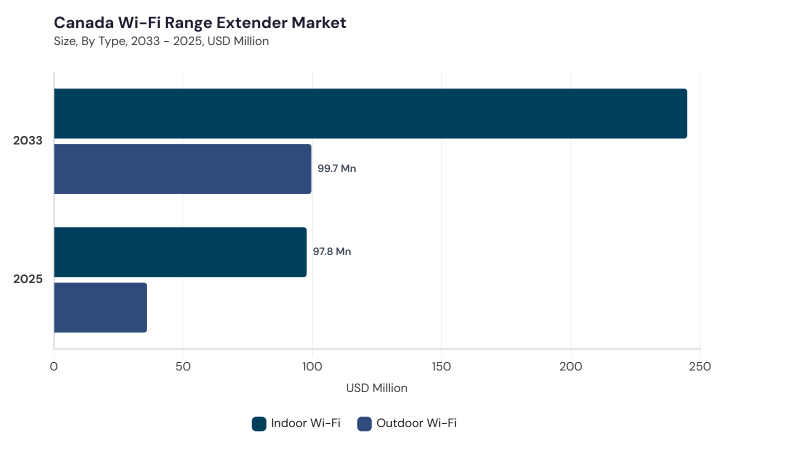
Based on Type, the market is segmented into Indoor Wi-Fi and Outdoor Wi-Fi. The Indoor Wi-Fi segment dominated the North America Wi-Fi Range Extender Market in 2025 and is expected to continue leading the market through 2032, thereby reaching a market value of USD 1,557.3 million by 2032. The Outdoor Wi-Fi segment is projected to attain a market size of USD 630.4 million by 2032.
Based on Product, the market is segmented into Wi-Fi Range Extenders / Repeaters, Mesh Wi-Fi Systems, Powerline Wi-Fi Extenders, and Outdoor Range Extenders. The Wi-Fi Range Extenders / Repeaters segment held the largest revenue share in 2025 and is anticipated to reach USD 940.0 million by 2032. The Mesh Wi-Fi Systems segment is expected to reach USD 645.8 million by 2032, while the Powerline Wi-Fi Extenders segment is forecast to attain USD 344.6 million by 2032.
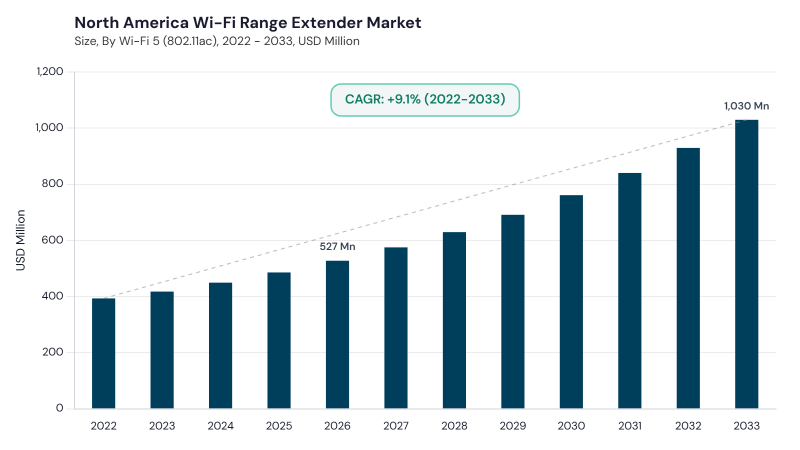
Based on Technology Standard, the market is segmented into Wi-Fi 5 (802.11ac), Wi-Fi 6 / 6E (802.11ax), and Wi-Fi 7 (802.11be). The Wi-Fi 5 (802.11ac) segment accounted for the largest market share in 2025 and is projected to reach USD 929.5 million by 2032. The Wi-Fi 6 / 6E (802.11ax) segment is expected to achieve a market value of USD 885.0 million by 2032. Additionally, the Wi-Fi 7 (802.11be) segment is forecast to reach USD 373.2 million by 2032.
Based on End User, the market is segmented into Residential, Small & Medium Enterprises (SMEs), Large Enterprises, and Public & Municipal. The Residential segment dominated the market in 2025 and is expected to reach USD 1,237.2 million by 2032. The SMEs segment is projected to attain USD 420.3 million by 2032, while the Large Enterprises segment is expected to reach USD 282.0 million by 2032.
Based on Sales Channel, the market is segmented into Online, Offline Retail, and B2B / System Integrators. The Online segment continues to dominate the market owing to strong e-commerce penetration and growing consumer preference for online electronics purchases. The B2B / System Integrators segment is witnessing increasing demand due to enterprise-grade deployments and customized networking requirements across commercial establishments.
By Type
By Product
By Technology Standard
By End User
By Sales Channel
By Country
Companies Profiled

By Type
By Product
By Technology Standard
By End User
By Sales Channel
By Country
Our team of dedicated experts can provide you with attractive expansion opportunities for your business.




 Unique Offerings