The sample copy of this report is available for access.
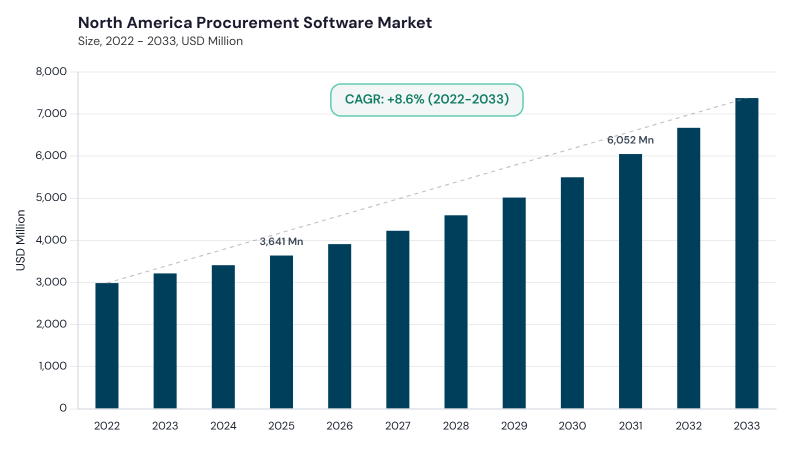
The North America Procurement Software Market is expected to reach USD 7,380.9 million by 2033, growing at a CAGR of 9.5% during 2026-2033.
The US market dominated the North America Procurement Software Market by Country in 2025 and would continue to be a dominant market till 2032; thereby, achieving a market value of USD 5,088.4 million by 2032. The Canada market is expected to witness a CAGR of 10.9% during (2026-2033). Additionally, the Mexico market would register a CAGR of 10.5% during (2026-2033). The US and Canada led the North America Procurement Software Market by Country with a market share of 77.9% and 10.9% in 2025.
The North America Procurement Software Market originated amid the early stages of digitization within corporate procurement functions, initially characterized by fragmented, manual processes supplemented by basic digital tools such as spreadsheets and standalone purchase order systems. As businesses sought greater operational efficiency and cost control, procurement software began evolving through integration of enterprise resource planning (ERP) components, gradually establishing a foundation for centralized sourcing and supplier management.
The emergence of cloud computing marked a significant turning point, enabling more scalable, flexible, and collaborative procurement solutions, which accelerated adoption across diverse industries in North America. Subsequent technological advancements, including automation and data analytics, expanded the capabilities of procurement software beyond transaction management to encompass spend analytics, risk mitigation, and strategic supplier collaboration. More recently, the integration of artificial intelligence (AI) and machine learning has facilitated enhanced demand forecasting, intelligent contract management, and predictive risk assessment, while the need for supply chain resilience amidst geopolitical uncertainties and global disruptions has further propelled market maturity.
Currently, three prominent trends shape the North America Procurement Software Market. First, the rapid infusion of artificial intelligence into procurement processes is driven by the imperative to automate complex workflows and extract actionable insights from voluminous data streams. This AI adoption is reshaping procurement from a transactional function into a strategic lever for competitive advantage, enabling predictive supplier evaluation and automated risk identification that enhance supply chain resilience.
Based on Deployment, the market is segmented into Cloud and On-Premise. The Cloud market dominated the North America Procurement Software Market by Deployment in 2025 and would continue to be a dominant segment till 2032; thereby, achieving a market value of USD 4,711.6 million by 2032. The On-Premise market is expected to witness a CAGR of 9.2% during (2026-2033).
Based on Enterprise Size, the market is segmented into Large Enterprise and Small and Medium Enterprises (SMEs). The Large Enterprise market dominated the North America Procurement Software Market by Enterprise Size in 2025 and would continue to be a dominant segment till 2032; thereby, achieving a market value of USD 4,338.3 million by 2032. The Small and Medium Enterprises (SMEs) market is anticipated to witness a CAGR of 10.2% during (2026-2033).
Based on Type, the market is segmented into Spend Analysis, E-Procurement, E-Sourcing, Contract Management, Supplier Management, and Other Type. The Spend Analysis market dominated the North America Procurement Software Market by Type in 2025 and would continue to be a dominant segment till 2032; thereby, achieving a market value of USD 1,932.6 million by 2032. The E-Procurement market is expected to witness a CAGR of 8.8% during (2026-2033). Additionally, the E-Sourcing market is expected to witness a CAGR of 10.0% during (2026-2033).
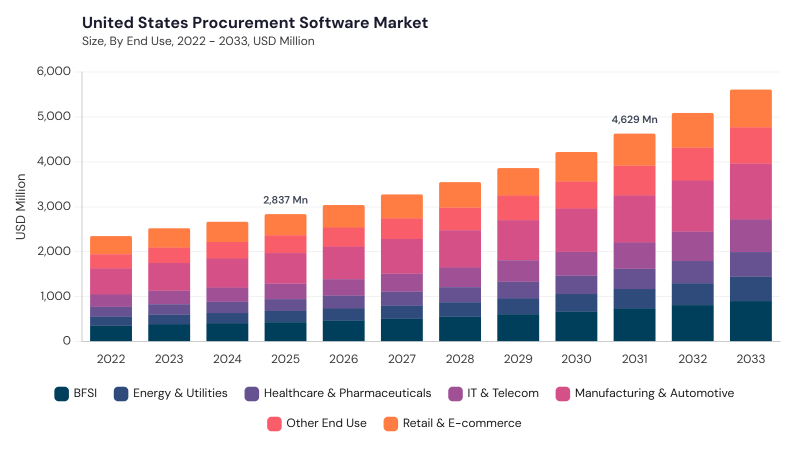
Based on End Use, the market is segmented into Manufacturing & Automotive, Retail & E-commerce, BFSI, IT & Telecom, Healthcare & Pharmaceuticals, Energy & Utilities, and Other End Use. The Manufacturing & Automotive market dominated the North America Procurement Software Market by End Use in 2025 and would continue to be a dominant segment till 2032; thereby, achieving a market value of USD 1,497.3 million by 2032. The Retail & E-commerce market is expected to witness a CAGR of 8.0% during (2026-2033). Additionally, the BFSI market is expected to witness a CAGR of 10.2% during (2026-2033).
Free Valuable Insights: The Global Procurement Software Market will hit USD 20,873.6 Million billion by 2033, at a CAGR of 10.1%
The United States represents the largest market for procurement software in North America due to its highly digitalized enterprise landscape, extensive adoption of cloud technologies, and strong presence of multinational corporations across sectors such as manufacturing, retail, healthcare, BFSI, and IT. Organizations in the country are increasingly investing in AI-enabled procurement platforms to automate sourcing, optimize supplier relationships, and improve spend visibility.
The demand for procurement software is further driven by the need for supply chain resilience, compliance with evolving procurement regulations, and the integration of ESG-focused procurement practices. Companies are emphasizing digital procurement transformation to enhance operational agility and reduce procurement cycle times. The growing deployment of cloud-native procurement suites, coupled with advancements in predictive analytics and automation, is expected to continue supporting market growth in the United States through 2032.

By Deployment
By Enterprise Size
By Type
By End Use
By Country
Market will reach USD 7,380.9 million by 2033, growing at 9.5% CAGR during 2026-2033.
The US dominates with USD 5,088.4 million expected by 2032. US and Canada held 77.9% and 10.9% market share respectively in 2025.
Enterprise digital transformation and cloud migration are accelerating adoption across manufacturing and retail sectors.
Cloud deployment leads the market, outpacing on-premise solutions across all enterprise segments.
Canada market grows at 10.9% CAGR during 2026-2033. Mexico registers 10.5% CAGR during the same period.
Large enterprises dominate the market, leading adoption over small and medium enterprises.
Our team of dedicated experts can provide you with attractive expansion opportunities for your business.




 Unique Offerings