The sample copy of this report is available for access.
The North America Personal Finance Software Market is expected to reach USD 1255.2 million by 2032, growing at a CAGR of 10.9% during (2026 - 2033).
The North America Personal Finance Software Market evolved from basic desktop ledger and checkbook-management tools into connected financial ecosystems supporting budgeting, investment monitoring, debt management, retirement planning, and credit visibility. Internet adoption enabled online account aggregation and real-time synchronization, while cloud computing expanded cross-device access and simplified data backup. Mobile platforms subsequently shifted financial management toward continuous, on-the-go engagement, while artificial intelligence and machine learning introduced automated recommendations, predictive analytics, and personalized insights.
AI-driven personalization, open banking, data security, cloud computing, and holistic financial wellness are shaping current market development. Software platforms increasingly use analytics and machine learning to automate budgeting, identify spending patterns, forecast financial outcomes, and provide individualized recommendations. Open banking APIs are improving account aggregation and interoperability across banks and financial services, while stronger encryption, authentication, and privacy controls are becoming central to consumer trust. Cloud-based delivery, mobile-first design, tax and regulatory functionality, investment tracking, debt management, and financial education tools are further broadening personal finance software from standalone applications into integrated financial management platforms.
Based on Type, the market is segmented into Desktop-based and Mobile-based. The Desktop-based market dominated the North America Personal Finance Software Market by Type in 2025, and would continue to be a dominant market till 2033; thereby, achieving a market value of USD 694.0 million by 2032, growing at a CAGR of 10.6 % during the forecast period. The Mobile-based market is expected to witness a CAGR of 11.4% during (2026 - 2033).
Desktop-based held the dominant position in the North America Personal Finance Software Market by Type in 2025, supported by comprehensive financial dashboards, detailed transaction management, advanced reporting capabilities, and continued preference for larger-screen interfaces when handling complex household finances.
Desktop-based software provides detailed budgeting, reporting, investment management, tax planning, and financial analysis capabilities, making it relevant for users requiring deeper control, offline access, and management of complex financial portfolios. Integration with cloud synchronization is increasingly extending traditional desktop functionality across devices while maintaining comprehensive analytical capabilities. Mobile-based software emphasizes convenience, real-time expense tracking, alerts, account aggregation, goal setting, and rapid access through smartphones and tablets. AI-powered insights, biometric security, open banking connectivity, and intuitive interfaces are strengthening mobile adoption among users seeking continuous financial visibility and simplified everyday money management.
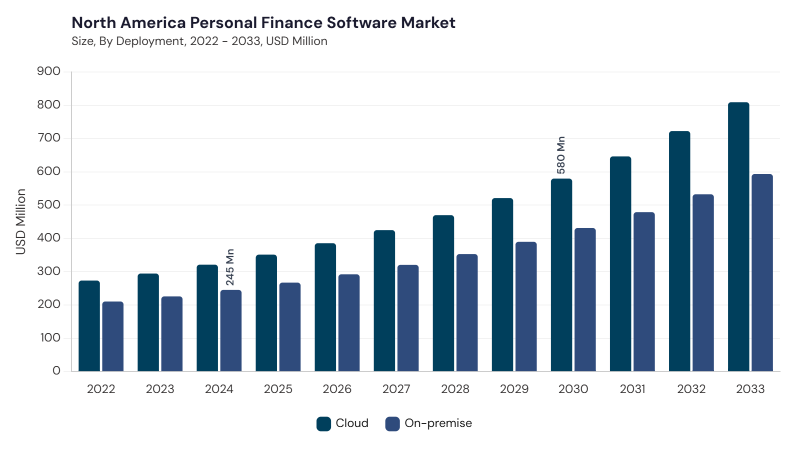
Based on Deployment, the market is segmented into Cloud and On-premise. The Cloud market dominated the North America Personal Finance Software Market by Deployment in 2025, and would continue to be a dominant market till 2033; thereby, achieving a market value of USD 722.5 million by 2032, growing at a CAGR of 11.2 % during the forecast period. The On-premise market is expected to witness a CAGR of 10.6% during (2026 - 2033).
Cloud occupied the leading position in the North America Personal Finance Software Market by Deployment in 2025, driven by multi-device accessibility, automatic synchronization, simplified software updates, scalable data storage, and integration with digitally connected banking ecosystems.
Cloud deployment enables users to access financial data across devices while supporting real-time synchronization, automatic feature updates, scalable storage, third-party integrations, and AI-powered financial insights. It is particularly relevant for consumers and small businesses seeking flexible and continuously updated financial management solutions. On-premise deployment provides greater direct control over financial records, localized data storage, customization, and reduced reliance on continuously connected services. This model remains relevant for users, financial advisors, and organizations with heightened privacy, security, compliance, or data-control requirements, although deployment and maintenance complexity can limit broader adoption.
Based on End Use, the market is segmented into Individuals and Small Businesses. Individuals use personal finance software for budgeting, expense monitoring, debt reduction, investment tracking, retirement planning, financial goal setting, and consolidated account management. Mobile banking, AI-based recommendations, subscription models, biometric authentication, and financial wellness functionality are strengthening engagement across different demographic groups.
Small Businesses use these platforms for cash-flow monitoring, expense categorization, forecasting, tax support, invoicing, payroll-related functions, and financial reporting. Cloud delivery and automation provide accessible alternatives to more complex accounting platforms while helping small businesses improve operational efficiency and maintain visibility over financial performance.
Based on Tools, the market is segmented into Budget Planner, Investment Tracker, Retirement Planner, and Other Tools. Budget Planner tools support income and expense tracking, categorization, spending limits, bill reminders, savings goals, and debt management, providing broad relevance across households and individual users. Investment Tracker tools offer portfolio aggregation, performance monitoring, market information, risk assessment, tax visibility, and analytics for users managing equities, ETFs, funds, and other investments.
Retirement Planner tools enable long-term scenario modeling, retirement-income projections, savings assessments, and goal-based planning incorporating future financial assumptions. Other Tools include credit monitoring, debt calculators, tax utilities, expense forecasting, net-worth dashboards, and specialized financial management capabilities that complement core budgeting and planning functions.
Free Valuable Insights: The Global Personal Finance Software Market will hit USD 4383.8 Million billion by 2033, at a CAGR of 11.6%
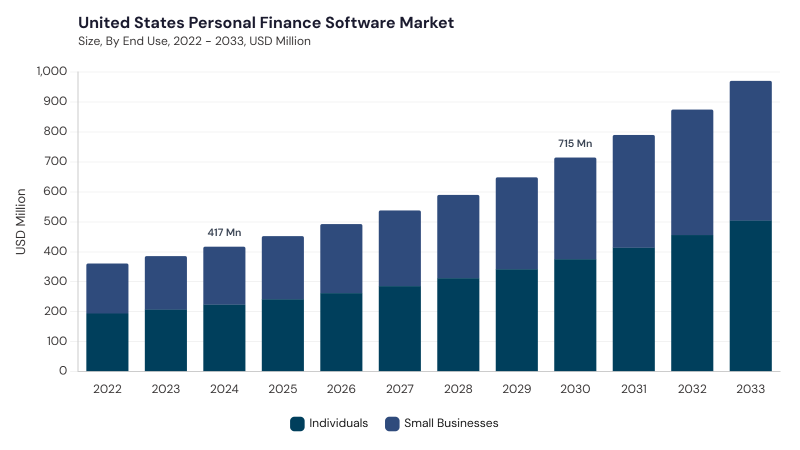
Based on Country, the market is segmented into US, Canada, Mexico, and Rest of North America. The US market dominated the North America Personal Finance Software Market by Country in 2025, and would continue to be a dominant market till 2033; thereby, achieving a market value of USD 874.6 million by 2032, growing at a CAGR of 10.2 % during the forecast period. The Canada market is expected to witness a CAGR of 12.8% during (2026 - 2033). Additionally, The Mexico market is expected to witness a CAGR of 12.2% during (2026 - 2033).
Across North America, personal finance software adoption is being shaped by AI personalization, cloud delivery, mobile accessibility, financial-data integration, cybersecurity, and evolving regulatory requirements. The US emphasizes AI-powered financial guidance, open banking APIs, financial wellness, advanced security, and integrated financial ecosystems, while Canada focuses on predictive financial planning, omnichannel accessibility, bilingual and localized functionality, privacy compliance, and financial-institution integration. Mexico is advancing mobile-first financial management, AI-based credit assessment, embedded finance, fintech inclusion, localized services, and cybersecurity, whereas Rest of North America continues to develop AI recommendations, multi-institution aggregation, privacy protection, mobile-first user experiences, and integrated financial planning platforms.

By Type
By Deployment
By End Use
By Tools
By Country
Set to reach $1255.2 Million by 2032, growing at 10.9% CAGR during 2026-2033.
The US leads with $874.6 million by 2032, growing at a 10.2% CAGR during 2026-2033.
Cloud adoption drives growth, with the cloud segment reaching $722.5 million by 2032 at 11.2% CAGR during 2026-2033.
The desktop-based segment will reach $694.0 million by 2032, growing at a 10.6% CAGR during 2026-2033.
The Canada market is expected to witness a CAGR of 12.8% during 2026-2033.
The mobile-based segment is expected to grow at an 11.4% CAGR during 2026-2033.
Our team of dedicated experts can provide you with attractive expansion opportunities for your business.




 Unique Offerings