The sample copy of this report is available for access.
The North America License Management Market is expected to reach USD 1.2 Billion by 2032, growing at a CAGR of 11.3% during (2026 – 2033).
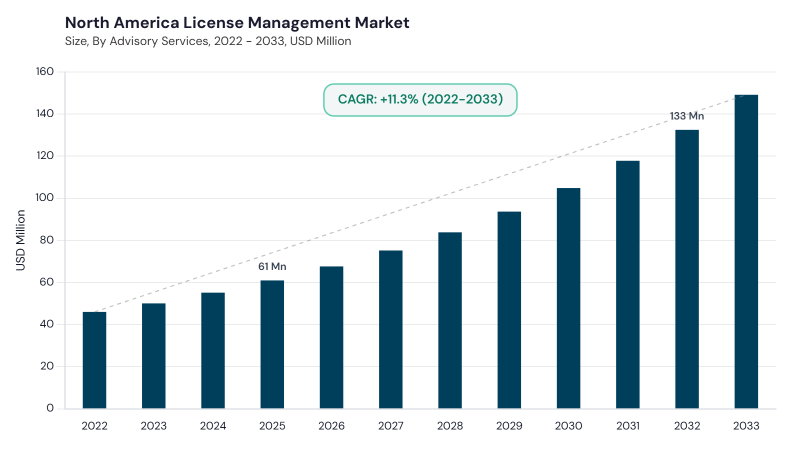
The North America License Management Market has evolved from manual software tracking and basic license verification methods into a strategic enterprise governance function. In the early stage, organizations mainly relied on spreadsheets, paper records, physical software keys, and basic activation controls to monitor software usage and prevent unauthorized deployment. As enterprise software portfolios expanded and licensing models became more complex, centralized license servers and software asset management systems gained adoption across large organizations. The shift toward cloud computing, SaaS applications, hybrid IT environments, subscription models, and multi-vendor software ecosystems transformed license management from a reactive administrative task into a proactive cost optimization and compliance capability.
The market is currently shaped by rising software spending, increasing vendor audits, cloud migration, subscription-based licensing, AI-driven analytics, cybersecurity requirements, and regulatory compliance pressure. Organizations across North America are seeking license management platforms that can provide real-time visibility into software usage, reduce over-licensing and under-licensing risks, automate compliance checks, and optimize license allocation across distributed workforces. Demand is also increasing for solutions that integrate with ERP, IT asset management, procurement, cloud platforms, identity systems, and software deployment tools. Vendors are focusing on AI-enabled license optimization, automated entitlement reconciliation, predictive renewal alerts, blockchain-based license records, SaaS usage monitoring, and cloud-native license governance.
Based on Component, the market is segmented into Software and Services. The Software market dominated the North America License Management Market by Component in 2025, and would continue to be a dominant market till 2033; thereby, achieving a market value of USD 707.8 Million by 2032, growing at a CAGR of 11.1 % during the forecast period. The Services market is expected to witness a CAGR of 11.7% during (2026 - 2033).
Software holds the leading position as organizations increasingly need automated platforms for license tracking, entitlement management, compliance monitoring, usage analytics, renewal management, audit preparation, and software optimization. These platforms help enterprises centralize license records, detect unused or overused licenses, manage subscription and usage-based models, and reduce financial exposure from non-compliance. Software adoption is especially strong among organizations with complex cloud, SaaS, hybrid, and multi-vendor environments. Services also play an important role as companies require consulting, implementation, system integration, customization, audit support, managed services, training, and ongoing optimization assistance. As licensing models become more complex, services help organizations align license management tools with internal processes, vendor contracts, compliance requirements, and long-term IT governance goals.
Based on Deployment, the market is segmented into Cloud and On-Premises. The Cloud market dominated the North America License Management Market by Deployment in 2025, and would continue to be a dominant market till 2033; thereby, achieving a market value of USD 657.4 Million by 2032, growing at a CAGR of 11.4 % during the forecast period. The On-premises market is expected to witness a CAGR of 11.2% during (2026 - 2033).
Cloud deployment leads the market as enterprises increasingly adopt SaaS applications, remote work platforms, hybrid IT models, and subscription-based software ecosystems. Cloud-based license management enables centralized access, faster deployment, real-time usage visibility, automated updates, scalable monitoring, and easier integration with cloud software environments. It also supports dynamic license allocation, subscription tracking, renewal alerts, and consumption-based analytics across distributed users and departments. On-Premises deployment remains important for organizations that require higher control over license data, internal systems, security policies, and compliance-sensitive software assets. Government, defense, BFSI, healthcare, and large enterprises continue to rely on on-premises systems where data privacy, internal governance, legacy integration, and customized licensing controls are major priorities. Hybrid models are also becoming relevant as organizations balance cloud flexibility with internal control requirements.
Based on Enterprise Size, the market is segmented into Large Enterprises and Small & Medium Enterprises (SMEs). Large Enterprises represent the leading segment because they manage extensive software portfolios across multiple departments, business units, cloud environments, geographies, and user groups. These organizations require advanced license management platforms that support automated compliance, license reconciliation, vendor contract management, renewal planning, analytics, and integration with enterprise IT systems.
Their adoption is driven by high software spending, frequent vendor audits, complex licensing agreements, and the need to reduce unused or duplicate licenses. SMEs are adopting license management solutions more steadily as software usage expands through cloud tools, SaaS platforms, remote work applications, and digital business systems. Many SMEs prefer affordable, cloud-based, easy-to-use platforms that reduce manual tracking, prevent compliance mistakes, and improve software cost control without requiring large IT teams.
Based on Application, the market is segmented into Compliance Management, License Entitlement and Optimization, Operation & Analytics, Audit Services, Advisory Services, and Other Application. Compliance Management leads the market as organizations face rising software audits, vendor license reviews, intellectual property risks, and regulatory accountability. This application helps companies monitor software usage, validate entitlements, maintain audit-ready records, and reduce exposure to penalties or contract violations. License Entitlement and Optimization is also important because enterprises are increasingly focused on matching purchased licenses with actual usage to reduce overspending and improve software value.
Operation & Analytics supports license lifecycle monitoring, usage dashboards, forecasting, renewal planning, and decision-making for IT and procurement teams. Audit Services help organizations prepare for software vendor audits, identify compliance gaps, and manage remediation. Advisory Services support license strategy, contract negotiation, policy development, and software asset governance. Other Application includes specialized use cases such as identity-linked licensing, mobile license control, industry-specific license workflows, and integration with broader IT governance systems.
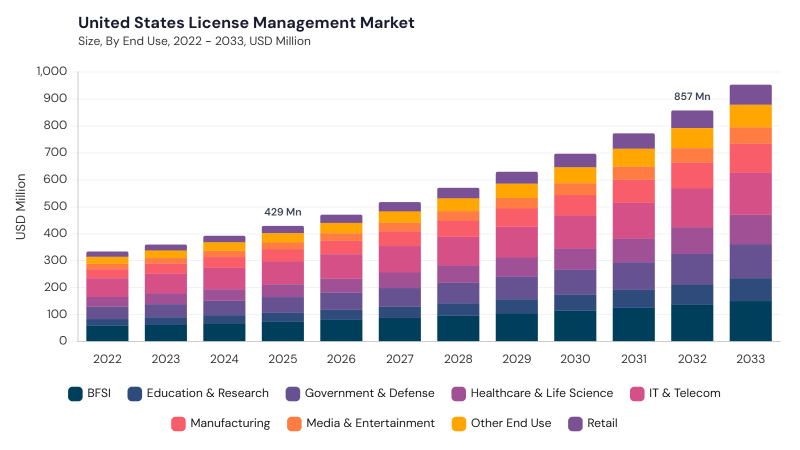
Based on End Use, the market is segmented into IT & Telecom, BFSI, Government & Defense, Healthcare & Life Science, Manufacturing, Education & Research, Media & Entertainment, Retail, and Other End Use. IT & Telecom leads the market due to extensive software deployments, cloud infrastructure, SaaS adoption, communication platforms, cybersecurity tools, and complex software vendor ecosystems. These organizations require strong license governance to manage frequent updates, distributed users, software subscriptions, and large-scale IT operations. BFSI uses license management to support compliance, risk control, audit readiness, and governance across banking, insurance, payment, fraud detection, and financial software systems.
Government & Defense relies on license management for secure software usage, compliance with IT policies, and efficient management of legacy and modern applications. Healthcare & Life Science adopts these solutions to manage electronic health records, medical software, research tools, and regulated digital platforms. Manufacturing uses license management for CAD/CAM tools, automation software, Industry 4.0 systems, and operational technology platforms. Education & Research requires license control for academic software, research platforms, and learning systems. Media & Entertainment uses license management for creative, editing, animation, and collaboration tools, while Retail applies it across POS systems, e-commerce platforms, customer analytics, and digital operations. Other End Use includes energy, transportation, hospitality, and professional services.
Free Valuable Insights: The Global License Management Market will hit USD 3.5 Billion billion by 2033, at a CAGR of 12.0%
Based on Country, the market is segmented into US, Canada, Mexico, and Rest of North America. The US market dominated the North America License Management Market by Country in 2025, and would continue to be a dominant market till 2033; thereby, achieving a market value of USD 857.4 Million by 2032, growing at a CAGR of 10.6 % during the forecast period. The Canada market is expected to witness a CAGR of 13.6% during (2026 - 2033). Additionally, The Mexico market is expected to witness a CAGR of 12.9% during (2026 - 2033).
The US remains the leading country market due to its large enterprise software base, strong SaaS adoption, mature cloud ecosystem, frequent vendor audits, complex state and federal compliance environment, and high demand for software cost optimization. Organizations in the US are adopting AI-enabled license analytics, cloud-native license management, automated compliance reporting, and integrated software asset management platforms. Canada contributes through growing cloud licensing, software compliance requirements, intellectual property protection, hybrid IT adoption, and demand for AI-driven license optimization tools. Mexico is gaining momentum through fintech growth, enterprise digitalization, cloud adoption, regulatory modernization, and increasing demand for automated license lifecycle management. Rest of North America supports market growth through regional digital transformation, cloud-based software usage, cross-jurisdictional compliance needs, and adoption of scalable platforms for software tracking, renewal management, and license optimization.

By Component
By Deployment
By Enterprise Size
By Application
By End Use
By Country
Set to reach USD 1.2 Billion by 2033, growing at 11.3% CAGR during 2026-2033.
The US leads with USD 857.4 Million by 2032, growing at 10.6% CAGR during the forecast period.
Rising enterprise cloud adoption is a main catalyst, with the cloud segment reaching USD 657.4 Million by 2032.
The software segment will achieve USD 707.8 Million by 2032, growing at 11.1% CAGR during 2026-2033.
The Canada market is expected to witness a CAGR of 13.6% during 2026-2033.
The services segment is expected to witness a CAGR of 11.7% during 2026-2033.
Our team of dedicated experts can provide you with attractive expansion opportunities for your business.




 Unique Offerings