The North America Healthcare Interoperability Solutions Market would witness market growth of 12.8% CAGR during the forecast period (2025-2032).
The US market dominated the North America Healthcare Interoperability Solutions Market by Country in 2024, and would continue to be a dominant market till 2032; thereby, achieving a market value of $3,269.7 million by 2032. The Canada market is experiencing a CAGR of 15.3% during (2025 - 2032). Additionally, The Mexico market would exhibit a CAGR of 14.7% during (2025 - 2032). The US and Canada led the North America Healthcare Interoperability Solutions Market by Country with a market share of 79.2% and 11% in 2024.
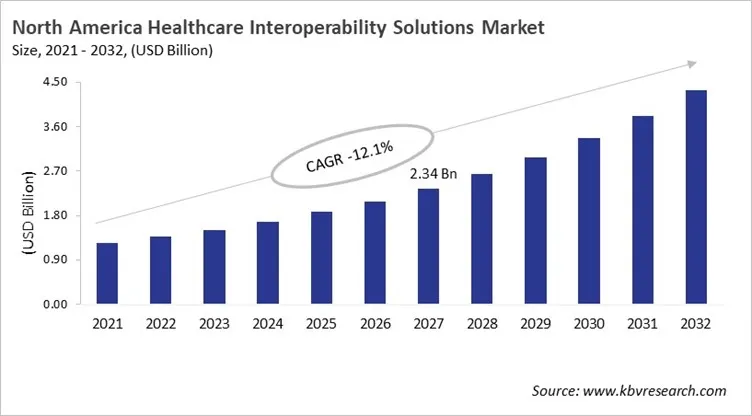
Healthcare interoperability in North America has progressed from standalone electronic health records to integrated data exchange ecosystems that facilitate coordinated care, public health reporting, and patient engagement. The Office of the National Coordinator for Health Information Technology (ONC) and laws like the HITECH Act and the 21st Century Cures Act have made it easier for people in the United States to use electronic health records (EHRs) and share data in a standard way. Policies that dealt with information blocking and certification requirements made the foundations of interoperability stronger. Frameworks like USCDI and TEFCA made it easier for people to share health information across the country in a safe way. Canada Health Infoway is a key player in promoting interoperable digital health systems across provinces in Canada. Together, standards, regulations, and government coordination have made interoperability a key part of how healthcare is delivered.
Interoperability is growing across the whole care ecosystem right now. This includes telehealth, payers, public health agencies, and apps that patients use. Using APIs, cloud platforms, and FHIR standards makes it possible to integrate data across systems in a way that is both scalable and flexible. Interoperability is becoming increasingly useful for analytics, AI, and population health management. It's going beyond just sharing data and giving you useful information. Market leaders are focused on following standards, working with other companies in the ecosystem, and connecting with larger digital health platforms. To meet regulatory requirements, there is also a strong focus on data privacy, security, and trust. Ongoing support and capacity-building for providers speeds up adoption even more, making interoperability the basis for a connected, patient-centered healthcare system.
Based on Level of Interoperability, the market is segmented into Structural, Foundational and Semantic. The Structural market segment dominated the US Healthcare Interoperability Solutions Market by Level of Interoperability is expected to grow at a CAGR of 11.4 % during the forecast period thereby continuing its dominance until 2032. Also, The Semantic market is anticipated to grow as a CAGR of 12.6 % during the forecast period during (2025 - 2032).
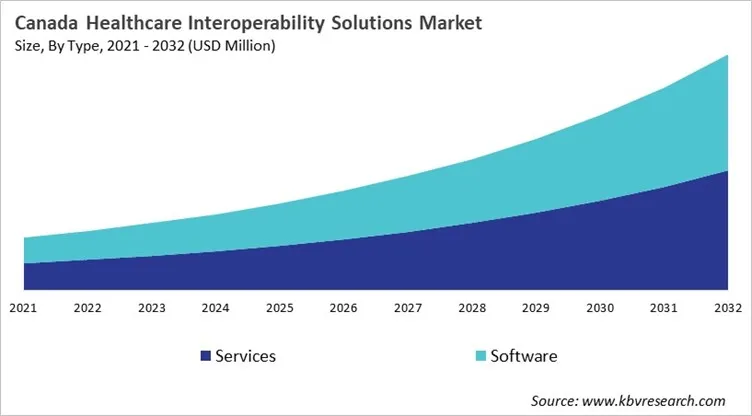
Based on Type, the market is segmented into Services and Software. With a compound annual growth rate (CAGR) of 15% over the projection period, the Services Market, dominate the Canada Healthcare Interoperability Solutions Market by Type in 2024 and would be a prominent market until 2032. The Software market is expected to witness a CAGR of 15.6% during (2025 - 2032).
Free Valuable Insights: The Healthcare Interoperability Solutions Market is Predicted to reach USD 11.22 Billion by 2032, at a CAGR of 13.5%
The US Healthcare Interoperability Solutions Market is the most advanced in the world because of widespread use of electronic health records (EHRs) and strong government oversight. Interoperability is important because the healthcare system is very fragmented and providers, payers, and patients need to be able to share data easily. Federal rules that encourage standardized data sharing, patient access, and stopping information blocking are big reasons for growth. As care becomes more value-based, there is a greater need for clinical and population health data to be combined. More people are using APIs, cloud-based platforms, and real-time analytics in the market. Interoperability is growing to include AI, precision medicine, and care from a distance. There is a lot of competition, and vendors stand out by following rules, being able to grow, being secure, and working with other systems.

By Type
By Interoperability
By End User
By Country
Our team of dedicated experts can provide you with attractive expansion opportunities for your business.








 Unique Offerings