The Asia Pacific Healthcare Interoperability Solutions Market would witness market growth of 14.4% CAGR during the forecast period (2025-2032).
The China market dominated the Asia Pacific Healthcare Interoperability Solutions Market by Country in 2024, and would continue to be a dominant market till 2032; thereby, achieving a market value of $778.4 million by 2032. The Japan market is showcasing a CAGR of 13.6% during (2025 - 2032). Additionally, The India market would register a CAGR of 15.2% during (2025 - 2032). The China and Japan led the Asia Pacific Healthcare Interoperability Solutions Market by Country with a market share of 30.5% and 17.7% in 2024. The Malaysia market is expected to witness a CAGR of 17.2% during throughout the forecast period.
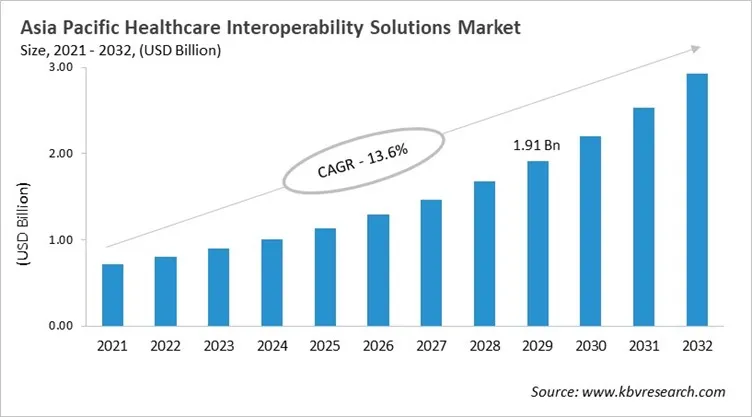
The market for Asia Pacific healthcare interoperability solutions has grown along with healthcare systems, the number of people with chronic diseases, the number of older people, and the speed at which digital health is being used. The first steps were to create national EHR and e-health programs led by governments to digitize records and make it easier for different parts of the healthcare system to work together. Over time, broken infrastructures, moving populations, and public health needs made people want platforms that could work with each other. Digital health strategies and data governance got stronger thanks to help from regional and global groups. The COVID-19 pandemic sped up the process even more by showing how important it is to be able to share data in real time and on a large scale. Interoperability is a key part of telehealth, population health management, and coordinated care today. The market keeps growing because more companies are working together with governments and following global standards.
Key trends in the market include strong government-led digital health frameworks that require standardized data exchange and health information exchanges that support patient-centered, integrated care models. Increasingly, healthcare systems are linking hospitals, clinics, pharmacies, and labs so that patient records can be kept over time and workflows can run smoothly. Cloud-native interoperability platforms are becoming more popular because they are scalable, secure, and cost-effective. Interoperable data infrastructures are being built on top of advanced analytics and artificial intelligence to help with decision-making and finding out more about the health of the population. Market leaders focus on aligning with regulations, building modular cloud architectures, and working with governments and providers. These strategies put interoperability at the top of the list of things that make data-driven, long-lasting healthcare possible in the Asia Pacific region.
Based on Level of Interoperability, the market is segmented into Structural, Foundational and Semantic. With a compound annual growth rate (CAGR) of 11.8% over the projection period, the Structural Market, dominate the China Healthcare Interoperability Solutions Market by Level of Interoperability in 2024 and would be a prominent market until 2032. The Semantic market is expected to witness a CAGR of 13% during (2025 - 2032).
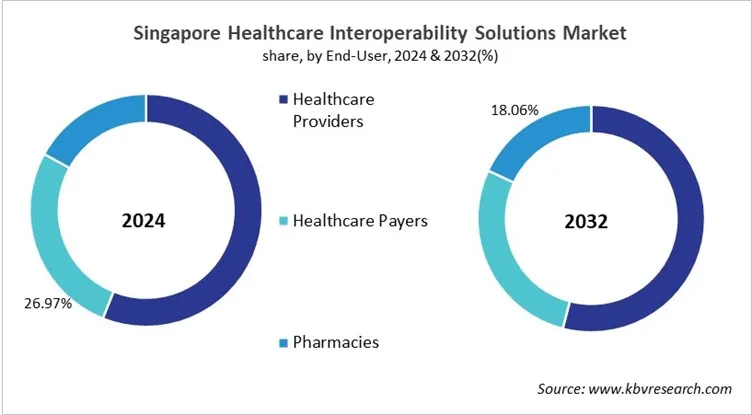
Based on End User, the market is segmented into Healthcare Providers, Healthcare Payers and Pharmacies. The Healthcare Providers market segment dominated the Singapore Healthcare Interoperability Solutions Market by End User is expected to grow at a CAGR of 15.6 % during the forecast period thereby continuing its dominance until 2032. Also, The Pharmacies market is anticipated to grow as a CAGR of 17.1 % during the forecast period during (2025 - 2032).
Free Valuable Insights: The Healthcare Interoperability Solutions Market is Predicted to reach USD 11.22 Billion by 2032, at a CAGR of 13.5%
The healthcare interoperability market in China is one of the biggest and most complicated in the Asia Pacific. This is because the healthcare system is mostly run by the government and the government is pushing for digitalization. Central authorities, especially the National Health Commission, require standardized regional health information platforms that let hospitals, primary care, public health agencies, and insurance systems share structured data. Some important trends are the growth of regional health information exchanges, their integration with public health management, digital consultations, and insurance reporting. The market prefers vendors that follow national standards and can offer scalable, secure, and regionally compliant interoperability solutions. However, international participation is still limited.

By Type
By Interoperability
By End User
By Country
Our team of dedicated experts can provide you with attractive expansion opportunities for your business.




 Unique Offerings